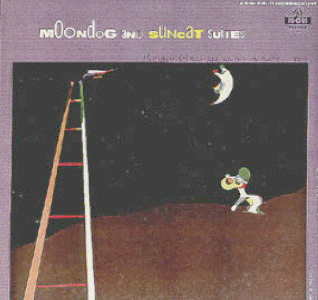
Moondog Suite
MGM E3544 (1959)
Side 1
1. One Four 0:35
2. West 46th Street 2:04
3.Two Four 0:20
4. Chant 2:02
5. Three Four 0:31
6. Utsu 4:14
7. Four Four 0:33
8. Lullaby 2:03
9. Five Four 0:42
10. Fog On The Hudson 1:59
Moondog Suite Published By Hollis Music Inc.
Side 2
1. Sunrise 3:00
2. Sunbeam 2:53
3.Tropical Sun 2:15
4. Sunstroke 4:35
5. Sunset 2:3O
6. Sunday 4:42
Suncat Suite Published By Ludlow Music Inc.
Sleeve Notes
Walking along the streets
surrounding New York City's Broadway-Times Square area late of an evening,
strollers often encounter a tall, monk-like figure of ageless quality. The
man is blind and he uses a long stave, like a shepherd of Biblical times,
to find his way. 'Though the night might be cold, his feet are usually
encased solely in sandals. His body is wrapped in a flowing robe fashioned
from rough, brown blankets. His bearded face bears a gentle, haunting
look. The man is the world-famous Moondog, poet, philosopher, mendicant,
musician extraordinary. Moondog is the son of missionary parents and grew
up on an Indian reservation in the west. A highly-trained musician, he has
an extraordinary knowledge of serious classical music as well as of jazz
and ethnic music. He has written provocative symphonic scores and he has
penned "pop" melodies. Friends of his will tell you that his
blanket garments are filled with cunningly-fashioned pockets very much
like cubby-holes and that these pockets bulge with musical scores. His
interest in primitive music has drawn him to fashion strange, beautiful
instruments of his own designing - whistles and flutes and percussion
instruments of unusual timbres. And these, too, fill the pockets of his
robe or hang from it by cords, ready for his use in impromptu,
street-corner concerts. Inevitably, too, there is his contribution box, an
object he once described to a reporter for a New York newspaper as "the
only instrument that really keeps me alive." Moondog is a modern bard
or minstrel, a musician who travels from crowd to crowd making spontaneous
music for whatever the listener might care to pay for his entertainment.
Usually, his street-corner music is improvised. He listens to the sounds
around him - traffic noises, a lonely fog horn bleating wearily from the
river, the rumble of a subway train under the street, the sudden drone of
an airplane overhead - and these sounds form the basis for the piece he
proceeds to create on the spot. His performing gifts are as phenomenal as
they are virtuosic and colorful. He uses his hands and feet all at once
with his percussion instruments, setting two and three and four rhythms
going simultaneously and contrapuntally. He sometimes takes his titles for
pieces from the locale - the address on the doorway near-by (2 West 46TH
Street) - or from the atmosphere (Fog on The Hudson). Almost any night in
mid-town New York, as you wander around, you'll encounter Moondog - and
the night around him is filled with startling, spellbinding, imaginative
music. A few years ago, some recordings of a Moondog street-corner concert
were made. A tape machine and a microphone were set up right there on the
sidewalk and Moondog played away in inspired fashion. You might remember
the recordings - they caused quite a stir in jazz circles and many a "serious"
musician was attracted to them, too. Those recordings travelled far-among
other places to England. And, there, they attracted the attention of the
noted British jazzman: Kenny Graham. Graham was fascinated by what he
heard - whole new worlds of rhythm and tonal coloration seemed to open to
his mind and ear. It was then that he decided to translate the music of
Moondog to the more orthodox instruments you might encounter in a jazz
combo of progressive design. Not too orthodox, however. In both sides of
this recording, you'll find such instruments and combinations of
instruments as vibraphone, xylophone, marimba, celeste, tubular bells,
Egyptian cymbals, flute, oboe, bass clarinet, accordion and "instrumentalizing"
voice. The voice belongs to the Ceylonese singer: Yolanda. The result of
Graham's labor is the provocative "Moondog Suite." Graham's
arrangements of Moondog's original material are wonderfully idiomatic,
excitingly accurate in capturing the spontaneity and vigor that had first
attracted him. And, the arrangements are performed superbly in this
recording by some of Britain's top instrumentalists. To complement the
unique "Moondog Suite," Kenny Graham has created a suite of his
own, inspired by some of the techniques of Moondog. To his delightfully
imaginative composition he has applied the notinappropriate title "Suncat
Suite." Again, here, we enter something of a bright, evocative new
world of jazz: one teeming with original instrumental colors and effects,
with sharp, new rhythms, and striking, meaningful ideas. "Moondog
Suite" and "Suncat Suite" are companion pieces that fit
together with exciting perfection. You'll find them rich,
lastingly-entertaining listening! Kenny Graham - One of Britain's foremost
jazz composers and arrangers; a large, red-bearded, soft voiced, strong
man with a penchant for spending the greater part of his free time in a
loose sweater refusing to conform. Mint example of that rare character,
the artist who really does have talent but who genuinely refuses to have
any truck with commercialism or to write anything bad just because it pays
well. Mercurial temperament which ideally suits almost surrealist life he
leads in Soho and elsewhere. Born July 19th, 1924 - "At eight o'clock
on a Saturday morning: the earliest I ever got up," says Kenny.
Biographical Details: Born in Kent near London. Started to study music and
to learn G banjo at 5; began to learn C-Melody sax when he was 12;
switched to alto at 15 - on which he played first professional job a year
later. Took up tenor before going into army when 17. In 1950, demobilized,
formed own revolutionary group called Kenny Graham's Afro-Cubists, which
he led for two years before fact that their amalgam of bebop, African and
Cuban rhythms and super-modern harmonies was too far above public forced
them to disband. Greatly in demand as powerful swinging tenor player,
Graham then played in variety of bands, including those led by Ambrose,
Nat Gonella, Eric Winstone and Nat Temple besides being starred at many
concerts and in small jazz club ad recording combos. More recently, has
been concentrating on writing to the exclusion of tenor playing. Has
written bestselling arrangements for the Ted Heath library, and has
written for and acted as M.D. at recording sessions with Josh White, Big
Bill Broonzy, Britain's Frank Holder and Cleo Laine- Has led many swinging
groups providing accompaniments on disc to stars.
Cover Painting By Joan Miro