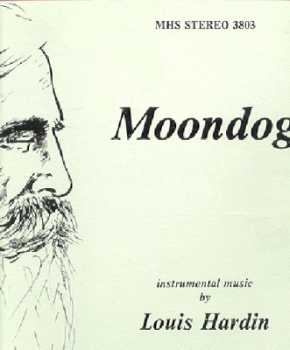
Moondog -
Selected Works
Musical Heritage Society 3803 (1978)
Side 1
1. Canon in C Major
(harpsichord)
2. Canon in C Minor (harpsichord)
3. Ground in the Ionian Mode (harpsichord)
4. Canon in the Mixolydian Mode (harpsichord)
5. Chaconne in G Major (string quartet)
6. Heimdall Fanfare* (Canon in the Dorian mode for 9 horns)
7. Romance (Second movement of String Quartet in C Major)
8. Chaconne in C Major (organ)
Side 2
Selections from Logründr
Book 1 for Organ
1. Logründr No. XV in B Major
2. Logründr No. XVII in E Major
3. Logründr No. XIII in F-sharp Major
4. Logründr No. XII in B-flat Minor
5. Logrundr No. VII in E-flat Major
6. Logründr No. IX in A Major (Portrait of my Mother)
Gavin Black, Harpsichord
Fritz Storfinger, Organ
Guy Carmichael, Horn
Louis T. Hardin, Percussion
* Conducted by Dave Kamien Pannonia Quartet Gabor GUI & Ludovik
Sandrik
Violins Klaus Koenig, Viola Bertalan Ikrenyi
Cello Co-Producers and Publishers: Managarm & Rhein & Ruhr-Film
(GEMA) Engineering: Helmut Rohlfing, Friedbert Keuken
The organ pieces were recorded on the Brell organ in Herz-Jesu Kirche,
Oberhausen, W. Germany.
The harpsichord pieces were recorded in New Haven, Ct.
Photo by: W. Beyna Cover Drawing: IIona Goebel
All music by Louis T. Hardin (Moondog)
Sleeve Notes
In the beginning was tonality.
Then came atonality which was revolutionary. Tonality continued in folk
music and popular music, in spite of atonality, but in the case of serious
composers, it was taboo to even think of writing tonal on pain of being
ignored and unperformed. I persisted in writing tonal music, and by
opposing the atonal revolutionaries, I became a counter-revolutionary. I
maintained the tonal tradition, unaware that the founder of atonality
himself had repudiated the 12-tone System, which he had conceived. But
that was not the end of atonality, for even though its founder gave it up,
his pupils did not, and so, for the time being, at least, it survives. As
it was in the beginning, is now, and ever shall be, Tonality! I write much
keyboard music which can be played on piano, harpsichord or even on the
organ manuals. I did not start writing organ music until 1974 in Germany
for my friend, the organist Paul Jordan. For the first time I began
writing music for the pedals, resulting in my first Logrundr Book. I
combined two forms into one, the canon and the ground, giving the ground
to the pedals and the canon to the manuals. I coined the word Logrundr:
Log meaning Law or Canon, Grundr means Ground. I like to write chamber and
choral music, especially for orchestra. But since it is not always easy to
have orchestral works performed, the organ is the next best medium to give
the composer vast tonal resources. In fact, I prefer the organ when it
comes to writing contrapuntal music because of the sustaining power of the
organ in long melodic passages. The orchestra is best in music which is
harmonic and rhythmic. A Bach fugue, transcribed for the orchestra, à
la Stokowski, is impressive, but not nearly so impressive as on the organ
itself. Organ versus Orchestra! A case in point, which brings to mind both
"King of Instruments" and "Instrument of Kings". Louis
Hardin, born in 1916 in Marysville, Kansas, wrote his first song at the
age of eleven. Only several years later, however, did he make the final
decision to become a composer, inspired by the book "The First
Violin." After musical study with Maud Manniny, Bernard Schaefer,
Anna May Sansom, and Daphne Ivans, at the lowa School for the Blind,
Hardin moved in 1943 to New York, which he felt to be the musical center
of America at that time. Over the next thirty years Hardin remained in New
York writing and playing his music. As a strong believer in tradition he
chose to respect the ancient rules of counterpoint in his work, following
them even more strictly than most composers of the past. He was attracted
especially to the form of the canon: in the 1950's and 60's Hardin wrote
300 madrigals in the form of canons, and over a hundred canonically based
keyboard works, including four books of The Art of the Canon for keyboard.
As the canon is the strictest musical form, so the couplet is the
strictest poetic form; and Hardin has authored over one thousand couplets
and longer poems over the years, including the madrigal texts. In New
York, Louis Hardin, who lost his sight at age 17, met many of the greatest
artists of the day, such as Artur Rodzinski, Arturo Toscanini, Dmitri
Mitropolous, Leonard Bernstein, George Szell, Martha Graham, Charlie
Parker, Benny Goodman and Duke Ellington. Hardin began using the name
Moondog in 1947, and under that name produced several records of his music
from the early 1950's on. During a concert tour of Germany in 1974,
Hardin, who in recognition of his affinity for classical tradition had
previously described himself as a "European in Exile", decided
to remain where he was. After a stay in Hamburg he settled near
Recklinghausen where he lives today ("incognito", according to
'Le Monde'!). The present record contains a sampling of Hardin's recent
music.
The four works played on
harpsichord are taken from collections put together in the early 70's. The
Canons in C major and C minor are from The Art of the Canon, Book 1, and
the two modal works are from Troubador Harp Book 1. Though these works
were not originally conceived for harpsichord, composer and performer
agree that they are well suited to the instrument. The harpsichord used
here was built in 1977 by Keith Hill.
The Chaconne in G was written in 1974. This piece is a Tonata in one
movement. The Romance is the second movement of a three movement Tonata in
C for string quartet, completed in 1976. The Tonata is a form conceived by
Hardin. He says "it is an outgrowth of the Sonata, though different
enough from it to require a new name. Each Tonata is a law unto itself,
though they all have much in common, all relying heaving on counterpoint,
featuring the canon and the ground, relieved here and there by harmonic
and rhythmic effects." The development sections of the two quartet
pieces are in canon form, double 2-part canons. In the Romance it has the
added feature of being a mirror canon. The Pannonia String Quartet of Marl
has been playing together since 1975. The Heimdall Fanfare forms part of
the Creation, begun in 1971, Hardin's most ambitious contrapuntal work to
date. The work tells the story of the Nordic Creation myth; in music and
elegaic couplets the music is based on the first nine notes of the
overtone series of the note g, used in order as a contrapuntal theme. The
Fanfare is a nine-part canon in the dorian mode. Heimdall, a figure from
the Nordic mythology, is the watchman of Asgard, who blows the
Gjallar-Horn. The Chaconne in C for organ was written in 1967. Along with
the other organ works recorded here, it is played on the Breil organ of
the Herz-Jesu Kirche, Oberhausen. The works on side two are taken from the
Logrundr Book One for organ, written between 1974 and 1976 and dedicated
to Paul Jordan. Like the twelve books of Madrigals and the four books of
The Art of the Canon, this collection contains 25 pieces in all keys,
arranged according to the circle of fifths, beginning and ending with
pieces in C major. The works are canons over a repeated bass, sometimes
with a coda. The counterpoint in all of Hardin's canons is invertible,
allowing the order of parts to be reversed in the middle of each piece.
Logrundr XIX is a portrait of the composer's mother. About organ sound,
Louis Hardin has said, "I like the diapason and the flutes the best,
and care very little for the reeds. I like a clear, pure classic tone on
the organ, without vibrato." On Hardin's being asked why some of the
organ pieces as recorded here have reeds, the reply was, "Ask
Storfinger". Hardin is currently at work on a second Logrundr Book,
dedicated to Fritz Storfinger, which will contain organ duets as well as
solo organ pieces.
Gavin Black
Fritz Storfinger of Oberhausen was born in 1951 as the son of an organ builder, and studied under Sieglinde Ahrens, among others. During the last two years he has been playing concerts of music by Louis Hardin in Germany. Gavin Black was born in 1957, and lives in New Haven, where he studied organ with Wendell Piehler and Paul Jordan. He has also studied in Princeton with Eugene Roan, and in Frankfurt-am-Main.