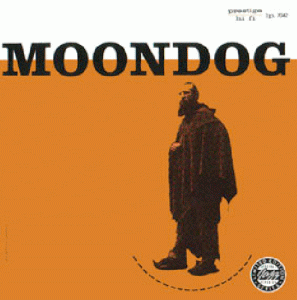
Moondog
Sometimes Known As Caribea
Prestige 7042 (1956)
1. Caribea 1:29
Sextet; featuring Moondog at the piano 5/4
2. Lullaby 2:13
Sextet; featuring Moondog´s wife, Suzuko,
singing to June, their six-week-old daugther 3/4
3. Tree TrailL 2:15
Quintet; featuring the Weiner-Sabinsky Duo 5/2
4. "Death when you come to me, may you come to me swiftly; I would
rather not linger, not linger." 2:01
Sextet; a Moondog quotation translated into Japanese, and recited by
Sakura Whiteing 5/4
5. Big Cat 1:48
Sextet; featuring Moondog, playing the recorder
in a portait of a tiger 1/4
6. Frog Bog 2:07
Quintet; featuring the Weiner-Sabinsky Duo 5/4
7. To A Sea Horse 1:42
Solo, Moondog at the piano 5/4
8. Dance Rehersal 0:49
Naila stages a routine for her pupil, Violetta, and Moondog accompanies
5/8
9. Surf Session 6:54
In three parts. Quartet; featuring the Weiner-Sabinsky Duo, in a
performance of Euphony No. 11 2/4
10. Trees Against The Skys, fields of plenty, rivers to the sea: this, and
more, spreads before me 0:45
Moondog records his own voice twice 5/4
11. Tap Dnce 1:15
Ray Malone ad libs to Moondog´s drumming 5/4
12. Oo Debut 1:06
Solo. Moondog plays oo and trimbas, simultaneously7/4
13. Drum Suite 2:12
Sam Ulano plays on Japanese drums, as Moondog plays ,
on trimbas, polyrhythms
14. Street Scene 3:37
Drums solos and dialogues, against the sound of Manhattan traffic 5/4
Recorded in New York City 1956
Sleeve Notes
Sometimes, Moondog the enigma,
defeats an unprejudiced view of his music. But, if we ignore the cloak of
seeming inscrutability and concentrate on the music, the experience can be
astonishing. Moondog possesses an admirable virtue; he perceives music
everywhere in life. The collection of vignettes contained in this album
are fully realized attempts to integrate music and sound. Music and life´s
sounds are inseparable to Moondog. Thus, the complete Lullaby contains the
cry of the baby; a string duo appears comfortably at home in a FROG BOG
setting; a New York Street Sceneincludes (American Indian inspired) drum
solos, the wisdom of a far eastern philosopher, and the strident blowing
of a police whistle commencing the flow of traffic. A vast amount of the
world´s music is part of Moondog's working vocabulary. This reservoir
of material serves his eclectic approach to composition. Moondog chooses
deftly amongst all of music to elicit his surprising couplings. A pair of
violins bowing Bach influenced counterpoint might be heard over a rhythmic
pattern of Cuban drumming. The ability to find unexpectedly complementary
areas of music is an essential ingredient in these miniature portraits of
life´s many parts. Moondog, the man (like his music) is a satisfying
blend of many fibres. To many of New York´s millions. Moondog's vigil
on street concerns presents an extraordinary contrast to his physical
background. Dressed in his famous army blankets. Moondog's handsome visage
and Royal Hussars´ physique challenges the steel towers amongst which
he has chosen to dwell. While selling the sheets of his music, hung around
his waist, his active hands are inconspicuously composing new music on a
braille boord, discreetly hidden under the folds of his protective
garments. At night, from well chosen sites, Moondog the street musician,
performs on his singular assortment of instruments. Using a maraca and a
clava as drumsticks. he plays upon two triangular-shaped drums. With his
self-styled instrumentation he obtains a music both melodic and rhythmic
in structure. The countless hours spent by Moondog on the streets of New
York provides a constant stream of material for this great silent
observer. Moondog's music is what he has found in the world in which he
lives. Through him we can view the world in a more perfect form.
Notes by Robert S. Altshuler