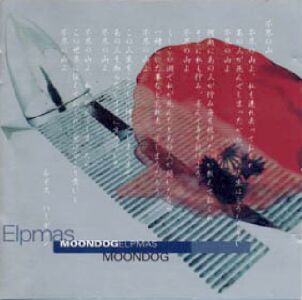
Elpmas
Kopf/Roof 123314 (1992)
1. Wind River Powwow 7:11
Arapa - host Arapa - home Arapa - hope
2. Westward Ho ! 6:00
Ship at Sea Prairie Schooners On The Oregon Trial
3. Suite Equestrie (Trail versus Road and Rail) 7:14
The Horse The Wheel The Motor
4. Marimba Mondo 1 - The Rain Forrest 5:33
5. Fujiyama 1 4:43 (instr.)
6. Marimba Mondo 2 - Seascape Of The Whales 5:51
Quintet; featuring the Weiner-Sabinsky Duo 5/4
7. Fujiyama 2 5:01
Lovesong 5/4
8. Bird Of Paradise 2:40
9. The Message 1:01
A-capella male chorus
10. Intoroduction and Overtome Contunium2:25
11. Cosmic Miditation 24:10
Henry Schuman: Oboe
Peter Wendland: Violone Viola Da Gamba (Diskant, Tenor, Bass)
Johannes Leis: Piccolo Saxophone (Alt Tenor, Bass)
Gotz Alsmann: Banjo
Andi Toma: Guitar
Louis Hardin: Keyboards Percussion
Voices: Andi Toma (Solos, whistling)
Akbar Huck, Louis Hardin, Max Alsmann ("Little man")
Recitation: Nobuko Sugai
All compositions by Louis
Hardin (Moondog)
Produced by: Louis Hardin, Andi Toma
Recorded at: Aacademy Of St. Martin's In The Strets
Engineered and mixed by: Andi Toma
Digital Mastering and Editing by: Ulf Horbelt at DMS, Gelsenkirchen Sleeve
Design: Dirk Rudolph
Photography: Volker (PIT) Pigors/H. Gross
Andi Toma courtesy of Sony Music
Sleeve Notes
This disk is largely a protest
against our treatment of aboriginese people, against our treatment of
nature, plants and animals, also against the idea that "we discovered
the New World", when it is as old or older than ours.
WESTWARD HO!, an 8-part canon for gambas is depicting the western migration from Europe to the New World. The first part features the one-year old MAX ALSMANN who sang the highest G flat on the piano, something no soprano could do! "Up so high? Like a lark you sing your song to the sky!" His father, GÖTZ ALSMANN played a one hundred year old banjo on THE OREGON TRAIL in a 2-part canon with ANDI TOMA on guitar. If some of my music sounds like Jazz of the "Swing" era, it is because Swing is North American in origin, coming right out of the drum beats and highly syncopated melodies of the Plains Indians, from the Arapaho to the Sioux. Their running-walking-running beats on the tomtom are fundamental to Jazz of the Swing era. I heard it for the first time, having been introduced to Arapaho Sun Dance music in Wyoming. I was about five years old. Chief Yellow Calf sat me on his lap and let me beat the buffalo-skin tomtom, an experience I never forgot. The Sun Dance drum beat stayed with me to the present day. I call it the Powwow beat. Later, in 1949, the Blackfoot Indians of Idaho let me beat their tomtom at the Sun Dance and invited me to play flute obligato to the chorus. Those fast-slow-fast beats are to be heard on tracks 1 and 3, where the running beat goes right into the walking beat and vice versa. My bass drum is hexagonal, my own design, sounding much like the tomtom. The sampler is ideal for my kind of music which is mostly contrapuntal, specifically canonic. With the sampler I can be sure that all the voices will be faithfully reproduced, as many times as I require, without the chance of a mistake, here or there, which can never be avoided when working with live musicians. The reason I used the marimba so much is because it sounds so realistic, due to its being so percussive. The bass notes were sampled in from a balaphone. Another sample I could use was the koto (Fujiyama). The small bells are from India. In the low and high solos in SEASCAPE OF THE WHALES I used a goard in unison with the sound of a lure, clapping the hand over the mouthpiece, plus the marimba doubling at the octave below. The FOUR ELPMAS BANDS in this CD are the MARIMBA BAND, the GAMBA BAND, the OBOE BAND and the OVERTONE BAND. Almost all pieces (track 1 to 8) are triple canons, that are three canons in one, or one in three. The Canon is for example sixteen bars long, that means canon 1 begins and ends on the first bar of a staff if one puts three bars to the line of a score. Canon 2 begins and ends on the second bar of the staff. Canon 3 begins and ends on the third bar. This makes a total of 48 bars. Canon 2 is a stretto canon to the first one, and so is Canon 3 to Canon 2. Canon 1 begins on bar 1, Canon 2 on bar 17 and Canon 3 on bar 33. The sixteen parts enter at a distance of every three bars. From bar 49 on, the 16-parts are answering at the distance of one bar. The parts can enter in different register order, such as middle, high, middle, low, or low, middle, high, middle, or whatever is suitable, depending on the piece. As in WIND RIVER POWWOW, each movement is 96 bars long, meaning that the first entry does sixteen bars six times, entries 2 to 6 play sixteen bars five times, entries 7 to 11, four times, entries 12 to 16, three times. From bar 81 to 96 the parts drop out, one every bar, so that the first part ends on bar 96. BIRD OF PARADISE is a 10-part triple canon. The same rules apply to it, though on a smaller scale. The triple canon, or triune canon is the only "triunity", or trinity existing not in religion but in music. Since the principle of "triunity" has always existed , I also refer to it as TRIUNERE. Quintuple canons are also following the same rules, being five in one or one in five. I have also written two 1000-part canons, but that is another story for another time. THE OVERTONE CONTINUUM Since 1973 I have been dealing with overtones working on my most ambitious composition, THE CREATION: The Overtone Continuum is a self-contained system, consisting of the first nine overtones, which I call the Noble Nine. I used the overtone series, G D G B D F G A and B as a theme in my CREATION. Little by little I achieved a breakthrough by applying diminution to the overtone series, reducing whole notes to half notes, to quarter notes, and so an. All those series could be played together, fitting perfectly, making a unique system, in accordance with the strictest laws of counterpoint. Slowly I realized that I had stumbled onto cosmic laws, such as the laws governing contraction and expansion, caouse-effect inversion, two-directionality of time, etc. The Overtone Continuum Chorus consist of a 4-part male chorus, sung by Andi, Akbar and me in unison, each part overdubbed twelve times, equaling thirty-six voices times four parts coming to 144 voices. We sang only the first two lines of every strophe of THE MESSAGE. It is not intended that four texts sung together are to be understood by hearing them. What is more important to me is the complexity and the mass effect. For better understanding the listener should read the lyrics. Chorus: The Overtone Continuum began with interactivation of the Plan. The Overtone Continuum is there, on any planet having sea and air. The Overtone Continuum is law, the law that people heard before they saw. The Overtone Continuum is proof that He, the Master Mind, is not aloof. The introduction to the Overtone Continuum is a homophonic fanfare. It consists of nothing but overtones on a cosmic theme, to announce the Overtone Continuum. The overtones are played first with whole notes, then half notes and quarter notes, making a 3-part exposition of the overtone series. The whole notes and their diminuations cover thirty-two bars. Each overtone represents Time and each rest between represents Space. Either the Overtone Continuum contains the message or is the message. A good symbol of my "Journey into Time and Space", by way of the Overtone Continuum, is the rocket-shaped model of the "MOONDOG Building" by Philippe Starck to be seen on the cover. The last 24 minutes of the CD are devoted to the "Overtone Band" performing a 2-part cosmic theme in a double 8-part canon. Canon 1 is in quarter notes, the parts answering every two bars. Canon 2 is the augmentation on Canon 1 (in half notes). Periodically the lowest "G" of Canon 1 is in the low register and in Canon 2 in the high register, setting up a vibration that goes right trough the listener. The overtones generate their own overtonal waves, suggesting the rising and falling waves of the Siderial Sea. This meditation music has quite a hypnotic effect on the listener. Its unworldly sound brings one close to the essence of things, to the "peace that passeth all understanding." (L. Hardin)
MANY THANKS TO: Andi for making this album possible, Stephanie Pakulat (and her family) for their warm hospitality, Aki Huck for his 'wizardry', Bernd for 'keeping us going' ..., Kristine for inspiring the whale piece, Karoline, Jörg 1 and Jörg 2 for transport, Götz and Max Alsmann, Martin Hess, Helian ('Würmchen'), Stephan Eicher who almost joined us, Thomas Darius at Tonleiter (Sounddesigner, Düsseldorf), Michael Grund, Poti and Klaus Marx. Ana a very special thanks tp: Nobuko Sugai who translated the lyrics of FUJIYAMA into Japanese and also recited them, Philippe Starck for the model of the Moondog-building on the cover, Henry Schuman for his wonderful playing and Robundo Publishing Inc. (Tokyo) for their fast co-operation.