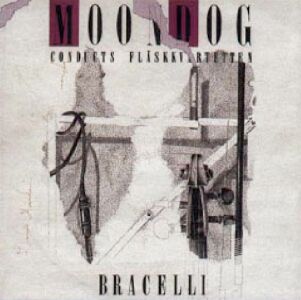
Bracelli
Kakaphone KPH102 (1986)
1. Gygg
A kind of jig, not in 3/8 but rather in 5/8 meter.
2. Danse Orientale
A minor canon built on shifting 6/4 rhythms.
3. Frost flower
Is a part of a series in 3/4 meter combined with 6/8. The title is
describing a phenomena that appears often in the Antarctica, where under
certain conditions frost rises up in a form resembling a flower.
4. Dark eyes
Is a csárdás in 5/4.
5. Speak Of Heaven
This is string arrangement of a love song which was written by the side of
a road in Arizona in 1948, 4/4.
6. Friska
Another made-up name, describing music as being "frisky", 4/8.
Hardin was inspired to this work by Moldavian music which he heard on a
short wave radio while working on some compositions.
7. Log In C Minor
This piece had been written originally for organ. It is a part of his
first Organ Book, op. 76, which he started right after he came to Germany
in 1974. It is a very short but very haunting piece, creating a mood of
sensuous resignation, 2/2.
8. Fantasia
Is a mood piece in the phygrian mode leading into
9. Canon in Asia minor 2/2.
The colouring of these is predominantly that of Asia minor.
10. As The Earth Turns
Is a Logrundr, a combination of a ground (grundr)
and a canon (log), in 7/2.
11. Magic Ring
In 4/4, a shortended version of a much longer piece for orchestra. It is a
descriptive piece, inspired by the story of Odin´s magic ring.
Draupnir which everOdin´sy night dropped a new golden ring for eight
nights. The pizzicato of the Double Bass represents the rings dropping.
The viola solo consists of motives from Hardin´s most ambitious work,
The Creation.
12. Log In G Major
Another piece of Organ Book I in 4/4, it is the first piece he wrote for
that cycle.
Performed by Bracelli,
Flaskkvartetten, The Flesk Quartet.
Conducted by Louis Hardin in Stockholm
Sleeve Notes
Double 2-part canons are used in Gygg, Dark Eyes, Frost Flower and Friska. FANTASIA is a canonic but not canon. Canon in Asia Minor is a 3-part canon with pedal point. LOG in c minor is a 2-part canon with pedal point. Log in G Major is a 3-part canon without pedal point. The Double Bass doubles Cello 2 at the octave wherever possible, also serving as a pedal point. The music in this collection constitutes a series of tonal pictures with tempo variations from 5/8 to 7/2. Although some of the melodies and some of the tempi are immediately congenial, their full flavour comes out on repeated listenings. This is complex music, with a sophistication that belies its seeming simplicity. Repeated hearings bring out further interesting combinations of sound, other subtleties of rhythm.: In spite of being contemporary, Hardin´s works are solidly grounded in old classical forms, the most common being the canon. This album introduces, for the first time, a new concept of string quartet, the Bracelli, consisting of 2 violas and 2 cellos, using the German word Bratsche for viola and Celli, with Contra Bass added. The traditional string quartet was formed for the playing of homophonic music. Since the viola and the cello are an octave apart in register, they afford the ideal combination for canonic writing. Five of the pieces are dynamically supported by percussion. The ´Moondog-style´ drums were built by Stefan Lakatos according to Hardin´s specifications. They are three-sided or triangular in shape, used in graduated sizes, called Trimbas. Ever since the late forties these kind of drums were partly responsible for the typical Moondog sound. For the first time Louis Hardin recorded with Swedish musicians, the Flesk Quartet, a group which works in both fields, classical and jazz. They were joined by Anders Öberg on Contra Bass and two percussionists, Tina Kjebon, who also did barefoot dance to Danse Orientale and Stefan Lakatos, the leading exponent of the ´Moondog method´ of drum playing.