| FROM THE BIG CHILL TO THE BIG PICTURE In 1982, I participated in a movie about a group of baby boomers who attend the funeral of a mutual friend who has committed suicide. During the course of the weekend together, they reflect on their lives and the loss of their sixties idealism. In The Big Chill, I played Meg, a single career woman who, after a disillusioning experience as a public defender, joins the corporate world as a real estate attorney. She jokes that her clients have gone from raping people to raping the land. Meg expresses a sense of loss from the bonds of their community of friendship and a sense of a shared commitment and goals. Meg, and most members of the group, have either dropped out or sold out on their former idealistic values. Sam, a TV star, confesses his feeling of mistrust of people and Meg agrees that it's a "cold world out there. Sometimes I think I'm getting a little frosty myself." She seeks "warmth" from Nick and wants him to father her child. He is impotent since Vietnam and unable to comply. Sam, who is already a father, feels guilty about his lack of attention to his own child. He also declines Meg's offer of fatherhood. She wants nothing from the men, just their sperm. She will raise the child on her own. Meg's frustration in finding a man hit a chord in many career women of my generation. I was constantly stopped on the street by women who related to that predicament, whose longing for intimacy and partnership was thwarted by the inability to find the "right" man. Meg thinks she might not even want a man any more, just a baby. By playing Meg, I was able to try on all of her emotions, processes and decisions. I wore them and lived in them for three months. They aroused disturbing feelings. Pretending to be Meg, I learned a lot about myself. I became conscious of my own alienation. Like Meg, work had become my family. I had no time to pay attention to the nagging feeling of separation from some core that I couldn't articulate. Meg thought a baby would bring her the connection, the intimacy, the "heart" she missed in her life. I realized that I needed to discover my own path to wholeness. I intuited that for me, this missing element would have to come from within before I could share it with someone else, whether that was a man or a baby. The emotions that erupted from playing Meg could not be ignored or �busied� away. Like it or not, my unconscious took this opportunity to speak to me. I began a descent into the dark, scary, mysterious depths of my being, not realizing it was the beginning of a journey toward finding a new sense of connection. I went from the outer-directed, work-centered, masculine journey, into the inner-directed, still waters of the feminine journey. So why in the Sam Hill am I telling this story in a book about ecology? My experience, Meg�s �frostiness,� Nick�s impotence, Sam�s mistrust, a friend�s �burnout,� a neighbor�s heart disease, a couple�s divorce, the isolation of an elderly woman on the street, a newborn baby�s addiction to crack, a teenager�s bulimia, have become everyday occurrences. These are human examples of a culture that is in need of healing and transformation. Now a growing group of scholars and researchers are arguing that there are real connections between the diseases in us and our society, and the host of environmental tragedies that are ravaging our earth. In her book, A Passion for This Earth, Valerie Andrews writes about the eighteenth century philosopher, Leibnitz, and his book, The Monadology. In it he said that the whole of his life is reflected in the smallest unit of reality or, in our context, what is happening among individuals is happening societally and to the entire planet. The effects on the planet may not be quite as easy to see as personal problems in our daily lives, but they�re there, and getting worse. Thomas Berry writes in The Dream of the Earth, �our entire society is caught in a closed cycle of production and consumption that can go on until the natural resources are exhausted or until the poisons inserted into the environment are fed back into the system.� We are making the land and air and sea so toxic that the very conditions of life are being destroyed. Due to our abuse of the planet, hundreds of thousands of species will be extinguished before the end of the century. This scenario is so unthinkable that, as Berry suggest, �a disturbance exists�on a greater order of magnitude than we dare admit to ourselves or even think about.� How did we get in this state of dis-ease? In our race for power, control, position, more, better, newer, faster, our culture has worked itself into an all-consuming, undisciplined, and out-of-sync existence. In The Chalice and the Blade, Riane Eisler describes two basic models of society: the dominator model (patriarchy or matriarchy), which ranks one half of the population over the other, and the partnership model, which involves the principle of linking rather than ranking, where diversity is celebrated and people aren�t broken down into inferior or superior groups. Recent anthropological studies suggest that the partnership model is not just a theory, but has a basis in history. Marijua Gimbutas, in The Goddesses and Gods of Old Europe, gives evidence of a matricentric society between circa 7000 and 3500 B.C. It was an earth-centered, agricultural, highly artistic and creative, Goddess-worshiping, egalitarian male-female society. Then came the Aryan invasions, and along with them a patriarchal model of social organization. This system was based on male dominance, male violence, and a generally hierarchic and authoritarian social structure. Four patriarchal structures have dominated Western history over the centuries: the classical empires, the religious establishment, the nation-state, and now the modern corporation. In all of these structures, males have dominated through systems based on power, control, and methods of warfare. The dominator model is now deeply embedded in our cultural traditions, in our religious traditions, in our language, in our entire value system, and its negative effects are accelerating. Berry, Eisler, and many others suggest we must move toward a more encompassing, holistic mode of existence. We must move toward a partnership society, and that means including the feminine values that were once part of our culture�feminine values which, while largely ignored, remain an important part of our collective unconscious. When I�ve mentioned this concept of balancing the masculine with the feminine, I�ve noticed resistance from some of my men friends. The hair goes up on the back of their necks�oh no, some feminist rap. This is not another divisive concept, but an inclusive one. Masculine forces have been at work in our culture to the exclusion of a counterbalanced feminine force. These archetypal forces are creative, and men and women contain both the masculine and the feminine. But there is much evidence that the predominance of masculine forces has become counterproductive�life-taking rather than life-giving�and needs to be balanced by the nourishing, nurturing energy of the feminine. This does not mean that men should become like women, but that the whole culture, men and women, should begin to appreciate and discover values that are more intuitive, relational, and interdependent. In The Heroine�s Journey, Maureen Murdock writes, �we need the moist, juicy, green, caring feminine to heal the wounded, dry, brittle, overextended masculine in our culture.� We all share the blame for what has happened to our planet and must work together in partnership to reach a new way of being. In moving toward partnership ways of being, as both men and women, we also need to discover our own authentic voices. We need to learn to form relationships with our unconscious, to �hear� the inner wisdom and guidance it can offer. Our bodies are conduits for this information, but through excessive food, alcohol, drugs, sex, and busyness we numb our bodies, and its signals are unable to reach our consciousness. I have learned that my �gut alarms� are powerful signs and when I ignore them, trouble is sure to follow. As I become more in tune with my body, I am increasingly grateful for its guidance. But I have to remember to be still and slow down so that I can �feel� its messages. When I get caught in the busy, doing, linear, rational mode, I begin to feel split apart, off-track, disconnected. I know I need periods of solitude, gardening and hiking in nature. Meditation and prayer also help me reconnect to my body and to a spiritual Source, the Self deep within. Being present in this realm has proven to be a comforting and nurturing experience, but alas, in depressions and burnout, it can also be frightening entering the unknown, where all seems to be arid and desertlike, devoid of meaning. Experience has taught me, however, that hanging on through the darkness (and it has not been easy) pays off. In the darkness lie seeds of renewal and rebirth. I have learned the importance of patience and process, two values that are not appreciated or respected in our fast food, instant-gratification culture. I have a new understanding of faith and trust. I have begun to see that the rhythms and cycles of nature are a part of not only my personal rhythms but of all living creations on this earth. There is reciprocity and interdependence linking all living things. And while I continue to struggle on the inner path, I also experience a yearning to move beyond myself into the community for connection and relationship. But this partnership business is not easy. Just think about the state of man-woman relationships. So often we are split apart by addiction, codependency, poverty, success, fear, illness, emotional unavailability, projections, alienation, and the inability to communicate. So how do we get together? What is the key? I wish I knew. But in my efforts, which range from the insane to the ridiculous, from the unconscious to the more conscious, I have learned a few things about what does not work. Seeking fulfillment or wholeness from a mate is impossible. Ultimately, he can not and will not fill the black hole. This is my responsibility. And we�re in trouble if I try to be his mother or he tries to be my father. Some experts suggest that by taking the inner journey and coming into relationship with our inner, opposite, archetypal masculine and feminine forces that unconsciously drive our actions, we are less likely to project those forces onto our mates. Others say we need to discover and heal the secret wounds of childhood, so we will not act out and repeat the dysfunctional family dynamics in our adult relationships. New hope comes from acknowledging, grieving over, and accepting all the denied hurts and fears, and finally forgiving those that delivered them. If I have the courage to look at my shadow side and acknowledge all the ugly, horrible, negative parts of myself that I have denied and driven into my unconscious and accept them, then their power over me begins to fade. When I begin to accept, with love, all the negatives in myself, I am more willing to accept the parts I�d like to criticize in my mate. In discovering who I truly am, I am more capable of allowing my mate to be who he truly is. The more my authentic self emerges, the more a healthy relationship is possible�based not on dominion or control of one over the other, but on a partnership of equals with diverse gifts, perceptions, and abilities. And getting back to Leibnitz�s theory, it follows that as we learn to accept the diversity in our own partners, our children and families, we also can celebrate the diversity of our neighbors�whether they live across the yard, the tracks, the state, or the world. So by finding our authentic voices, we find the freedom to change the focus from self to others. And we respond to the need to serve a larger purpose. In community and partnership we can begin the difficult task of effecting change for our culture and our planet. And in spite of the enormous magnitude of our challenge there is hope. There is hope in the growing ecology movement, where the focus is moving from our human-centered reality to nature-centered reality. There is hope in our increased consciousness and awareness of what we have to do to heal ourselves, our community, and our planet. There is hope in moving toward a partnership society and the feminine, eliminating the warfare system. There is hope in reconnecting to the earth and becoming its lover again. But we can not love what we do not know. We must spend time with nature and experience the mystery of her rhythms and cycles of birth, death, and rebirth. We must teach our children to respect these mysteries and to have reverence for the sanctity of the earth, as our Native American people have always known. There is hope in listening to the earth. We must come into communion with Mother Earth and rediscover her life-giving energies. Like the wisdom of our bodies, the body of the earth can aid and direct us in our mutual, interdependent journey back to wholeness. In the depth of her wounds lie the seeds of healing. We must let go of the illusion that we know what is best for earth. Our greatest hope is in forming a partnership with the earth, letting the earth become our guide. I would like to acknowledge the following authors whose scholarships, research and insights informed this article: The Heroine�s Journey, by Maureen Murdock (Shambhala Publications, 1990) The Dream of the Earth, by Thomas Berry (Sierra Club Books, 1988) The Chalice and the Blade, by Riane Eisler (Harper and Row, 1987) Fire in the Belly, by Sam Keen (Bantam Books, 1991) |
 |
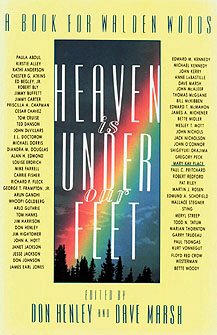
| The contributors included a wide range of people from vastly different public arenas. Among them were Jimmy Carter, Tom Cruise, Arlo Guthrie, Jesse Jackson, Bette Midler, Jack Nicholson, John O'Connor, Garry Trudeau, Kurt Vonnegut and Mary Kay Place. The essay that Ms. Place wrote was entitled, "From the Big Chill to the Big Picture." Below, I have transcribed the entire piece. It is wholly Ms. Place's work and is Copyrighted by The Isis Fund as published by Longmeadow Press. |
| In 1991, singer Don Henley and Dave Marsh compiled Heaven is Under Our Feet, A Book for Walden Woods. The essays in Heaven is Under Our Feet were written as contributions to the Walden Woods Project, a non-profit organization founded in 1990 to acquire and preserve historic and environmentally significant sites in Walden Woods. |
 |
 |
| �Not till we are lost, in other words, not till we have lost the world, do we begin to find ourselves, and realize where we are and the infinite extent of our relations.� Walden Henry David Thoreau |
 |

|
| Visitors Since June, 2001 |
 |
 |