INDIA
Stamps Portray Creative Cultures
by
Daniel Keren
Dominating the populous sub-continent of southern,
central Asia is the Republic of India. Independent since 1947, the world's
largest democracy is home to more than 600 million people who speak over
1500 different languages within the confines of the approximate 1,200,000
square mile territory. the journey from a feudal past to the technological
opportunities of the twentieth century, has been a major challenge to the
leaders of India; and the obstacles of success have served as the focus
for the many of the stamps that have been released by the India Post Office.
The two predominant ethnic groups makeup the bulk of the Indian population
are the Dravidian and Aryan races. Surviving in the more remote areas of
the republic are about 20 million aboriginals from such tribes as the Todas,
Bondos, Gonds, Nagas and Kanis. While hosting considerable minority communities
of Moslems, Christians, Jains, Buddhists, Sikhs and Parsis; the overwhelming
majority of Indians observe the doctrines of the Hindu Religion in their
worship.
Colonial History
The most significant event in the modern history of India occurred when
the British finally consented to granting their largest colony its independence
following the second world war. The story of the European Colonial tradition
in India dates to just before the turn of the 16th century when the Portuguese
explorer Vasco Da Gama landed in Calcutta. By 1510 the Portuguese claimed
their first colony at Goa. In the following years other European powers,
most notably Britain, France and Holland were attracted to the rich trade
markets that India offered. Gradually, by the late 18th century, the British
had forced out other European contenders and proceeded to consolidate its
control on the vast subcontinent. Within the next one hundred years it
would complete its power drive that would culminate in the symbolic crowning
of Queen Victoria as the Empress of India.
Independence
At about this time, the nationalistic drive of the growing Indian intelligencia
erupted. Educated at newly established European-style universities, these
individuals became envious to the democratic liberties that they observed
to be permitted to the citizens of England. In the beginning of this century,
the movement towards ultimate Independence was let by Mahatma Gandhi, the
universally respected advocated of non violent civil disobedience and the
more pragmatic Jawaharlal Nehru . Realizing that the yearning of the Indian
masses for true freedom could no longer be put off, the British Government
of Prime Minister Clement Atlee agreed to a program that would partition
the giant colony into separate Hindu (India) and Moslem (Pakistan) dominions.
In 1971 the eastern part of Pakistan would separate form the west and establish
the Bengali Republic of Bangladesh.
The stamps of independent India reflect on both the past cultural glories
of a dynamic nation and the current aspirations of a people desperately
battling the grinding influences of an increasing population problem, lack
of adequate employment opportunities, a debilitating caste system and the
depressing effects of a timeless impoverishment.
Royal Leader
In 1974 two interesting stamps were released to honor individual Indians
who played an important role in the governing o this most strategic land.
Featured on Scott #606 is the 25 paise issue that commemorated the 300th
anniversary of the royal coronation of Chattrapati Shivaji Maharaj (1627-80)
as the enlightened ruler of the Maratha community
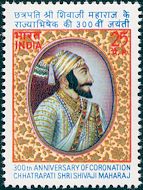
Sc # 606
Chattrapati Shivaji Maharaj
|
Kamala
A later release, Scott #613, focused on the
75th anniversary of the birth of Kamala Nehru (1889-1936). Not only was
this woman an ardent champion of India's freedom, but she was the loyal
wife of Jawaharlal Nehru who would, after her death, succeed to govern
as the first prime minister of an independent India. In addition, her daughter,
Indira Gandhi would later rise to power after the death of her father and
assume the position of prime minister. This is a major accomplishment in
a land where the rights and options of women have been so limited.
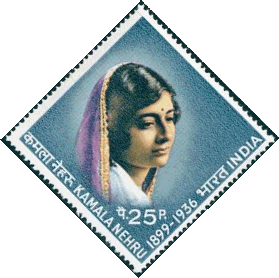
Sc# 613
Kamala Nehru
|
Silver Jubilee
In 1973, India celebrated the 25th anniversary
of her modern independence. A number of stamps were issued to highlight
the achievements of the Silver Jubilee year. Based on famous photograph
taken by an American journalist; the India Post Office released Scott #589
a 20 paise stamp that caught Mahatma Gandhi and Jawaharlal Nehru in a light
mood during the days preceding the end of British Colonialism. The ascetic
and pacific Gandhi would be gunned down in 1948 by a fanatic Hindu
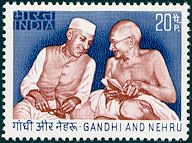
Sc# 589
Gandhi and Nehru
|
assassin who objected o his compromising attitude
with regards to the Moslem minority within India. Nehru would continue
to steer India through a neutralist policy and gain respect of the world
leaders as one of the leading architects of the Third World non-aligned
movement. Hundreds of millions of his countrymen would mourn his passing
away in 1964 at the age of 75.
Population
The vast population of India has always been
a major concern to the nation's leaders. The awesome responsibility of
trying to ensure that enough food exists to feed the people has always
occupied a significant share of the government's attention.
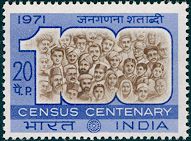
Sc# 538
Census Centenary
|
Through various programs, the citizens
are being encouraged to try and limit the sizes of their families. A major
obstacle is that this runs against the grain of traditional cultural beliefs.
In 1971 to mark the centenary of the first national census count, India
released Scott# 538 which graphically depicted a cross -section of the
multi-ethnic population. the figures and date compiled from this significant
census will play an important part in the planning of the government for
years to come.
Stressing Nationhood
Dozens of stamps have been issued by the India
Post Office to commemorate individuals who have made noted contributions
to the national culture through such mediums as poetry, philosophy, theology,
science, engineering and public service.
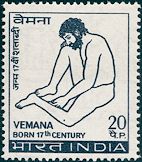
Sc# 560
Vemana
|
These issues play a valuable role in instilling
national pride among the hundreds of millions of Indians. Symbolic of these
stamps is the 1972 value, Scott #560, which honored the much respected
18th century poet-Vemana.
Dance & Military Traditions
The interesting cultural activities of India
have always attracted enormous foreign interest. Pictured on a 1975 stamp,
(Scott #694) is a young woman performing the traditional Kathak dance.
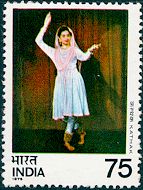
Sc# 694
Traditional Kathak Dance
|
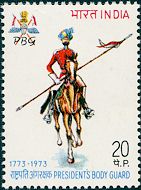
Sc# 593
President's Bodyguard
|
The military tradition of this large nation
is both long and proud. Dedicated to serving the interests of the people,
Indian troops have developed a colorful history. One of he many units to
have distinguished themselves was the President's Body Guard that was honoured
by a 1973 stamp (Scott #593) on the occasion of its 200th anniversary.
Philatelic Challenge
Obviously one can only hope to just scratch
the surface of the topic, when attempting to discuss the general philatelic
program of a nation as vast and complex as India. The stamps definitely
portray valid aspects of an emerging superpower that is struggling to assess
its role in today's complex world. The postal issues reflect themes that
are basically relevant to the culture, history and aspirations of the Indian
people. Many stamp collectors will eventually find their curiosities drawn
to this challenging philatelic area. The possibility of carving out unique
collections of merit exist in abundance to those who can combine the necessary
attributes of diligence and creative imagination.
Credits, Acknowledgements and Disclaimer:
-
Article written by Mr. Daniel Karen. I take
no credit for it except for the fact that it was formatted by the webmaster
for web-publishing.
-
This article first appeared in "S T A M P
S" on July 5, 1980. Most of the text of this article is the same as the
original except a few changes which were necessary for web-publishing.
-
All images are from my personal collection.
-
All copyrights acknowledged.
-
Article appears only as a reference source.
Please contact me if anybody has
a problem and I will reconsider the decision to put it up on the web-site.
Back
to Main page
[email protected]