 |
 |
|
|
|
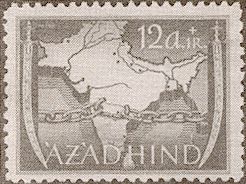
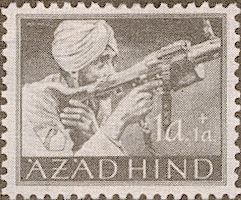
Figure 1. An Entire Subcontinent - note that the map includes all of British India, without distinctions between Pakistan, India and Bangladesh - liberated by the sword from British rule is the implicit mesage of the 12-anna + 1 ruppee semipostal (left). A second stamp (right) shows the means of achieving it - a turbaned Sikh armed with one of the excellent German light machine guns of World War II.
These unusual semipostals are listed as private German issues of world
War II in the Michel German Specialized Catalog. Printed in 1943 by Berlin's
State Printing works. these stamps are well known as collectors of Third
Reich material.
Being at war with Great Britain , Germany was naturallu sympathetic
to anyone working against British interests. What the stamps don;t tell
was that Nazi support for Azad Hind-- the Free India Movement-- went far
beyond printing stamps.
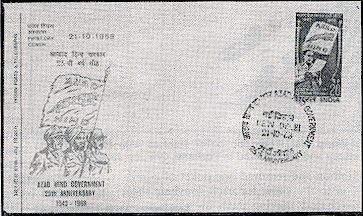 |
Figure 2. A 1968 Indian first Day cover for a commemorative marking the 25th anniversary of Subhash Chandra Bose's proclamation of the Azad Hind provisional government for India on Oct. 21, 1943, from Japanese-occupied Singapore. Note the leaping tiger banner.
Figure 2 shows a 1968 first day cover for an Indian stamp marking the 25th anniversary of the Azad Hind movement. That India chose to commemorate it made me realize that this movement was more than a Nazi footnote. Mahatma Gandhi is best know, but many others made a significant contribution to struggle for freedom on the Indian subcontinent. Subhash Chandra Bose's Azad Hid was a very militant faction.
Born in Bengal in 1897, Subhash Chandra Bose was the son of a civil servant. Expelled from college in India, Bose studied in England and passed the Indian Civil Service exam. Shortly afterwards, responding to Gandhiji's call to revolution, Bose resigned his civil service post, returning to India to work for Independence.
Bose was first arrested in 1921for organizing a boycott during the visit to India of the Prince of Wales (later King Edward VIII). In the late 1930s, believing that on;y military action wuld succceed in driving the British out of India, Bose broke woth Gandhi and the Indian National Congress over the question of the use of violence.
Under house arrest waiting trial for militant speech, in early 1941
Bose slipped out in the night disguised as a Muslim cleric and made his
way across Afghanistan and Russia to Berlin. Glad of any assistance against
Britain, the Germans provided Bose with high powered radio equipment which
beamed daily broadcasts into India, promoting such terrorism as train derailments,
the assassination of British soldiers and the bombing of public buildings.
 |
 |
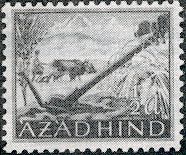 |
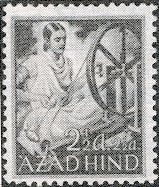
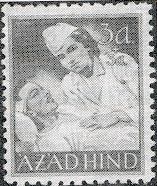
Figure 3. The traditional peacetime Indian
domestic tasks of ploughing and spinning are illustrated on these three
semipostals from the 1943 Azad Hind issus, along with the vital wartime
task of caring for the wounded.
India soldiers captured in North Africa were freed from prisoner of
war camps to form an Indian regiment in the German Army. Semipostal stamps
printed for the movement, shown in Figures 1 and 3, never reached the provincial
government Bose formed under Japanese protection.
Bose, anxious to return to South Asia persuaded the Germans take him
to submarine around Cape of Good Hope, for a rendezvous with Japanese sub
off Madasgascar for the voyage to Singapore, where he arrived in July 1943.
An Indian army awaited him; when the British surrendered the fortress at
Singapore, the garrison included 60,000 Indian troops.
Freed from P.O.W camps, these British trained Indian soldiers became the Indian National Army. Japan let Bose and his army administer the Andaman and Nicobar islands in the Bay of Bengal. When Bose proclaimed the Azad Hind provincial government on Oct. 21, 1943, he appointed himself prime minister, war minister and foriegn minister. Promptly recognized by Japan, Germany, Burma and Philippines, Azad Hind declared war on Great Britain and the United States.
In March 1944, from a headquarters in Rangoon, Bose and the Indian National
Army attack the British garrison at Imphal. Although there was initial
success, the assault soon faltered and the INA surrendered in Rangoon in
May 1945. Bose escaped via Saigonn, but died in a plane crash on Formosa.
After the war, a British military tribunal found INA soldiers and officers
guilty of treason. However, riots, demonstrations and anti-British sentiment
among the Indian military prevented the imposition of harsh sentences.
The strong popular support for the INA contributed to the British realization
that the time for colonial rule in India was at an end. Although not as
well known in the West, Bose and the Azad Hind played a significant role
in the Indian struggle for Independence.