49th New York Volunteers
Regimental History
Tune:
Battle Cry of Freedom
1861 - The Founding of the Regiment
The 49th New York was one of 25 empire state volunteer infantry regiments which came into creation by edict of state governor Edwin Morgan on 30 July, 1861, at the request of the federal government. In Buffalo the governor's proclamation was taken up by a committee of the city's prominent citizens, who chose Daniel Davidson Bidwell as the colonel of what was called at the time the Second Buffalo Regiment.
Daniel Bidwell was a natural choice to lead the regiment, and in many ways he embodies the best of the officer class of the Union's volunteer army. He was born in 1816, the son of Benjamin Bidwell, a Buffalo pioneer and co-owner of a shipbuilding firm constructing vessels for the Great Lakes trade. Though educated in law, he worked for the family firm until elected as Justice of the Peace, and went on to be Police Justice for the City of Buffalo. A court reporter at the time, Josephus Larned, described Bidwell as a conscientious magistrate who was firm but capable of compassion, a character description echoed by many veterans of the 49th.
In the years leading up to the Civil War municipal and county militias were the rage across America, satisfying the need for social and athletic interaction among men of the middle and upper classes. In North and South alike, these militia organizations formed the nuclei of the volunteer regiments which answered the call in 1861, and which formed the mass of the first rebel and federal armies. Interested in soldiering from his early youth, Daniel Bidwell joined the 65th Regiment of New York as a private in the 1840s, rising to command its Company D. When D Company broke away from the 65th and became the 74th Regiment of the New York National Guard Bidwell was offered the colonelcy but refused it, though it appears that in the years leading up to the Civil War he took an almost paternal interest in the regiment, and supported the regiment with his own personal fortune.
With their showy comic-opera uniforms and relaxed weekend drills, the amateur militias would have inspired laughter from their regular army counterparts. However, as war became more likely in the months leading up to Fort Sumter in 1861, the militias stepped up their drilling, no doubt in the anticipation of one brief, glorious Napoleonic campaign to victory. It was only natural that the militia leaders should supply many of the commanders of the volunteer regiments - there were very few West Pointers to go around, and in most cases the regular officers were little better, being trained in the duties of frontier constabulary, with little more experience than command of a company. The militia officers also had the highest social standing in their communities, and so it was only natural that they would be turned to for leadership in time of war Daniel Bidwell's Civil War career would prove that the militia officers could be as good in battle as their regular counterparts.
It is not clear how many men of the 74th Regiment followed Bidwell into what would become the 49th New York Volunteers. The 74th Regiment remained in garrison in Buffalo throughout the war, and in 1865 they turned out as welcoming escort when the survivors of the 49th returned home.
Fort Porter in Buffalo was chosen as the first headquarters of the Second Buffalo Regiment, and recruiting of nine companies was begun. Of these companies, A, G, I and K were raised in Chautauqua country, Companies B, D, E and F in Erie county, and Company H in Niagara county. The companies came together at Fort Porter over the course of August. Fort Porter was located on the American side of the International Peace Bridge connecting Buffalo with Canada, and was demolished when the bridge was constructed in the 1920s.
1862 -Washington DC, The Peninsula Campaign and the Seven Days
Perhaps no society, with the exception of Europe in 1914, went to war as gladly as America did in 1861. The scene of the Second Buffalo's leave-taking of Buffalo in mid-September was typical of the war-mania that gripped the country. Sergeant Norman Thompson of G Company remembered that "It seemed as though the entire populace of Buffalo and the surrounding country lined up on both sides of the streets thru which we marched". , Similar scenes were enacted across New York. George Stevens, surgeon of the 77th New York which served in the same brigade as the 49th, wrote of cheering crowds as the regiment left its first home of Saratoga Springs, and of its passage to Washington along railroad tracks lined with "men, women and children, filling the windows of houses and thronging the wayside ... shouting and waving flags and handkerchiefs. Children in the arms of their nurses waved little flags from the windows in great glee, while gray haired old men in piping tones cried 'God bless our soldiers' ".
Such was the mood of the country that early fall when the Second Buffalo was ordered to New York City, where it was mustered into United States service as the 49th New York Volunteers. The 49th's first issued weapon was the Harper's Ferry model 1842, a smoothbore musket converted to take a percussion cap. By September 21 the regiment was in transit to Washington, DC, with a jittery transit through Baltimore, a city of strong rebel tendencies. It was in Baltimore that the men were first ordered to load their weapons in the expectation of action, but the passage was uneventful. From Washington the regiment took up camp on the Virginia side of the Potomac and took part in the construction of Fort Ethan Allen, part of the the considerable defenses of Washington, which still expected a rebel assault after the summer's defeat at Bull Run.
During its time at Fort Ethan Allen the 49th's raw troops knew their first taste of army discipline. Sergeant Hiram Thompson of H Company remembered that until this period no NCOs had been appointed, the company officers detailing men for NCO duty as the occasion demanded. There was a man in H Company, Charley Murphy, who had been acting orderly sergeant, but was denied the spot when the NCOs list was formally announced. Murphy and his supporters went to their company commander, Charles Moss, to demand that Murphy be made orderly sergeant. Captain Moss was West Point educated, and had recruited H Company in his native Lockport, so no doubt his troops expected a sympathetic hearing from a fellow Niagara County man. Captain Moss listened to them "calmly and patiently", and then proceeded to read his green and unruly troops the riot act in no uncertain terms. As Thompson remembered it, "the language of the captain impressed us with one idea at least, and that was that we were play soldiers no longer, but soldiers in earnest and that the captain was on the job".
Another harsh reminder that the Army was in earnest came that fall when the Division was paraded to witness the execution by firing squad of Pvt. William Scott, K Co, 3rd Vermont, who had been found asleep on picket duty. At the very last moment the affair was halted and a presidential pardon read aloud. George Stevens recalled that "Shout after shout arose from the division, and hundreds blessed the name of President Lincoln". Scott was spared that day, only to be killed in action the following April at Lees Mill, on the
Peninsula.
The weather in that December of 1861 was warm and forgiving, and the troops enjoyed the first novelties of army life, and the stirring sight of mounted Lancers going through their drill, red pennons flying from their lances. By January however the weather worsened, and disease began to haunt the camps around Washington. George Stevens, Surgeon of the neighboring 77th NY, recalled that during this period typhoid, fever, malaria and diptheria were at times so widespread that the majority of men were unfit for duty. One victim was the 49th's Captain Moss of H Company, who caught typhoid fever and died at home in Lockport that March. Mud made the movement of wagons almost impossible, and men became frustrated at the inactivity, waiting for a chance to get at the rebel forces that seemed to be almost encircling Washington. Another obstacle to movement were the soldier's own packs. Sgt. Thompson of H Company recalled that the green troops "had crowded [their packs] with mementoes from home so that they resembled young houses, when astride a man's shoulders, and they felt like it after carrying them for two or three hours".
The 49th was part of the Third Brigade of General W.F. (Baldy) Smith's division (Fourth Corps, Army of the Potomac), which consisted of the 33rd New York, the 77th New York, and the 7th Maine. The brigade was commended by General Davidson. The First Brigade consisted of the 43rd New York, the 49th Pennsylvania, the 6th Maine, and the 5th Wisconsin, and the brigadier was General Hancock, later to become famous as the commander of the 2nd Corps. The Second Brigade of Smith's division was the famous Vermont Brigade, consisting of the 2nd, 3rd, 5th and 6th Vermont Regiments, under General Brooks. Throughout February the Division was based at Camp Griffin, Fairfax Country, Virginia, near Washington, and Smith occupied the men with regimental, brigade, and divisional drills. Smith also had his men patrol into rebel-held territory, though the mud was a worse enemy than the confederates.
During March of 1862 the 49th was engaged in coastal operations in the vicinities of Hampton Roads and Newport Roads, but saw no real action other than one skirmish that left two men wounded by rebel small arms fire. While at Fort Monroe in late March the men of the regiment were no doubt bemused to see the famous ironclad Monitor, a curious apparition described by one contemporary as a "cheese
box on a raft", lying at anchor after her engagement with the CSS Merrimac. A more hostile naval encounter occurred then when men of Smith's Division were shelled bathing in the James River by the rebel gunboat Teazer, an incident which caused fear to the victims and amusement to onlookers, but no casualties.
On April 4th, the Army of the Potomac began its ponderous advance on Richmond. George Stevens wrote that the march was made in warm weather, and the green, over-laden men of the brigade left the road strewn with discarded clothing, greatcoats, dress coats and equipment.
At Lees Mill on the Warwick River Smith's division was deployed into line of battle facing rebel fortifications on the far side of the river. An exchange of rifle and artillery followed, causing about twenty casualties in the Third Brigade. One of these was Milton Lewis of Company K, who was shot in the head and thus had the misfortune of being the first man of the regiment to be killed by enemy fire. The rebel works were part of seven lines of trenches dug across the Virginia Peninsula by Confederate General Joseph Johnston. The ground was swampy and flooded because the rebels had damned the Warwick, and movement was only possible across fallen trees, known as corduroy roads. In the swampy ground the Union forces moved blindly, feeling out the shape of the rebel lines, an eerie foretelling of the fighting to come at Spotsylvania Court House in 1864.
What McClellan did not know was that Johnston's army was badly outnumbered, despite its imposing works, and so the fighting along the Warwick continued until April 16th, an affair of sniping and skirmishing in the swamps with little result for either side. On the 16th an assault by the Vermont Brigade of Smith's Division opened the way across the Warwick, and McClellan's army ground slowly forward, only to settle into siege works around Yorktown.
George Stevens of the 77th NY remembered this period as being a brutal ordeal, the men of the Corps alternating between digging in the siegeworks by day and waiting in kit and in line at night, in case of rebel attacks. Twenty of the thirty days in the line were marked by heavy rain, said Stevens; "Men lay down to rest at night with their equipments bucked about them and wet to their skins", and many fell ill and died from exposure, fever, and malaria. The failure of the Army to deliver fresh food, vegetables, and proper medicines to the troops and to the surgeons moved Stevens to complain of the "criminal negligence" which left these supplies "locked in the storehouses of Washington". He recalled the men of the Brigade moving about without enthusiasm and with few smiles, but still retaining "a fixed and determined purpose". However, they were cheated of the decisive battle they hoped for, waking on the 4th of May to find that the rebels had abandoned Yorktown and had fallen back on Richmond, leaving behind abandoned and booby-trapped fortifications.
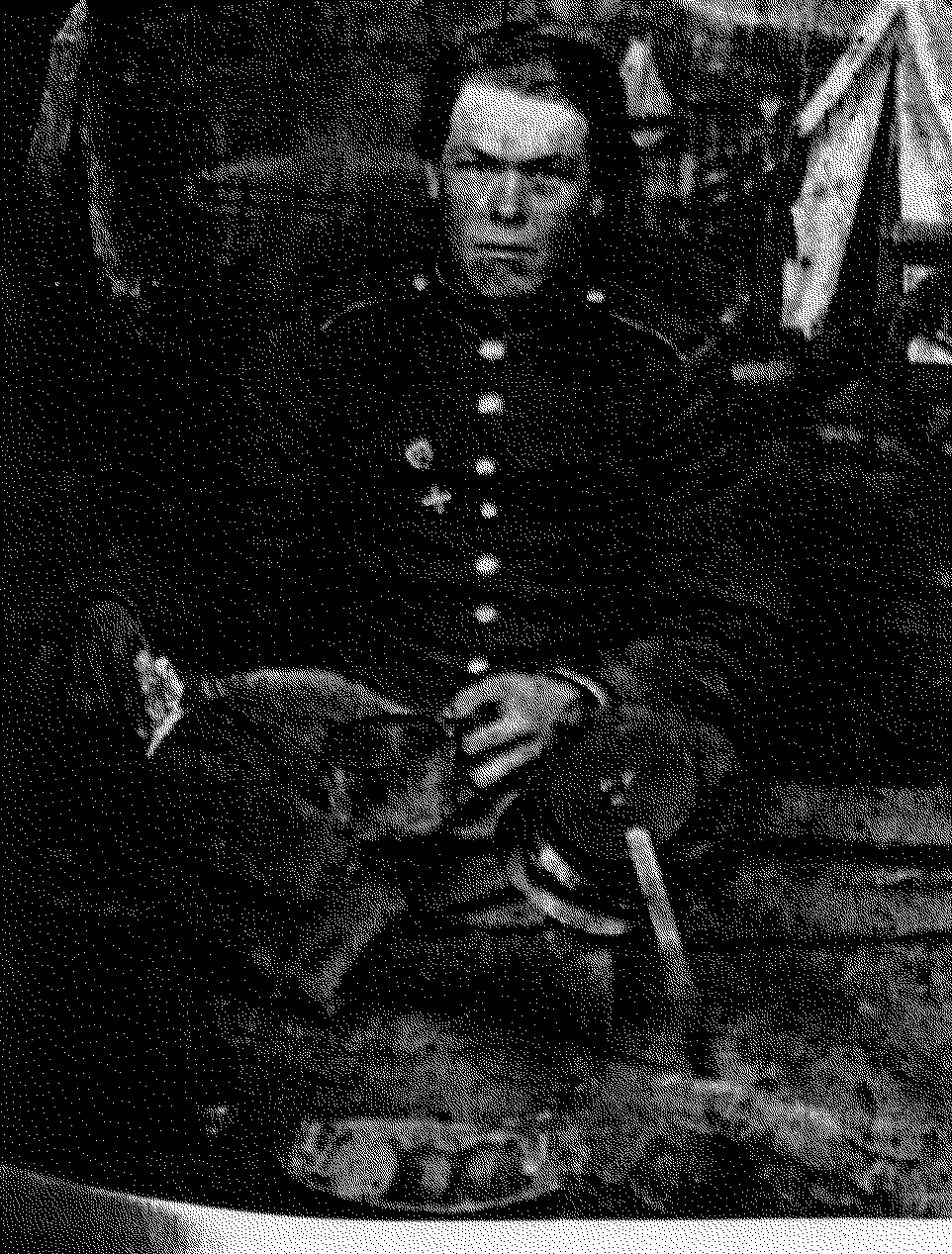
In this posed (and horribly grainy)
photograph, a young soldier of the 49th is seen wearing a 6th Corps badge on
the breast of his coat, a New York State Militia jacket. (Dale S. Snair
collection, Richmond)
Throughout May the 49th was part of the Peninsula Campaign, the Army of the Potomac's first ponderous, ineffective advance on Richmond. The regiment was keen to fight, but its first opponents were straw sentries and wooden cannon at Fort Hunter, part of the Confederates' successful efforts at spooking and slowing McClellan, the Union commander. The 49th was in reserve during Hancock's assault on Fort Magruder, and the sight of wounded and dead men at this battle must have given many of the New York volunteers pause for thought. By mid-may the 49th was at White House Landing on the Pamunkey River, and learned that as a result of a reorganization of the Army of the Potomac it was included in the Third Brigade, Second Division, of the newly-created Sixth Corps, in which it would serve for the remainder of the war.
By May 23rd the Army of the Potomac was closing in on Richmond, and the 49th was at Mechanicsville on the Chickahominy River. There was an anxious moment on May 24 when four companies of the 49th were ordered to destroy the Virginia Central Railroad bridge, less than four miles from the Confederate capital, and narrowly escaped being cut off and captured by a rebel force. The following days were rainy, and the regiment was employed in cutting trees for bridges and log, or "corduroy", roads through the swamps along the Chickahominy. It was difficult work, often in water that was waist deep, and the regimental surgeon issued the men rum mixed with quinine. The 49th was kept at this routine of fatigue and picket duty throughout most of June, as the Army of the Potomac settled in for the siege of Richmond. The battles of Fair Oaks, Seven Pines, and Gaines' Mill had been fought, and while the men of the 49th knew that something was up, they saw no part in these actions. What they did not know was that Robert E. Lee had assumed command of the Confederate forces in Virginia. It is likely that many of the men of the 49th expected to be in Richmond within the week and back home in time for the fall harvest, but they were in for a surprise.
 Back to History Page
Back to Home Page