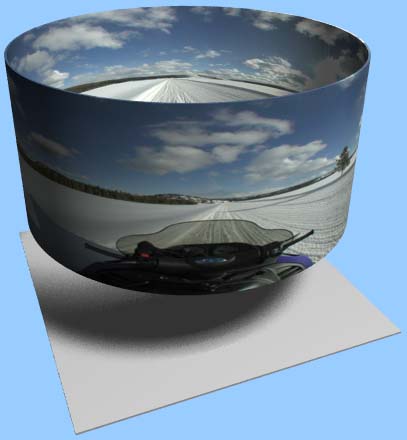
Cylindrical panoramas are well suited for scenes that are close to the horizon, like the skyline of a city or the Grand Canyon. The point above or below the observer is not included. Objects towards the sun should be avoided because they are back-lighted and will appear much darker than those in the sunshine. The scene should not include objects that are clipped at the upper or lower edge of the panorama, as often seen in QuickTime panoramas on the web. In these cases, a wider frame or a spherical panorama would be better.
Since cylindrical panoramas cover only part of the overall scene, they can provide high resolution and are well suited to printing. The cylinder can be unrolled and the image can be framed in a flat frame. Cylindrical panoramas can be stitched together from several images. Any kind of input image can be used, but wide-angle images are preferred because fewer of them are needed to cover the panorama. The highest resolution is achieved by shooting vertical (portrait) pictures that cover slightly more than the height of the panorama. The images have to be re-mapped (warped) into the coordinate system of the panorama and oriented relative to each other. The software page describes the details of this process.
 |
Panorama home
|
Panorama home