Cocopelli:
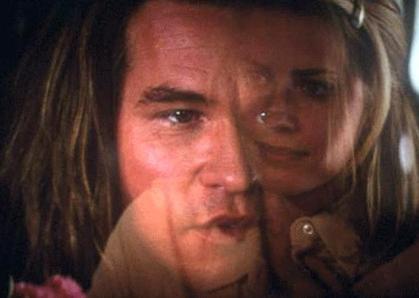
However,while most of Val and Philip's additions added excitement and great humor to the story, I believe they took a wrong turn in the course of The Saint's plot when they expanded the romantic entanglement between Simon and Emma. While it is perfectly feasible for Simon to have a love interest, there is absolutely NO room in the Saint's life for a sustained attachment to a woman, from both a character development and film genre standpoint. Let's explore each category to see why.
Mermoz:
It was almost essential both to the origin story of The Saint and to the success of the film that Simon not only fall in love but be subject to a transforming love. Bit by bit he is won over not only by the
purity and generosity of her motives, but by her ability to recognize a real self that he himself no longer knows. This makes his radical transformation from thief to philanthropist more believable.
 |
CHARACTER DEVELOPMENT
|
Cocopelli:
The Saint provides us with a handy look into Simon's inner self in the initial scenes of the movie. Simon, an orphan, is shown living a tortured existence in a Far Eastern Catholic orphanage. The priests are as cold and unbending as the stony exterior of the home, the strict rules call for instant and stoic obedience, and there is certainly no room for joy. Partly as a reaction to this environment, along with the emotional trauma of losing his parents at such a young age, Simon, through a survival
mechanism retreats into a fantasy world. He imagines that he is a Knight Templar, capable of plunging into adventures only to emerge ever victorious. To help foster this fantasy, Simon has already perfected some particular skills - picking locks as well as pockets. His supposed love for the orphan girl Agnes can also be viewed as a further example of his retreat from reality - Agnes is the embodiment of the "Princess." evilly trapped in a
tower - golden haired, virtuous innocent, replete with a white gown and a kiss for her knight as he goes off into battle. In any event, even if we can believe for a moment that this is Simon (or John Rossi's) last tenuous connection to the real world, it is quickly severed with Agnes' cruel and swift death.
Mermoz:
Actually, this part establishes the original Saintly character, a boy who is smart, brave, tough, and full of imagination -- the bane of authority, and the hero of the downtrodden (the other students). The death of Agnes destroys his ability to see himself as a hero, but that boy remains in Simon somewhere.
Cocopelli:
This is a pivotal scene, for it provides the critical and irreversible maxim for Simon's life - "never let them know who you are...never surrender your heart." Or as Philip Noyce himself puts it "... Just as he did as a child, the adult Templar retreats from reality, using disguises which are really an escape, a mask hiding the real man." Simon cannot allow anyone to get close to him - it had been drilled into him at such a young and extremely impressionable age that all he loved would be destroyed.
Mermoz:
Well, is this childhood the mold that makes the man, or is it the perfect set-up for the ultimate romance? The bad man redeemed by the love of a good woman, or the disillusioned man who rediscovers joy and goodness in love, is a story that goes back a long way both in books and in film. Simon's traumatic childhood sets him up as a tragic figure who has known joy, friendship, and love, and who the audience wants to see rediscover that. This is why, when he tells Emma his real name, it is the name he chose for himself in his heroic boyhood -- Simon Templar -- that he tells her.
Cocopelli:
The very fact that he tells Emma that his real name is Simon Templar is further proof that there is no real person - he is simply perpetuating his fantasy of his boyhood - he is once again the Knight Errant and Emma is the adult embodiment of Agnes, the Princess in the Tower .
This credo was undoubtedly reinforced as Simon matured, as his exploits became more and more dangerous - an intimate relationship would potentially jeopardize Simon's personal and professional health, as it would give his enemies a very valuable strategic pawn. Simon was, and has to remain a lone wolf.
Mermoz:
Although Ilya seems to have an amazing ability to see through most of Simon's disguises, Simon's establishment of many identities would seem to indicate that he could develop relationships that his enemies never
knew about.
 |
GENRE
|
Cocopelli:
Perhaps a more compelling (at least financially) argument to explain why the Saint could not or should not have a sustained relationship, can be found in the historical success of the action-adventure genre. The lead characters of this very profitable type of movie (this category consistently grosses the highest revenues) have many thing in common: they are handsome, debonair, extremely sexy, more intelligent and creative than their respective enemies, AND unattached. And it this is not to say these men are in anyway not interested in women; in such successful, long-term franchises such as James Bond, Indiana Jones, Jurassic Park, even Batman, the main men manage to find female companionship - but no sequel has shown a continued relationship from the prior episode. Why? Because the romantic device simply does not help. Too often (think Moonlighting) a successful series has been ruined by consummating a previously tension-filled mating dance -- once caught, the excitement is gone (remember, we are talking here about what makes an audience want to continue watching - NOT real life!). It is the possibility of love that intrigues viewers - not the actuality. Even if we look at stories which do have a recurring love partner -- DIE HARD or even the some of the older Saint books - the woman in question is in the background, more as a footnote than an integral part of the story. Emma and Simon as a couple simply add nothing to the storyline - the pairing has to go.
Mermoz:
From the viewpoint of the genre, it is glaringly obvious that the romance in The Saint has been stoked up to make it appeal more to female viewers than the average action-adventure movie. This can only contribute to its financial success. The romantic device in The Saint is not a little piece of amusement thrown in as an extra plot device, but essential to the plot. It is Simon's love for Emma that transforms him. A transforming love can't be tangential, it must be central to the story. The romantic tension in the story is not between Simon and Emma at all, but between Simon the cynical thief and Simon the hero. It is her ability to see the original heroic, generous Simon, the way her generosity and purity touches a inner person he has done his best to forget, that draws him to her.
Who really thought the Saint would settle down once transformed by love? Not even Emma. There's no reason, really, that they can't continue a relationship into the next movie, although it's just as likely that they will have gone their separate ways by then, retaining fond memories of each other. It's not necessary, really, to "clear the decks" for another full-scale romantic attachment, because Simon needs to experience this kind of transforming love only once. In later movies the romance can be lighter, just as they are expecting the story itself to be lighter (and thus more true to the character established in the books), now that the origin story is out of the way.
Cocopelli:
If the goal was not to have Emma return in future generations of the film, then what was the point really? This device did not move the plot - the coda towards the end of the film where Emma and Val meet in the quaint little cottage looked more like a clip from another film than a scene which further moved either character development or the storyline. There was not enough in the relationship to prove that the Saint had been reformed or transformed or whatever- if indeed Emma changed his life - he could no longer really be The
Saint .
Mermoz:
I don't think the goal was to have Emma return in future generations of the film, but to show that Simon was transformed by love and willing to believe in miracles ("magic") again. As for the transformation that took place -- yes, Emma did indeed change his life, by compelling him to rediscover and claim the dashing, generous hero that he once was. The criminal who steals anything to fill his bank account is gone, but his skills and knowledge will be very useful to a man who intends to continue as the bane of authority while helping the downtrodden.
This discussion by Mermoz and Cocopelli was originally published (with different pictures) in the May 1997 (Vol 2 #3) paper issue of the Val Kilmer Newsletter.