|
Though they tell the same story, there are big and small differences between the two movies. The five most noticeable ones are listed below.
FUGITIVE
CHAINS
|
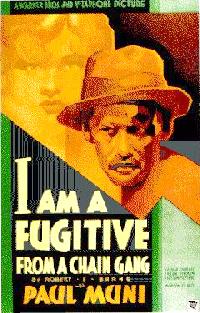
I AM A FUGITIVE FROM A CHAIN GANG is a very well-made movie. You are immediately caught up in the passion and commitment of the main character, whose name is James Allen. (I imagine they changed it for his protection.) He returns from a stint in the Army Engineer Corps eager to put his new knowledge to use building things, but things at home are both too much and not enough the same. His mother, brother and old boss still expect him to be the same old Jim and work at the same old factory job and be grateful for it, but his girl doesn't seem interested in him anymore.
The brother in FUGITIVE is very different from the brother in CHAINS. The brother in FUGITIVE seems very self-righteous and full of himself, convinced that his younger brother should take his advice and not terribly supportive when he doesn't. The way his character is drawn is a good example of the chief differences in characterization between the two movies: in FUGITIVE, the main characters are more stock or stereotyped while the minor characters (most notably the prison warden and guards) are for the most part played as fairly ordinary and businesslike; in CHAINS, the main characters are more multi-layered and human but the minor characters by contrast are very broad stereotypes. It's as if FUGITIVE spreads its stock characterization around while CHAINS concentrates it in the minor characters.
|
 |
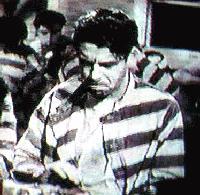
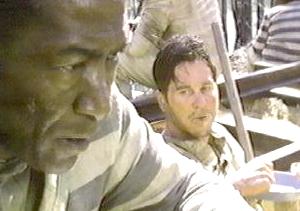
Some of the differences between the movies are clearly a result of the later one taking modern sensibilities into account, and a difference in what you can show in movies today. In CHAINS Burns is depicted as a man still haunted by the horrors of war, while in FUGITIVE, Allen is a returning hero whose horizons have been broadened by his war experience. FUGITIVE was made between the world wars when the horror of war was not much acknowledged in movies and before "post-traumatic stress syndrome" became a household word. CHAINS also shows more direct brutality than FUGITIVE - Burns is put into and pulled out of the hot box, whipped, and kept in the stocks right on screen, with make-up effects to show the physical damage, where in FUGITIVE he is whipped offscreen. In CHAINS, when Burns asks Big Sam, an African-American prisoner known for his great strength and accuracy with a hammer, to help him bend his shackles, Sam says "No white man ever helped me." and Burns backs off. Sam agrees after Pappy Glue makes a gesture indicating that Burns is okay. In FUGITIVE, the worker Sebastian agrees readily, saying "I don't want to get in no trouble, but I'd sure like to see you get away from this misery!"
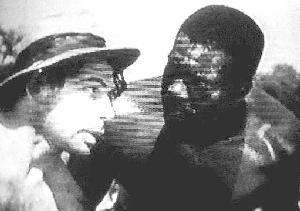 |
Sebastian for help |
 |
The whipping scene in each movie is vividly affecting, though for different reasons, and is another telling demonstration of different movie-making eras. In FUGITIVE, Allen is much affected by the plight of a fellow convict who is too sick to work, and mutters a curse at the guards when they choose the sick man to be whipped for "pulling a faint." They hear Allen curse and choose him to be whipped also. Previous victims have yelled and cried, but as the camera pans from convict to convict, each turned towards the unseen punishment, each listening intently, blow after blow falls and Allen makes no sound. This scene marks Allen as a hero in the conventional mode - sticking up for the less fortunate, and bearing punishment in silence. In CHAINS, Burns is chosen to be whipped at the whim of the warden, and he protests volubly, asserting that he hasn't "missed a lick in thirty-five days," trying futilely to appeal to what he knows is right, crying desperately, "I am a human being!" He is shown being whipped and gritting his teeth against crying out from the pain, attended by no audience but the guard and the warden, while his fellow convicts watch from the windows of distant barracks. The scene marks Burns as heroic, not just in a traditional mode, but because he continues to survive and to assert his humanity in the face of brutal and dehumanizing treatment.
The two escapes in FUGITIVE are much more drawn out and suspenseful than in CHAINS. When Burns escapes the first time in CHAINS, he runs through the woods, steals a boat and rows away through the swamp. He is next seen boarding a train. When Allen escapes the first time in FUGITIVE, he runs through the woods, then plunges into water to escape the dogs. In a scene of petrifying suspense, he lies underwater, breathing through a reed, while one of the guards enters the water and searches the undergrowth a few feet away. Allen steals some clothes and then buys a suit and hat once he is in the city, then while he is getting a shave, a policeman comes in and begins to talk about and describe the escaped convict. Allen asks for a hot towel to cover his face, but then when he is let out of the chair to leave, he is brought face to face with the policeman - who never looks up from his paper! As Allen leaves, the barber asks him if it was close enough. "Plenty!" Allen replies, and he isn't referring to the shave! He is lucky enough to get shelter for the night with a recently released fellow convict, who is happy to see that he is provided for the night with everything he couldn't get in prison - good food, liquor, money, a soft bed and female companionship. Allen boards a train the next day.

One of the most harrowing shots in the movie is when, after his bloodied body is hauled back to the barracks by the guards, and though he is nearly unconscious and can barely move, he has to hold up his chain ring for the nightly ritual of "threading it up." |
Burn's imprisonment as depicted in CHAINS is much brutal than in FUGITIVE, though they are both horrifying. In FUGITIVE, when Allen is shoved to the floor on his first morning, the guard throws the heavy iron loop of his chain right at him and hits him in the head. Later on, while he is working, a guard hits him hard enough to knock him down when he wipes sweat off his forehead without permission. These cruel acts seem to rise out of the general brutality and are not specifically directed at him.. By contrast, in CHAINS, Burns is singled out from the beginning for special cruelty. He is reviled as a Yankee and is actually told that they mean to kill him. Besides being tripped several times by his own chains, he is put in the hot box. The second imprisonment is even worse, starting out with the chilling scene where he hands the warden the agreement that says Burns is to be released in forty-five days, and the warden takes it from him, saying, "You're in Georgia now. Things'll be done Georgia's way." The other prisoners are told not to talk to him, he is again singled out for especially cruel treatment, and is told that a New York paper plans to investigate his case, but they won't find anything, because he'll be dead by then.
Some parts are almost exactly the same in both movies: His reaction to the food in prison; getting dumped out of bed on the first morning; his terror just getting on the train, when he thinks they have spotted him; the painful scene where hammer blows bend his shackles; the suspenseful scene after his shackles are bent, when the guard tests the chain at the end of the day; and his reaction upon being blackmailed by his landlady.
Both movies deliver everything promised in the intensely dramatic trailer for FUGITIVE: DRAMATIC INTENSITY, THRILLING LOVE INTEREST, TERRIFIC SUSPENSE, right up to the affecting endings.
At the end of FUGITIVE, Allen rushes out of the dark to confront the woman he left his wife for. She loves him and wants to help him, but he tells her his life on the run is not safe. "Can't you tell me where you're going?" she asks, and he backs away from her into the concealing dark, shaking his head. As she demands "Will you write? Do you need any money?" he continues to back away, shaking his head in frantic negation. "But you must, Jim. How do you live?" she demands, and his last words are heard out of utter darkness: "I steal!" The whole scene is given even greater depth by the 1932 theater audience's knowledge that Allen (or whatever his real name is) is still on the run.
The end of CHAINS is no less affecting. Burns' book about being a fugitive from a chain gang becomes a best-seller, but he is still being pursued and dare not buy it or even be seen looking at it in the store. His story is made into a movie, and though it's dangerous, he sneaks in to see it, though at times he can barely watch as the black-and-white screen brings all the horror back to him. He leaves the theater and pauses to look back at the title on the marquee - he is still a FUGITIVE FROM A CHAIN GANG. Printed words against the background of a deserted prisoner camp tell you that Burns was finally pardoned in 1944. I AM A FUGITIVE FROM A CHAIN GANG was released in 1932.
THE END