10/12/2008
Empire St. University: Deck Theory 101
Short Curve Strategy
by Patrick Yapjoco
Of all of the different archetypes in Vs, probably the most common is the �Short Curve� deck. It�s simple and straight-forward to play. You just point and shoot, so to speak. This is the epitome of aggressive decks. It wasn�t always this way, however. During the game�s early stages, many players opted for the curve deck, or long curve deck. That is, games did not start until turn 2 or 3. Then, they would plan to win the game in the later turns, usually turn 7 or turn 8. Back then, 1-drops were rarely played, as players couldn�t justify playing many 1-drops in the deck, as it would compromise the late game. The exception during that time was The New Brotherhood (TNB). This deck has been in the metagame since the beginning and has always made an impact in one form or another. This deck eschewed the late game antics for its early game dominance. It was not uncommon to see this deck win on turn 4 or 5. The key was its heavy emphasis on its early game, that is, on turns 1-3, and wanted to stabilize and dominate those turns by having a good board presence and applying as much pressure as possible. The deck also utilized plenty of �pumps� that could regularly swing 2-3 slots up the curve. By turn 5 or 6, the game would be all but over. It was the forefather of the short curve deck.
There are many different short curve decks that have made an impact in the metagame, but it was the advent of the hidden area that really gave short curve decks the chance to shine and make a stamp on the metagame. That, coupled with the ever-growing �generic� pumps has made the short curve deck more and more potent. The hidden area has given birth to decks such as MKO, Skrulls, BoP, and IG. The fact that it is harder to get access to the hidden area means that the hidden decks can swing back for 1-sided stuns and effectively, steal initiative. Therefore, by having initiative almost every turn, the game usually ends by turns 4-6, as opposed to turns 7-8.
Essentially, the short curve deck functions like a curve deck, dropping the biggest character it can at each drop. However, instead of starting the game on turn 2 or 3, it wants to start the game on turn 1 so it can apply pressure from the get-go. Typically, short curve decks usually want to take evens as to be able to end the game on turn 6, which is easier to do than turn 5. Although hitting a 1-drop might seem insignificant at first glance, it could mean the all the difference in that it will set the tempo for the game. Let me illustrate: You drop a 1-drop and 2-drop and your opponent�s first play is a 2-drop. For the most part, you can trade your 1-drop with his 2-drop, and swing directly with your 2-drop. At the end of turn 2, the score should be around 49-42 in your favor. As you can see, you have opened up a lead that will only continue to grow as you continue to trade �2-for1s� on turns 4 and 6. If you still have your 1-drop by turn 4, which is most common in hidden decks, you have the opportunity to trade your 1-drop for a 3-drop or even a 4-drop, with the right amount of pumps, of course. By then, your lead will have gotten large enough and you can almost always have a character swing directly for massive endurance loss. At this point, any swing-back from your opponent will not be enough to catch-up. Like I mentioned, the deck has a heavy emphasis on the early game/curve, but continues to drop �on-curve� characters. This is different from the off-curve strategy in that it wants quality characters whereas the off-curve wants a large quantity of characters so it can overwhelm the opposition in the long run.
I mentioned earlier that one of the strengths of the short curve deck is its ability to be able to swing 2-3 slots up the curve. It is because of this that it can handle standard curve decks pretty easily. How do they do it, you ask? Pumps, of course! With the ever-growing number of pumps being released, the more potent the short curve deck becomes. The most common ones played are: [Flying Kick], [Big Leagues], [Savage Beatdown], [Crackshot], and [Blinding Rage]. This is in addition to the pumps the deck has that are team-stamped (ie, [Crime Syndicate of Amerika] and [Interstellar Offensive]). You will normally see 12-16 pumps in a deck, and in many cases, even more! Basically, you just swing up the curve with a pump to achieve the stun, and swing down the curve to avoid a stun-back. As a result, the deck has little to no room for �tech� cards or �silver bullets� because the deck only runs characters, pumps, and search cards, for the most part. The concept is simple: swing up the curve until you get a clear shot directly, play pumps to hit, and win. The simplicity and directness, meaning there are no �tricks� to have to try and get off, is why a lot of players opt for this type of deck, especially newer players.
Build-wise and character-wise, the short curve deck is like a standard curve deck, however, in tempo and pace, the deck is like an off-curve deck. Believe it or not, but the short curve deck is just as fast, if not faster, than an off-curve deck. This is due to the fact that the deck drops bigger and bigger characters, turn after turn, matching the opposition, whereas the off-curve deck drops plenty of �smaller� drops. They normally team-attack to achieve stuns up the curve as the game progresses, but the short curve deck doesn�t need that as their characters are larger, stat-wise. The main thing going for the short curve deck, however, is the fact that there are fewer decisions to make, in terms of recruiting and attacking. The off-curve deck has to decide how to best use the recruit step as it usually has plenty of options in recruiting. The same goes for the attack step, they have to decide how to best use the attacks without over-compensating. The short curve deck just plays 1 character, which eliminates a lot of stress in itself. The fewer characters on the board = the fewer decisions need to be made.
Like all fast decks, there needs to be some kind of "finishing element." It serves as an insurance policy for winning the game when the game is in doubt. Sometimes, just having pumps won't be enough to win the game. Reinforcement effects ([Burn Rubber]), defender-removing effects ([Reset]), attacker-removing effects ([Force Field Projection]), or even endurance-gaining effects ([Messiah Complex]) can really slow down the deck, particularly in combat. There is nothing more disheartening that thinking you have the direct swing for the win, only to see that they have recovery effect that brings back their largest character. This is why the short curve deck needs a finishing element. For the most part, this is in the form or direct-endurance loss, or burn effects. The deck does not want to "run out of gas" after turn 6, but it does get to turn 7, it is still more well-equipped to handle a turn 7 than an off-curve deck. Victory becomes a farther reach once it gets to turn 7. Cards like [Wolverine, Agent of SHIELD/HYDRA] and [Human Torch, Secret Avenger] are good finishers as they can burn directly to push the final bit of damage. In the MKO deck, the combination of [Vengeance] and [Ghost Rider, Spirit of Vengeance] can easily burn the opponent for a minimum of 10 endurance, plus any stun that occurs on the opponent's side. This should be enough to ensure victory.
Some of the best decks in the history of Vs have been short curve decks. Decks like TNB, Squadron Supreme (no-hand), and Good Guys have all won major tournaments in its day, and have set the precedent for the current crop of short curve decks. The current most played decks in Silver Age and Modern Age are undoubtedly hidden decks. MKO, Skrulls, and IG are all major contenders in the metagame. Why? It's the fact that they are all hidden decks. Like I mentioned before, the hidden area essentially gives the short curve player initiative every turn. Also, because these decks are easy to play, with no major decisions to be made (as compared to other decks) and the framework of the deck allows for maximum combat damage, it is always popular with veteran players and new players alike. It is after, all, a combat-oriented deck, and that's what Vs is all about.
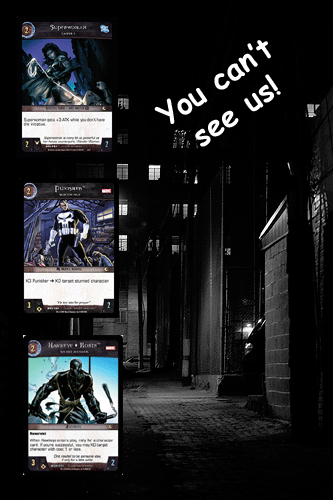 The short curve deck is a cross between an off-curve deck and a curve deck. It uses the best elements from each archetype, and throws out the rest. A typical short curve deck wants to drop a character starting from turn 1, and ending on turn 5 or 6. �It�s not much different than an off-curve,� you might say, but the main difference is the fact that it uses all of its points on 1 character at each turn. Off-curve decks want to play multiple characters starting on turn 2. �This looks like a curve deck then,� you might say, but the difference here is that it wants to hit a 1-drop, and it caps off at a 5-drop or a 6-drop, in most cases. Curve decks normally start on turn 2 or 3, and end with a 7-drop or 8-drop. It is important to hit a 1-drop, but not necessary to winning. You can more or less make up for missing your 1-drop as the game progresses, especially in hidden decks, where you can pick and choose your battles, regardless of initiative.
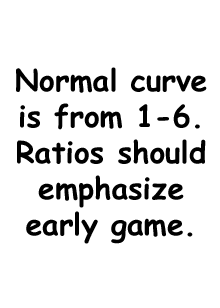 The ratios for this type of deck have plenty of 1-drops and 2-drops. Normally, you will see 8-10 1-drops as to insure hitting that first turn character. MKO is a perfect example as most versions run eight 1-drops and, along with 4 [Wild Ride], you essentially have 12 chances at hitting your 1-drop. The 2-drops usually number 7-8 characters and the 3-drops usually run 5-6. Turn 4 is the last turn where you see 4 or more characters. Turn 5 and 6 usually number anywhere from 3-5 characters total. This is because it is more important to hit the early game than the mid-game because sometimes, under-dropping in this kind of deck does not hurt it when it comes to turn 5 and 6. Also standard is 4-8 character search cards, depending on the number of characters the deck is running.