As the name implies, this is Madonna's second Greatest Hits collection, comprising most of her amazing songs from the 1990s. So is it comparable to the almost incomparable 'The Immaculate Collection'? Read on and find out...
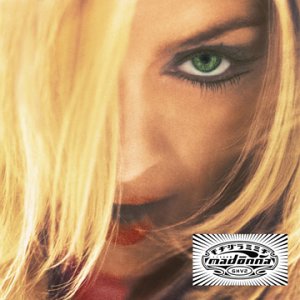
Songs
- Deeper And Deeper*
- Erotica*
- Human Nature*
- Secret*
- Don't Cry For Me Argentina*
- Bedtime Story*
- The Power Of Goodbye*
- Beautiful Stranger*
- Frozen*
- Take A Bow*
- Ray Of Light*
- Don't Tell Me*
- What It Feels Like For A Girl*
- Drowned World/Substitute For Love*
- Music*
Deeper and Deeper is a jaunty song, right in the middle of the Ninties disco sound, describing how Madonna falls headlong in love after forgetting that she could. Stabbing portentous piano, a skipping syncopated drum machine, synth bass and touches of string form the basis of the melody, boasting a thicker arrangement than anything else on the album. The lyrics describe how Madonna's parents taught her how to love, but that she had forgotten how to and that her new lover had taught her how to love again: "someone said that romance was dead and I believed it instead of remembering what my Mama told me, let my father mould, when you try to hold me you remind me what they said". This is followed by an instrumental section with three spanish guitar, one solo and castanets - possibly the most interesting part of the music. A very powerful and moving track if only you listen to the lyrics.
In Erotica, Maddy plays the part of a kinky dominatrix and she goes about seducing you, the listener. The song opens with a crackling sound of vinyl - an indication of how the 'dirty' analogue sound of this album is sexy whereas crisp digital sound is cold and uncool - and a low two-note bass riff. The arrangement is similarly sparse as 'Justify My Love' but more upbeat and there is also a jumpy funk guitar riff and the swirl of synth strings. Over this, Madonna does a low growly rap about the pleasures of S&M. Nice touches include the use of simultaneous spoken and sung phrases and the slowed down "I'm not going to hurt you". The mood is definitely spicey with a Middle Eastern air, heady and almost orgasmic at times, taking on a subversive power. The groove is hypnotic, and the attention to detail is fantastic throughout the song - including a sample from Kool and The Gang's 'Jungle Boogie'.
Don't be fooled into thinking that Human Nature is a cover of Michael Jackson's classic - this is an altogether angrier, more bitter song. In it, Maddy blasts her former lover, sometimes with scathing sarcasm - "oops, I didn't know I couldn't speak my mind, what was I thinking?". The inspiration for this song was the backlash Madonna received after Erotica/Sex - Madonna is in fact attacking the press and her detractors in general - and a typical stanza is "you punished me for telling you my fantasies, I'm breaking all the rules I didn't make", "oops, I didn't know I couldn't talk about sex, I must have been crazy" and "you're the one with the problem". She even implicates hypocrisy: "I'm just like you", "just look in the mirror" and "oops, I didn't know I couldn't talk about you" and also double standards "would you like me better if I were a man?". She is most certainly unrepentant ("and I'm not sorry, it's human nature". A great number with a superb kinky (catwoman suit, whips and fondling!) video, but not one for the kids, as there is some 'naughty language' and imagery. Of course, you wouldn't know it from the version on this CD as it's been edited out (quite unnoticeably if you haven't heard the original song) to make it suitable for kids (but what happened to "express Yourself, don't repress yourself"? This sort of emasculates the song). The music opens in a trip-hop style with heavy bass and drums looping to the accompaniment of Madonna whispering "Express yourself, don't repress yourself" (which became something of a motto amongst Madonna fans). The singing style Madonna uses is very nasal (in a Nineties soul way), something that would have sounded awful in any other song, but fits absolutely to the theme and sound of this song. In fact, she uses three voices in the song, sometimes simultaneously: the nasal voice, the whispering voice and a sung backing. All three blend together very effectively in a masterful song.
Secret is bluesy track, with Madonna singing in a deeper register. In it, deeply unhappy Madonna finally learns the secret of happiness - namely that it lies in one's own hands - from her new lover. The song is introduced with acoustic guitar and flashes of wah-wah (the latter of which recurs later in the song in the form of a solo). The first chorus is supported with strings and then percussion kicks in. There is a good example of contrary motion between the descending guitar chords and the ascending string line. The song has plenty to keep one interested in it, including a good section of harmonising at the end. This is a very cool and laid back track, and deservingly a single.
The most famous song in the film Evita is, of course, Don't Cry For Me Argentina. A real musical classic, which Madonna does not disappoint with, with a performance worthy of Elaine Paige and Julie Covington (who took it to UK number 1 in 1977), previous incarnations of Evita. Evita appeals to the people for support after Peron becomes President with a vast dose of fake humility and popularism, and she is stunningly successful. The song starts with strings only, to which harp is added. The second verse sees the introduction of light percussion with acoustic guitar. A fine piece of drama it is, but perhaps a little overdone over the years and certainly within the film and soundtrack this tune rears its head more than once.
Bedtime Story is an ambient piece of electronica, this song is another wierd one, leaving you unsure what Madonna's on about half time. Not surprising as it was co-written by the wierd woman herself - Bjork. It's actually a hymn to the joys of unconsciousness and a rejection of constraints of reason and language "today is the last day I'm using words...leaving logic and reason to the arms of unconsciousness...words are useless, especially sentences, they don't stand for anything...let's get unconscious Honey...". The music is very acid house, based over a skeletal synth arrangement over which Madonna groans, with prominent drum machine and machine handclaps - a very addictive blend. Madonna sings in a very subdued manner, with a twist of the East in "how can I explain how I feel?". Towards the end, the mixing is impressive, messing around with the stereo sound so that the lead synth moves between the channels - one for the headphones! The song ends abruptly with "and all that you've ever known, try to forget - I'll never explain again".
Power Of Goodbye is another great song. The intro is incredibly cool and the blue-hued video sees Madonna looking simply stunning without any embellishment, healthy and shining. It is arguably the most compelling ballad of Madonna's career. Music-wise, acoustic guitar blends into keyboard reggae rhythms as Madonna bids farewell to a lover. Drawn from despair, it is an altogether beautiful ballad. In this song Madonna echoes what she first considered in her 'Promise To Try' back in her 'Like A Prayer' days, namely closure and the ability to move on - in this case the end of a relationship, rather than the loss of her mother in 'Promise To Try', perhaps talking about how she was finally over her ex-husband, Sean Penn. Madonna's voice is simply beautiful and radiant here.
Frozen (another Orbit/Leonard collaboration) was the first single released from the Ray Of Light album and is frankly, quite astonishing. Also influenced by India (evident from the mehindi figure of 'om' written on her palm in the spectacular video), this atmospheric beauty is haunting (especially the chorus), wierd and beautiful in equal measure. A magic spell seems to be cast on the listener, as Madonna beckons "give yourself to me", to the backdrop of windswept ambience and blunted beats which deepen the pathos of the song's lyrics. Time loses all meaning when listening to this song, and indeed it does seem to transcend time. It moves with an eerie, theatrical intensity, sheer simplicity is what makes it stick. Though it is a ballad (though it doesn't sound like a typical ballad), and though it is certainly a slower track, there is nothing boring about this track. It opens on strings before breaking into one of those glorious vocals that just oozes sensuality and atmosphere. The song folds back on itself with strong but random-sounding kettle drums echoing and a string-blissed centre which add to the grandeur of this majestic song, and Madonna's clear voice really adds the icing to this most delicious of cakes. Like 'Ray of Light', this is a clearly groundbreaking track. The version on this CD has been edited down so that it fits onto the CD with all the other songs, but it's been done so skilfully that you don't quite notice it unless you listen carefully.
Take a Bow is a classic Madonna song - an extremely successful song that Americans in particular liked, though Europeans were less keen. A slow and rhythmic recitation, Maddy 'commends' her lover on his acting ability, and says that he ought to get an award. This doesn't refer to any acting aspirations, but to his relationship with her. He broke her heart and it's time to end it all...very sentimental. Musically, there is more than a hint of the Far East here, with oriental pentatonics and exotic chop-suey strings. The verse is sustained by a long descending chord sequence with a few odd twists. Backed and produced by Babyface, it bears all of his languid and laid-back style. Lyrically, it contains quite a few cliches, also drawing inspiration from William Shakespeare with "all the world is a stage and everyone has their part". As stylish and beautifully performed as it is, it lacks the final stage of emotion that would make it a great track, and it is perhaps a trifle over-long.
Ray Of Light has a very different beat, with a strikingly distinctive guitar riff. Energetic, dynamic, pulsating and even operatic at times, this track has been hailed as the best song by Madonna, by a lot of people. The video is unmissable for its speeded up effects, mirroring everyday life. What most people don't know is that this is a cover of a song by Curtis & Muldoon in the 1970's. It however, was nowhere near as successful as this song, which benefits from 'orbitalisation' and Madonna's mastery of voice, gliding in and out of falsetto range, even tossing off a little Aretha-like growl and culminating in a shriek of sheer ecstacy - for the only time on the record, she breaking into wails, losing language altogether, before regaining it with "and I feel, and I feeeeel like I just got home" - which is remarkable in that it works in the context of the song, something that only true masters can achieve. The intro is like a rising sun after a nuclear holocaust and its a stunningly optimistic dance orientated track where Madonna voice soars way way above the fallout. The music bops from hypnotic disco to anthemic pop in a way that is simply remarkable. Sounding like Kate Bush on an E-pill, 'Ray Of Light' is the perfect antidote to the miserable lyric of all her female (and male) songwriting contemporaries. So proving that a great great song can still be a happy one. What exactly it is about, is a matter for debate. Unfortunately, the version on this CD has been 'butchered' to make it fit the CD and it is exactly that - butchered. The intro is shorter, which is more acceptable, but the song fades rather abruptly after the aforementioned shriek, which is quite noticeable even to someone who hasn't heard the song before. Shame.
Don't Tell Me (a Mirwais production) is an upbeat inroad into country music (originally written by Madonna's brother-in-law Joe Henry and referred to Madonna by her sister - Joe's wife) with an orchestral backing in places to an overall guitar and drums backing and occasional electronica (the so-called techno-country). Important note: the stuttering accousitic guitar intro is entirely intentional and is not a defect of manufacture...because some people didn't 'get' that, despite the same trick being played on one of Madonna's previous songs 'Erotica'. Madonna's voice mutates into a Sheryl Crow sound-a-like, which is surprisingly good. The pace is slower, but she sounds oh so cool, mostly flinty, but outright growly in places and slinky in others. The lyrics sometimes give you a tingling feeling, especially the hook "tell me, love isn't true, it's just something that we do..." and "don't tell me to stop, tell the rain not to drop, tell the wind not to blow, 'cause you said so...". Madonna seems to be warning her critics not to tell her to stop and to give up, not to write her off - another example of time-defiance, as started on 'Music'. It's a simple, uncomplicated message for the most part, but there are a couple of really wierd lines: "tell the bed not to lay, like the open mouth of a grave" and "...not to stare up at me, like a calf down on its knees. Only God and Madonna know for sure what she means by that! Madonna backs herself with some computerised vocals and some normal vocals and this complexity is fascinating. This is a song that ends (in terms of vocals) unexpectedly fading out into an orchestral finale and it leaves you wanting more. This is a much more successful foray into country than Madonna's only previous attempt - 'Crazy For You' - a real eye-opener.
What It Feels Like For A Girl is so very different, perhaps because it was produced by Guy Sigsworth. Before you do a double-take on hearing the start (as I did), it's not Madonna in the spoken intro section. It's an actress called Charlotte Gainsbourg (daughter of Serge Gainsbourg) and its a snippet from a movie called 'The Cement Garden'. Anyway, back to the song itself. Is this is 'Man, I Feel Like A Woman'? The answer is no! It is less jingoistic, more profound than the Shania Twain song, and sounds more like a female Semisonic song. It is more a question "Do you know what it feels like for a girl?" than a rocking country track. The song has some pretty lyrics detailing how a girl 'ought' to be like and basically the theme is: why is it alright for a boy (also read men in general) to do something but not alright for a girl (read women) to do the same thing; or, according to intro, it's OK for a girl to do something as long as it's what a boy would do but not alright for boys to adopt the female way of looking at things, as it's somehow 'inferior'. It's a challenging concept, and really probably a bit too profound for the bulk of music buyers, who are teenagers more into pure pop songs. The song had a cool but controversial (read violent!) video directed by hubby Guy Ritchie, and this improved the song's 'cool-factor'. Despite this, this is really a beautiful song in its original format and it veers smoothly (if that's possible) from slow rock to pop and back again, and it's a emotionally-sung ballad in the true sense rather than an electronica track...my only criticism is that perhaps it's a little (only a little, mind) too long. However, the welcome return to a strongly-themed debating song more than makes up for this.
Drowned World/Substitute For Love is a hybrid of two component songs, and you can tell the difference between the two halves. But they have been welded together so seamlessly that it just seems like different phases of the same song. This is reputed to be Madonna's favourite song from the 'Ray Of Light' album, and even if one does not agree, one can certainly see why. It contains a poignant lyric which shows Madonna in the sudden realisation of how shallow fame can be. 'Drowned World' stays in the senses long after the final track has faded, such is its beauty and power. In a soundscape that sounds like a submarine trying to surface, the track shimmers into your senses for a full 6 minutes. The opening is spooky, all ethereal airs opening onto a gorgeous slow vocal before breaking into an equally slow beat that builds easily on a stuttering pattern before a guitar picks in 'Substitute For Love' which opens into a backbeat kicked dubby groove. There is even the hint of a jungle breakbeat, which is a piece of genius by producer William Orbit. Madonna's singing is extraordinary: beautifully phrased, no over-reaching, pure and emotive. Then, almost from nowhere, big, fat electric guitars drop into the mix and the whole thing metamorphoses into a rock song. In a video that was criticised as being too much like the plight of the late Diana, Princess of Wales, she flees from pursuing paparazzi, only to have her picture taken by hotel maids. Sporting a simple look in the video, Madonna creates a dreamy atmosphere and this is a worthy start to the album. The song is inspired by British author J.G. Ballard's apocalyptic 1962 novel 'The Drowned World', which is the first of four futuristic disaster novels by Ballard - each with their own theme of Air, Fire, Water, and Earth - in which the protagonist, at the end of a long journey through fire-engulfed and fantastic worlds, discovers the Truth. 'Drowned World/Substitute for Love,' draws the analogy between Ballard's ravaged landscapes and Madonna's former soul-killing obsession with success. Mature Madonna's 'truth' has turned out to be not showbiz but love, motherhood, and family. This is especially well expressed in two different ways by two parts of the song: in one part she sings "famous faces, far-off places, trinkets I can buy. No handsome stranger, heady danger, drug that I can try. No ferris wheel, no heart to steal, no laughter in the dark. No one-night stand, no far-off land, no fire that I can spark...", starting softly and increasing in volume and emotion until the end where her rage is something quite marvellous - one of the best parts of the 'Ray Of Light' album. The second is at the end, where she sings softly "and now, I find I've changed my mind. This is my religion.".
Music is a party anthem dedicated to music. A curiously masculine sounding intro vocal of "Hey Mr DJ, put a record on, I wanna dance with my baby" (produced by slowing down Madonna's voice) leads into the by-now famous godzilla thumping bass synth and accompanied percussion crash (and interspersed with Prince-like guitar riffs) leads which in turn leads to a crazily digitally-altered question "do you like to...boogie-woogie?" repeated three time, and ended by "do you like my...acid rock?". Basically, this song returns to the age-old Madonna theme of getting up and shaking your booty - as started in 1982 with 'Everybody' - but refreshed to include the latest technical wizardly. As full of statements as vintage Madonna tracks, the song states that "music makes the people come together" and "music makes the bourgeoisie and the rebel" (now how many pop songs have you heard with that word in it - how she manages to sing it like that with a straight face is beyond me), but it also covers ground not usually seen on a Madonna song, like the "uh uh uh" usually found on rap/hip-hop. There is an element of Madonna's psyche that seeks to defy time, and she reaffirms that here with "don't think of yesterday and I don't look at the clock". The song ends with a series of techno wails from producer Mirwais' machines to the accompaniment of "do you like to...boogie-woogie". Mirwais' production is certainly creditable and the song has a thumping beat with some nifty special effects, all set against the resurgent French disco scene. Influenced by work from bands like Daft Punk, there is no doubt that this song was going to do well ever since it was leaked on the Internet before its release, and it was a number one hit in many countries, including the UK and the US (where it was Madonna's first number one for several years). Don't look too deeply into the lyrics for hidden meanings, as that's a road to disappointment. You have to get your mind out of Ray of Light gear and firmly into party mode, as this is where this track ultimately thrives and not on the spiritual plane. It's so full of hooks that it's almost impossible to escape once snared! The live version of this song throws yet another hook in at the end, where Madonna alters the lyrics to "music, music, music, muu-oo-sic!". A superb way to end this album, as this song is now a modern-day signature tune of Madonna's.
RatingWhen you listen to this album, you will be bowled over by the sheer talent of this diva. This album is an extremely worthy Greatest Hits compilation for the entire career of a major popstar - and let's not forget that this particular Greatest Hits only covers half of Madonna's career up until this point!
So the main question I guess everyone is asking is: does it match up to 'The Immaculate Collection'? Well yes and no. On one hand, there is no doubt that Madonna's songs have increased in depth and feeling and that her voice has matured immeasurably and become a real instrument in itself, from the Eighties. In that respect these songs are way superior to the old ones. However, there is a timeless quality about Madonna's classic hits from the Eighties, the complete domination of the charts that Madonna enjoyed in that decade and a recognition of 'The Immaculate Collection' as one of the greatest pop albums of the last century. It remains to be seen if 'GHV2' can match this iconic level that 'The Immaculate Collection' has set. I strongly suspect it won't match sales-wise and we'll just have to see about the cultural relevance.
Another reason why it doesn't pass 'The Immaculate Collection' is the fact that it has no new songs on it at all. 'The Immaculate Collection' had the new songs 'Rescue Me' and 'Justify My Love', which helped to sell the album to fans who already had the other songs. In addition 'Justify My Love' became famous (or infamous!) in its own right and was a great boost to the album. 'GHV2' is a Greatest Hits album in the more classic sense, with some of Madonna's original hit songs collected together under one roof - there aren't even any remixed versions of songs - although some of the editing to make it all fit or have 'clean' language was quite brutal. While this does not matter to the casual fan or the non-fan public who will buy this album to collect songs they know and like, it does seem a little bland for core fans who will see nothing new or different at all.
There is a danger of sounding too negative about these considerations - they are in fact picky points (apart from the point about the editing). The fact remains that this is a Greatest Hits album by the Queen of Pop and some of the best songs of the Nineties and early Noughties are on this CD. It's actually essential for pop fans who maybe don't have Madonna's original albums from 1992-2000. If there was any doubt as to who the top popstar in the world still is, refer to this CD. A very impressive 9/10.
� Josh Deb Barman, Topman & Rikky Rooksby 2001