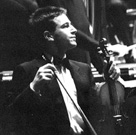

CBS Photo
Remembering Daniel Pearl in Prayer

By
DANIEL PEARL
Staff Reporter of THE
WALL STREET JOURNAL
(From the Wall Street Journal Archive: Oct. 17,
1994 article by Daniel Pearl)
STRADIVARIUS VIOLIN,
LOST YEARS AGO, RESURFACES BUT NEW OWNER PLAYS COY
LOS ANGELES -- David Margetts still
doesn't know if he left the borrowed Stradivarius on the roof of
his car and drove off, or if it was stolen from the unlocked
vehicle while he bought groceries.
That was in August 1967. Mr.
Margetts, then a second violinist with a string quartet at the
University of California at Los Angeles, sent notices to pawn
shops and violin stores and took out classified ads. He spent the
next 27 years worrying that the "Duke of Alcantara"
Stradivarius, made in 1732, was gone forever.
It wasn't. Officials of UCLA, to
which the instrument had been donated, say the same violin
reappeared this January. But the tale doesn't end there.
University officials have discovered that once somebody is
smitten with the love of a Stradivarius, taking it away is like
wresting a baby from its mother's arms.
Antonio Stradivari of Cremona,
Italy, made about 1,200 violins, half of which still survive.
After his death in 1737, factories churned out hundreds of
thousands of copies. And every day, people bring violins with
Stradivarius labels to appraisers, thinking they have bought the
genuine article for a song. To break the bad news to such
would-be millionaires, Los Angeles violin dealer Robert Cauer
shows them a 1909 Sears Roebuck catalog advertising a
Stradivarius copy for $1.95.
But Joseph Grubaugh, a violin dealer
in Petaluma, Calif., says that when a violin teacher showed him a
student's instrument bearing a Stradivarius label one day in
January, he thought he was looking at the real thing. The slight
ruggedness of the scroll, the spontaneity of the
"purfling" and the "ropiness" of the Bosnian
maple backside suggested that only the Italian master could have
made the instrument.
He opened his copy of the
Iconography of Antonio Stradivari and found a photograph of a
violin with similar scratch marks on the back. It was the Duke of
Alcantara. A bigger shock came a week later when the violin
teacher picked up the repaired fiddle. Mr. Grubaugh flipped
through a violin registry and saw the instrument listed as stolen
from UCLA.
The student was amateur violinist
Teresa Salvato, who says she got the violin as part of a divorce
settlement last year. She says her husband received the violin
around 1979 from his aunt, who helped run a music store and kept
the double-violin case in a closet for years before her death.
(The case also contained another violin that had been reported as
missing at the same time.) Where the aunt got the violin case
isn't known, Ms. Salvato says, but one piece of family lore had
her picking it up beside a freeway on-ramp after mistaking the
canvas-covered case for a baby.
Ms. Salvato contacted UCLA, but over
the next 10 months declined the university's pleas to surrender
the violin. Also, Ms. Salvato didn't appreciate the unannounced
visit to her home in May by two campus police officers who, she
says, threatened to arrest her and told neighbors she was a theft
suspect. When they reappeared last week to serve civil court
papers, Ms. Salvato wouldn't leave her locked car. She now is
staying in a hotel.
And the Alcantara is in hiding. UCLA
lawyers tried to get an injunction Friday in Superior Court in
Los Angeles to force Ms. Salvato to disclose the location.
Instead, university officials settled for Ms. Salvato's offer to
bring the violin today to a museum, where it will stay unplayed
while the court decides who owns it.
All the fuss is over a violin that
by one estimate is valued at $800,000 -- a quarter of what the
best Strads fetch. Antonio Stradivari would have been 88 years
old when he built the Alcantara, and his sons Omobono and
Francesco probably cut the F-holes. Experts who have seen the
violin say its varnish was later touched up clumsily.
Besides, the violin wasn't played by
anybody famous, unless one counts the concertmaster of the
Detroit Symphony. The original owner was an obscure Spanish
nobleman described in archives only as an "aide-de-camp of
King Don Carlos, assassinated in Lisbon," according to
Charles Beare, a Stradivarius expert and dealer in London.
Still, even a mediocre Stradivarius
can be inspirational. Violinist W. Thomas Marrocco, who played
the Alcantara in the 1960s, wrote a novel whose main character
was the violin. Of the Alcantara, he says: "It's sweet, it's
mellow, it's strong, it responds to every notion one has."
Violinists can have sticky fingers
with such instruments. One New York violinist waited until he was
on his deathbed in 1985 to reveal that the instrument he played
for years was a Stradivarius stolen from Carnegie Hall nearly a
half-century earlier. And David Sarser is losing hope of playing
another Bach partita on his 1735 "ex-Zimbalist"
Stradivarius, which disappeared three decades ago. Mr. Sarser
says the violin has been photographed in Japan, but nobody will
tell him who has it. "I have no desire to play any other
instrument," he says. "It became part of me, and I
became part of it."
Ms. Salvato played her mystery
violin for the first time in January. It was
"heavenly," she says, "smooth and gorgeous."
It even helped her play in tune. "There are things I can't
do on the violin, but I can execute them on that violin,"
she said.
During a recent telephone
conversation with Robert Portillo, a musical curator for UCLA,
Ms. Salvato asked if less-accomplished musicians might be allowed
to play the violin. And she wondered "if there is any
possible legal way I could keep it."
There isn't, says Carla Shapreau, a
violin maker and lawyer retained by the university. If the Duke
of Alcantara was stolen, "You can't get good title from a
thief," and if it was found, the finder would have had to
try to locate the owner.
But Ms. Salvato notes in a court
filing that she wasn't the finder, and that several lawyers have
told her she might have a claim to the violin. Attorney Allen
Hyman, who represented her in Friday's hearing, said later that
the violin could have been stolen centuries before UCLA ever got
it.
"Can they trace it back to the
Duke?" he asked with a grin. "Maybe we have to get in
touch with the Duke's relatives."
Ms. Salvato insists she only wants
what is right for the instrument. The university "lost it
once," she says. "They're really not careful."
Mr. Portillo -- who complains that
Ms. Salvato is taking the university "for a ride" --
says UCLA will be extremely mindful of the instrument if it is
returned. One faculty member who is likely to play it is
Alexander Treger, concertmaster of the Los Angeles Philharmonic
Orchestra, who already plays an orchestra-owned 1711
Stradivarius. On tour, Mr. Treger says, "I don't leave the
violin even if I have to go to the bathroom."
Updated
October 17, 1994 11:59 p.m. EST

THE DANIEL PEARL TRUST AND DANIEL PEARL FOUNDATION

Madeline
Felkins: Rocketdyne/Boeing Contamination News
Violin and Piano Instruction: Artist Development
Please Contact [email protected] Regarding Lessons