
Throughout Macbeth, Shakespeare uses animal imagery for three main reasons: to characterize, to show emotions, and to foreshadow.
"... As sparrows, eagles, or the hare, the lion." (Act 1, Scene 2, Line 39).
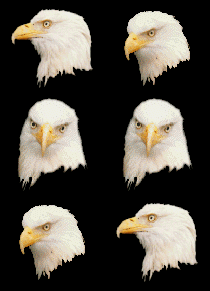 Here, the soldier is speaking of Macbeth and Banquo. Just as an eagle easily defeats the sparrow or the lion easily defeats the hare, Macbeth and Banquo defeat their opponents. This shows
how fierce Macbeth and Banquo really are. The lion and the eagle are fierce animals, whereas the sparrow and the hare are very weak and can be easily killed.
Here, the soldier is speaking of Macbeth and Banquo. Just as an eagle easily defeats the sparrow or the lion easily defeats the hare, Macbeth and Banquo defeat their opponents. This shows
how fierce Macbeth and Banquo really are. The lion and the eagle are fierce animals, whereas the sparrow and the hare are very weak and can be easily killed.
"I come, Graymalkin. Paddock calls; --anon." (Act 1, Scene 1, Lines 11-12). Graymalkin is a cat and Paddock is a toad. This shows the witches are ones who believe in evil spirits, and that they have foretelling knowledge. Shakespeare uses a cat as a spirit, as cats are significant to witches. The toad portrays the witches' ugliness.
 "What, all my pretty chickens and their dam At one fell swoop?" (Act 4, Scene 3, Lines 255-226).
Here, Macduff has just found out that his family has been murdered. Shakespeare uses chickens because they are vulnerable, helpless, skittish and easily frightened. This makes the audience feel sorry, almost helpless towards Macduff's family. By using chickens, we feel how helpless they must have been and how scared they really were.
"What, all my pretty chickens and their dam At one fell swoop?" (Act 4, Scene 3, Lines 255-226).
Here, Macduff has just found out that his family has been murdered. Shakespeare uses chickens because they are vulnerable, helpless, skittish and easily frightened. This makes the audience feel sorry, almost helpless towards Macduff's family. By using chickens, we feel how helpless they must have been and how scared they really were.
"Throw physic to the dogs, I'll none of it." (Act 5, Scene 3, Line 55).
 Shakespeare is referring to throwing medical science to the dogs. He doesn't want anything to do with medical science because the doctor just said that he cannot cure Lady Macbeth, because, she's not physically sick, but instead, menatally ill. Shakespeare refers to throwing physic to the dogs because wants to evoke a sense of frustration from Macbeth over the condition of Lady Macbeth.
"They have tied me to a stake; I cannot fly, But bear-like I must fight the course." (Act 5, Scene 7, Lines 1-2).
This is metaphor refers to a popular sport, bear-baiting. Macbeth realizes that he is trapped, but feels that if he fights it out to the  end of the 'course' he might triumph. In his mind, there is a hope that he will somehow escape because he doesn't believe that
the final prophecy could come true.Although he doubts the last prophecy, there is still the feeling that he is tied to a stake,
like a bear, just waiting to be attacked, waiting for the end of the match. This makes the audience feel for Macbeth because just as anyone hates to see an animal trapped, they feel this for Macbeth. Although it appears that he deserves to die, there is still a sense of remorse.
end of the 'course' he might triumph. In his mind, there is a hope that he will somehow escape because he doesn't believe that
the final prophecy could come true.Although he doubts the last prophecy, there is still the feeling that he is tied to a stake,
like a bear, just waiting to be attacked, waiting for the end of the match. This makes the audience feel for Macbeth because just as anyone hates to see an animal trapped, they feel this for Macbeth. Although it appears that he deserves to die, there is still a sense of remorse.
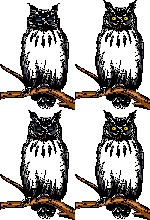 "A falcon tow'ring in her pride of place, Was by a mousing owl hawk'd at and kill'd." (Act 2, Scene 4, Lines 14-15).
 "And Duncan's horses ... Turn'd wild in nature, broke their stalls, flung out, Contending with obedience ..." (Act 2, Scene 4, Lines 16-20).
These two quotes describe the unnatural events that occurred the night of Duncan's murder. It is very unnatural for an owl to kill a falcon, and for horses to be cannibalistic. These unnatural happenings not only echo the tragedy of Duncan's unnatural death, but also foreshadows the downfall of the Macbeths.
"And Duncan's horses ... Turn'd wild in nature, broke their stalls, flung out, Contending with obedience ..." (Act 2, Scene 4, Lines 16-20).
These two quotes describe the unnatural events that occurred the night of Duncan's murder. It is very unnatural for an owl to kill a falcon, and for horses to be cannibalistic. These unnatural happenings not only echo the tragedy of Duncan's unnatural death, but also foreshadows the downfall of the Macbeths.
"The most diminutive of birds, will fight, / Her young ones in her nest, against the owl." (Act 4, Scene 2, Lines 12-13). This foreshadows the fate of Lady Macduff and her children. She speaks of how even the small or weak birds will fight against any predator to protect its young ones. Lady Macduff and her children are being portrayed as small, defenseless animals. This forshadows the fact that they do not stand a chance when up against any form of enemy.
Act ONE Scene THREE:
Lady Macbeth: "The raven himself is hoarse that croaks the fatal entrance of Duncan"
Lady Macbeth: "Look like the innocent flower but the serpent under't"
Banquo: "but this bird hath made his pendent bed and procreant cradle"
Lady Macbeth: "Idare not wait upon i would, like the poor cat i' the adage?" 
Act TWO Scene TWO:
Lady Macbeth: "it was the owl that shrieked, the fatal bellman"
Lady Macbeth: "I heard the owl scream and the crickets cry"
Scene THREE:
Lennox: "the obscure bird clamored the livelong night"
Scene FOUR:
Old Man: "a falcon towering in her pride of place was a mousing owl hawked and killed"
Act THREE Scene ONE:
Macbeth: "as hounds and greyhounds mogrels spaniels cures shoughs water rugs and demiwolves are clept all by the name of dogs"
Scene TWO:
Macbeth: "we have scotched the snake, not killed it"; Macbeth: "oh, full of scorpions is my mind, dear wife!"
Macbeth: "ere the bat hath flown his cloistered flight ere to black Hecate's summons the shard-borne beetle with his drowsy hums"
Macbeth: "light thickens, and the crow makes wing to the rooky wood"
Scene FOUR:
Macbeth: "there the grown serpent lies"
Macbeth: "approach thou like the rugged Russian bear, the armed rhinoceros, or the Hyrcan tiger"
Act FOUR, Scene ONE:
Third apparition: "be lion-mettled, proud and take no care"
Scene TWO
Lady Macduff: "for the poor wren, the most diminutive of birds, will flight, her young ones in her nest, against the owl"
Son: "As birds do mother"
Lady Macduff: "what with worms and flies"
Scene THREE:
Malcom: "to offer up a weak, poor, innocent lamb to appease an angry god"
Macduff: "There cannot be that vulture in you to devour so many as will to greatness themselves finding it so inclined"
Ross: "were, on the quarry of these murded deer, to add the death of you"
Macduff: "what, all my pretty chickens and their dam at one fell swoop?"
Act FIVE Scene THREE:
Macbeth: "where got'st thou that goose look?"
Macbeth: "throw physic to the dogs, I'll none of it"
Scene SEVEN:
Macbeth: "But bearlike I must fight the course"
|
|
|
|
|
|
|