|
The purpose of maneuvering during slow flight is to help you develop a feel for the airplane's controls at slow airspeeds, as well as gain an understanding of how load factor, pitch attitude, airspeed, and altitude control relate to each other. The speed used for slow flight, 1.2Vs1, is sufficiently slow so that any significant reduction in speed or power, or increase in load factor, results in stall indications.
While in slow flight, any change in flight attitude, such as a level turn or increase in pitch attitude, increases the airplane's load factor, as well as its stall speed. Since the airspeed is just above a stall speed during slow flight, any maneuvering should be accompanied by a corresponding change in power to prevent the aircraft from stalling. Coordinated flight is essential throught all slow flight maneuvers. Before begining a slow flight maneuver, you should do a clearing turn to check for traffic. You may either execute one 180° turn or two 90° turns in opposite directions. Start the maneuver at an altitude which will allow you to recover no lower than 1,500 feet AGL. It is a good idea to select an entry altitude and heading which can be easily read on your instruments, such as 3,500 feet and 090°. |
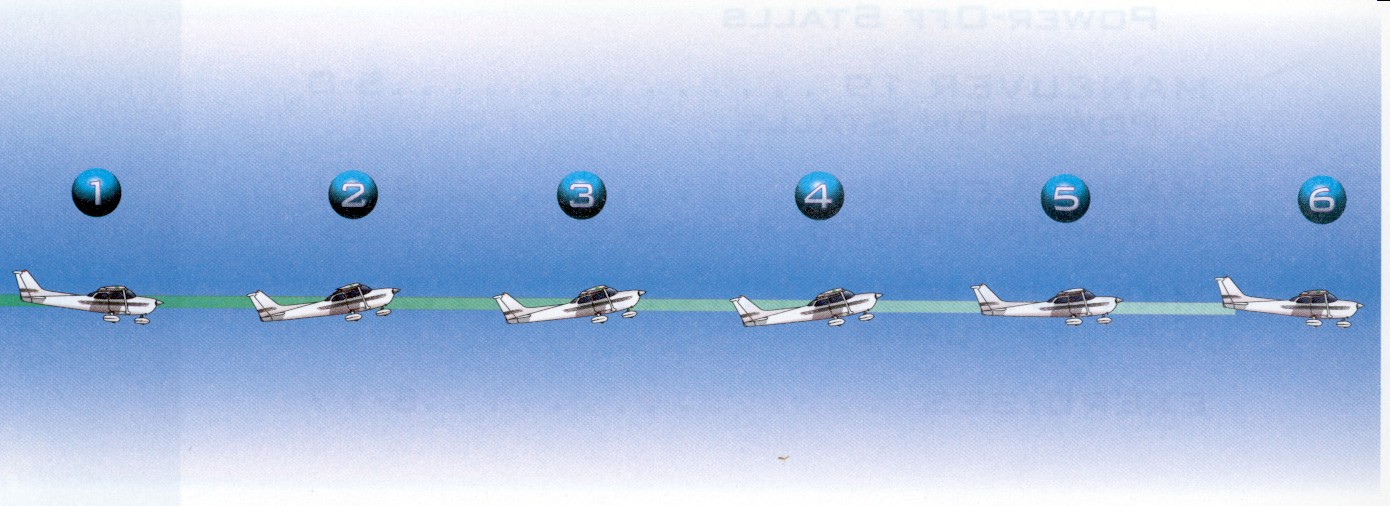
1 |
Upon completion of your clearing turns, apply carburetor heat (if applicable), reduce power, and gradually apply back pressure on the yoke to maintain altitude. As airspeed decreases, maintain coordinated flight with increasing right rudder. Trim to relieve control pressures. |
2 |
As the airplane reaches the maximum airspeed for flap operation, lower full flaps in increments. As the flaps extend, adjust pitch attitude and power to maintain altitude. Extend the landing gear (if applicable) as you reach Vle. Trim to relieve control pressures after each configuration change. |
| To maintain coordinated flight, use right rudder to offset the left-turning tendencies associated with the low-airspeed, high-power flight regime. |
3 |
Upon reaching your desired airspeed, increase power to maintain altitude and airspeed. Trim to relieve control pressures. |
| Once established in slow flight, you primarily maintain airspeed and altitude by making small power adjustments as necessary. To maintain the proper pitch attitude, you should divide your attention between outside references and instrument indications. The correct procedure for regaining lost altitude is to apply power. When you do this, it will also be necessary to make a small increase in pitch attitude to maintain the desired airspeed. To lose altitude, reduce power and, at the same time, reduce pitch attitude slightly. |
4 |
Once the airplane is stabilized, perform turns, climbs (if possible), and descents as directed by your instructor. To climb, you must coordinate a pitch and power increase to maintain airspeed. Correspondingly, a descent requires a coordinated pitch and power decrease to maintain airspeed. The shallow turns you execute during slow flight will require you to add power to maintain airspeed and avoid a stall. |
| When you are maneuvering during slow flight, you will get a sensation of insufficient control response. The controls feel mushy, and it is necessary to use greater control movements for corrections than are normally required. |
5 |
When directed by your instructor, set the carburetor heat to COLD (if applicable) and add full power to return to cruise flight. While maintianing your heading and altitude, raise the flaps slowly in increments. Also, raise the landing gear (if applicable). As the airplane accelerates, lower the nose attitude and anticipate the need for less right rudder to maintain coordinated flight. |
6 |
As you reach your desired airspeed, reduce power and trim to relieve control pressures. |
PTS Requirements |
|
Exhibit knowledge of the elements related to maneuvering during slow flight. Select an entry altitude for the maneuver that allows completion no lower than 1,500 feet AGL or the recommended altitude, whichever is higher. Stabilize the airspeed at 1.2 Vs1, +10/-5 knots. Demonstrate straight-and-level flight, and level turns at specific bank angles and configurations as specified by the examiner. Demonstrate coordinated climbs and descents, in both straight and turning flight, in configurations and bank angles specified by the examiner. Divide your attention between airplane control and orientation. Maintain a specified altitude, +100 feet, specified heading +10°, and a specified airspeed, +10/-5 knots. Maintain a specified angel of bank, not to exceed 30° in level flight, +0/-10°. Maintain a specified angle of bank, not to exceed 20°, in climbing or descending flight, +0/-10°. Roll out on a specified heading, +10°. Level off from climbs and descents, +100 feet.
|