
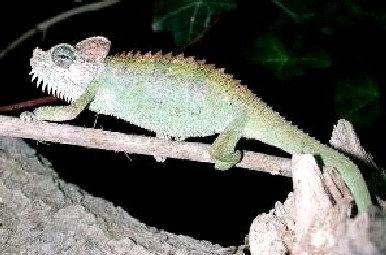
 Family: Chamaeleonidae
Common Name: High-casqued Chameleon
Scientific Name: Trioceros hoehnelii
Food: Insects
Distribution: Kenya (Laikipia, 6000 ft alt.), Uganda (Mt. Elgon)
Habitat:
Color Discription:
Physical Discription: This is a small species bearing a high casque with no occipital lobes. Rostral crests converge above the mouth tip into a round horn. Dorsal crest consists of 15 groups of 3 - 5 conical scales dominated by 1 large conical scale. Small, medium and large body scales, with the large scales making 2 or more visible, lengthwise stripes. Females are typically smaller in size, have a less developed casque, rostrals, dorsal crest, and smoother scalation. However, some females are as large, or even larger, in size than the males, with well developed casques, rostrals, and crests. Males show prominent hemipenal bulges at the base of the tail.
Size: 7" - 10"
Temperatures/Humidity: Temperatures should be kept no higher than 95º F during the day. There should be a dramatic temperature drop at night. A night - time cool down of 40º F is ideal. In their natural habitat, Trioceros hoehnelii are known to survive nights down to 32º F and even slightly lower. The species can tolerate slightly higher temps for a short period of time if the humidity is high and good ventilation is provided; but not for extended periods. Heat should be only provided by a hot spot; the rest of the environment should stay cooler. Humidity should be maintained at 80 - 100%.
Breeding/Reproduction: Depending on size and maturity, bear between 4 - 22 live babies. Gestation is approximately 150 days and females may give birth 2 times a year.
Cage Setup: Males are very aggressive towards other males and similar looking species. While this species should be housed singly in standard cages, some have kept them in pairs or even in 1 - 2 groups but only within very large enclosures. Pregnant females should be kept alone.
Water: Hydration requirements are high and water is best accepted by simulating warm rainfall, as well as from a drip system.
Special Needs: Trioceros hoehnelii has a high UV requirement, and natural sunlight is beneficial.
Special Note: