| Punch and Judy: |
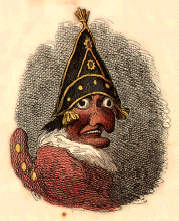
| Italian Pulcinella, hooknosed, humpbacked character, the most popular of marionettes and glove puppets and the chief figure in the Punch-and-Judy puppet show. Brutal, vindictive, and deceitful, he is usually at odds with authority. His character had roots in the Roman clown and the comic country bumpkin. More modern origins can be traced to Pulcinella, a character who appeared in the Italian commedia dell'arte in the 17th century. It is not certain who was the first Pulcinella, although claims have been made on behalf of Silvio Fiorillo, a professional comedian who was performing at the beginning of the 17th century. In early pictorial representations, he is depicted as large, shambling, and stupid-looking, dressed in a loose white shirt and very full trousers. The Italian actors soon began to travel throughout Europe, bringing with them the puppet showmen. Polichinelle, the French adaptation of the character Pulcinella, became firmly established in France by the middle of the 17th century. The origin of the grotesque, humpbacked, and hooknosed marionette Polichinelle may have resulted from a fusion of the Italian character Pulcinella with an earlier French tradition of humpbacked fools. A similar tradition of the humpbacked fool existed in England when the first Italian puppeteers arrived after the restoration of Charles II in 1660. Two years later, the first references to Punchinello, soon shortened to Punch, appeared in the writings of the English diarist Samuel Pepys. By 1700 practically every puppet show in England featured Punch, and his wife, Judy, originally called Joan, was also a well-known figure. Traveling showmen carried these plays to country wakes (festivals) in the summer and visited London for the fairs in August and September. Early in the 18th century Punch became famous in political circles through the use of the name by Martin Powell, a marionette showman, in a scurrilous attack on Robert Harley entitled A Second Tale of a Tub (1715). In the 1790s the marionettes lost their popularity at the fairs. There was, however, a new interest in the humbler glove puppets, and in this form the Punch-and-Judy play became a success. Plots varied, but the hooked nose, the humped back, the tendency to wife beating and outrageous lawlessness typical of the English Punch were established characteristics by the 19th century. In England in the second half of the 20th century, more than 50 professional puppeteers carried on the vigorous tradition of Punch's humour. His influence survives in such common phrases as �pleased as Punch.� ~Encyclopedia Britannica |
 |
 |