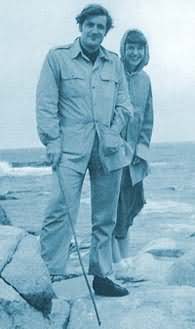
| Poet Sylvia Plath, born in Boston, Massachusetts (1932). Her father was a German-born professor of biology who specialized in bees. His health began to decline when Plath was a baby, but he refused to see a doctor because he was terrified that he might have cancer. He finally collapsed in 1940, and it turned out he had diabetes. He died that same year, when Plath was eight years old. Her family moved inland from the coast, and she always associated the loss of her father with the loss of the sea. She wrote, "Those first years of my life sealed themselves off like a ship in a bottle�beautiful, inaccessible, obsolete, a fine, white flying myth." In school, she became a straight-A student, got into Smith on a scholarship and won all the prizes for writing contests. She was beautiful and outgoing, and she wrote cheerful letters home to her mother about all her successes. At the same time, she started keeping a journal about her growing mood swings. She wrote, "It is as if my life were magically run by two electric currents: joyous positive and despairing negative�whichever is running at the moment dominates my life, floods it." Plath spent the summer of 1953 working as a guest editor for the college issue of Mademoiselle magazine, and she found the competition among the other ambitious young women exhausting. That August, while staying at her mother's house, she took forty sleeping pills, and crawled into the cellar. Her brother found her two days later, when he heard her moaning through the floorboards. She survived, spent time in a mental hospital, and then went back to Smith and graduated summa cum laude. She went to England, and it was there that she met her future husband, the poet Ted Hughes. She spent the years of their marriage helping support his career�typing his manuscripts and writing letters to editors for him. He encouraged her to write her own poetry, but she didn't have much time after caring for the children and working part-time as a teacher. When she published her first book of poems, The Colossus (1960), it got mixed reviews, and she fell into despair at the idea that she would never amount to anything. Her behavior grew increasingly erratic, and one day Hughes found that she had destroyed the manuscripts of his recent poems. Her marriage with Hughes broke up in 1962. Living alone with her two children, she wrote every morning from 4:00 AM until the children woke up. She'd always been a slow, painstaking writer, but in the fall of 1962 she began to write furiously, in a kind of nursery rhyme style, finishing one or two poems every day. At the end of October, during which she had finished thirty new poems, she wrote to her mother, "I am writing the best poems of my life; they will make my name." That winter in England was one of the coldest on record, and Plath kept coming down with fevers. She sent her new poems out for publication, but the editors of various magazines rejected them as too strange and disturbing. On the morning of Febuary 11, she got up and sealed her children's bedroom door with tape. Then she sealed herself in the kitchen, stuffed a towel under the door, opened the oven and turned on the gas, killing herself. A collection of her late poems, including "Daddy" and "Lady Lazarus," was published as Ariel in 1965, and it became the model for a new kind of confessional poetry. When her Collected Poems was published in 1981, it won the Pulitzer Prize. ~The Writer's Almanac |
 |
 |