| Oscar Wilde, born Oscar Fingal O'Flahertie Wills Wilde, in Dublin (1854). He's the author of the plays Lady Windermere's Fan (1893), A Woman of No Importance (1893), and The Importance of Being Earnest (1895); and he's one of the most quotable authors in the English language.
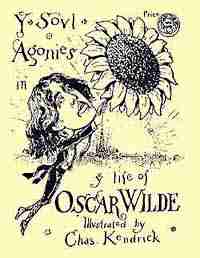
His mother was a famous poet, journalist and Irish nationalist; and his father was a noted ear and eye doctor. He went to college at Oxford, where he began affecting an aristocratic English accent and dressing in eccentric suits and velvet knee breeches. He stayed in England after college, and made a name for himself as a brilliant conversationalist in the high society of London. A movement in art and literature called Aestheticism was becoming popular at the time, and Wilde became known as one of its leading spokesmen. The movement's motto was "Art for art's sake." Wilde began lecturing on the importance of art and beauty in people's everyday lives. He said, "We spend our days looking for the secret of life. Well, the secret of life is art." And he said, "Even a colour-sense is more important, in the development of the individual, than a sense of right and wrong." He worked for a women's magazine, and he wrote essays, stories, and plays. But he didn't become well known as a serious writer until he came out with his first and only novel, The Picture of Dorian Gray, in 1891, about a beautiful young man who remains young while a portrait of him grows old. Wilde then burst upon the British theater scene with four consecutive comedy hits: Lady Windermere's Fan (1893), A Woman of No Importance (1893), An Ideal Husband (1895), and The Importance of Being Earnest (1895). Wilde attended the opening of Lady Windermere's Fan wearing a green carnation in his suit. After the final curtain went down and the crowd erupted in applause, Wilde came out on stage and said: "Ladies and gentlemen: I have enjoyed this evening immensely. The actors have given us a charming rendering of a delightful play, and your appreciation has been most intelligent. I congratulate you on a great success of your performance, which persuades me that you think almost as highly of the play as I do myself." Wilde was married and had two children, but he was never completely comfortable with family life. He experimented with homosexuality, and fell in love with a young poet from Oxford named Lord Alfred Douglas. Eventually, Wilde was charged with sodomy and went to trial. He was found guilty, and sentenced to two years in prison. On the last day of the trial, Wilde wrote to Lord Douglas, "This is to assure you of my immortal, my eternal love for you. Tomorrow all will be over. . . . Your love has broad wings and is strong, your love comes to me through my prison bars and comforts me, your love is the light of all my hours." Wilde was released from prison in 1897, and died three years later, in a cheap hotel in Paris. Oscar Wilde wrote: "It is only shallow people who do not judge by appearances." " The only way to get rid of a temptation is to yield to it." " It is absurd to divide people into good and bad. People are either charming or tedious." "Experience is the name everyone gives to their mistakes." "Nowadays most people die of a sort of creeping common sense, and discover when it is too late that the only things one never regrets are one's mistakes." ~Writer's Almanac aestheticism: Devotion to and pursuit of the beautiful; sensitivity to artistic beauty and refined taste. 2. The doctrine that beauty is the basic principle from which all other principles, especially moral ones, are derived. |
| Wilde at Heart |
 |
 |