| Wilcox, Ella Wheeler (1850 - 1919)
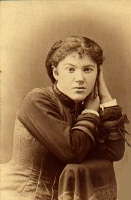
American poet Ella Wheeler Wilcox was probably the best-known poet of her day, writing verses that appeared in more than 250 newspapers across the United States. Ella Wheeler was born in Johnstown Center, Wisconsin, and claimed that she was a descendant of Princess Pocahontas. Encouraged by her mother, she began composing verses even before she could write. By the age of seven Ella was a "professional" poet, having received payment for her poems from the publishers of the magazines in which they appeared. She continued to versify prolifically for the rest of her life, producing at least one or two poems every day, and was soon able to support her family on her income. In 1884 she married the journalist Robert M. Wilcox. The couple travelled widely, using their wealth to indulge their passion for collecting: she collected dolls and necklaces, and he collected musical instruments. Ella also made several visits to Britain, where she had almost as many fans as in the United States; her hard work there during World War I may have contributed to her death from nervous exhaustion. Wilcox's verses were first published in book form in the collection Drops of Water (1872). A later volume, Poems of Passion (1883), contained some mildly erotic verses that were condemned by the church but did nothing to affect her popularity. Her simple sentimental poetry, with its message of hope and comfort and OPTIMISM, touched the hearts of readers of all ages and classes, though it failed to impress the literary critics. Wilcox also wrote novels, short stories, essays, and two autobiographical works: Story of a Literary Career (1905) and The World and I (1918). |
 |
| Will
THERE is no chance, no destiny, no fate, Can circumvent or hinder or control The firm resolve of a determined soul. Gifts count for nothing; will alone is great; All things give way before it, soon or late. What obstacle can stay the mighty force Of the sea-seeking river in its course, Or cause the ascending orb of day to wait? Each well-born soul must win what it deserves. Let the fool prate of luck. The fortunate Is he whose earnest purpose never swerves, Whose slightest action or inaction serves The one great aim. Why, even Death stands still, And waits an hour sometimes for such a will. |
 |
| Laugh, and the world laughs with you, weep, and you weep alone. "Solitude" |