|
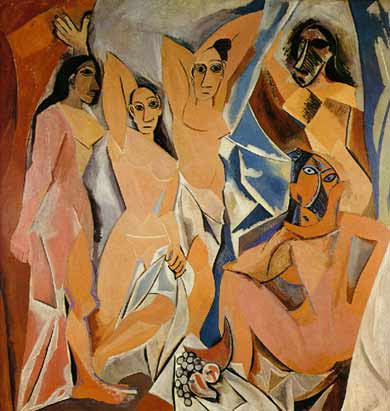
Pablo Picasso, born in Malaga, on Spain's south coast (1881). He didn't like school when he was a boy, except for art class. He painted his first oil painting when he was nine years old. It was a picture of a bull ring, inspired by the bullfights he often attended with his dad. Picasso went to art school in Barcelona and Madrid and eventually settled in Paris. He met people in the art world who supported him for a time until he made a name for himself with his "blue paintings," a series of blue-hued paintings depicting dying clowns and acrobats. He did sculpture and drawings and lithographs, water color, ceramics, mosaics, etchings, and oils. He did still-lifes and landscapes and nudes. Along with Georges Braque, he invented the style of painting called Cubism, which broke up objects into fragments represented from different perspectives. Some say Picasso invented collage when he attached a real piece of imitation chair caning to a still life. Andr� Malraux called Picasso "the archwizard of modern art." He painted more than 6,000 pictures in his lifetime. He became very famous and rich, partly because he was a good bargainer and smart with money. He knew not to flood the market with his paintings, so he only released about 40 a year, and hoarded the rest in private studios and his various homes. He also gave several paintings to charity, and to old friends and lovers.
Picasso had trouble getting out of bed in the morning, and usually spent the afternoon conversing with friends. It was at night that he did most of his work, usually in the dark, except for two spotlights shining directly on his canvass. He didn't use a palate�he just had the cans of paint sitting on the floor, and he would dip the brushes right in and then wipe the excess off on newspapers. He stood up while he painted, often for three or four hours at a time. Then once in awhile he'd take an hour off to go sit on the other end of the room in a wicker armchair and stare at his painting, analyzing his work.
Picasso was quicksilver, constantly experimenting. His name in the popular mind, however, stands for a kind of perverse distortion of the figure and for fragmentation, as in his powerful GUERNICA. A Picasso seems deliberately misshapen and angular.
~ The Writer's Almanac
Cubism: A movement in modern art that emphasized the geometrical depiction of natural forms. Pablo Picasso was one of the leading cubists |
|