
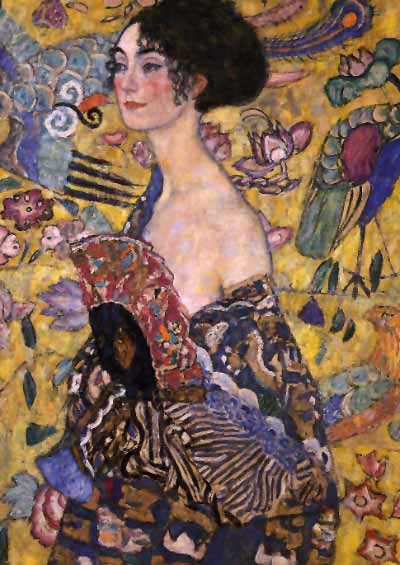
From the age of fourteen to twenty he studied at the School of Plastic Art in Vienna. From the age of eighteen, he, his brother Ernst and Franz Matsch undertook commissions for decorative works. In 1897 he became the first President of the Vienna Sezession. Influenced first by Makart, he turned away from him after a trip to Vienna where he discovered Byzantine mosaics. In 1912, he withdrew from the Sezession and became President of the Austrian National Union of Artists. In 1917, he was granted an honorary professorship at the Viennese Academy.
From his early works, Klimt caused uproar. His works were frequently taken down; the Nazis burnt some of them. His technique is fairly classical, but his subjects were scandalous; naked girls mingle with skeletons, sexuality expressed in all its forms. Ornament is all-pervasive in his work; from this background the bodies struggle to the surface. He was witness to the decadence of an entire society and the fantastic world that his paintings occupy testify to this by their collection of sex and death, while the audacity and freedom of his graphic style foreshadow modern art.
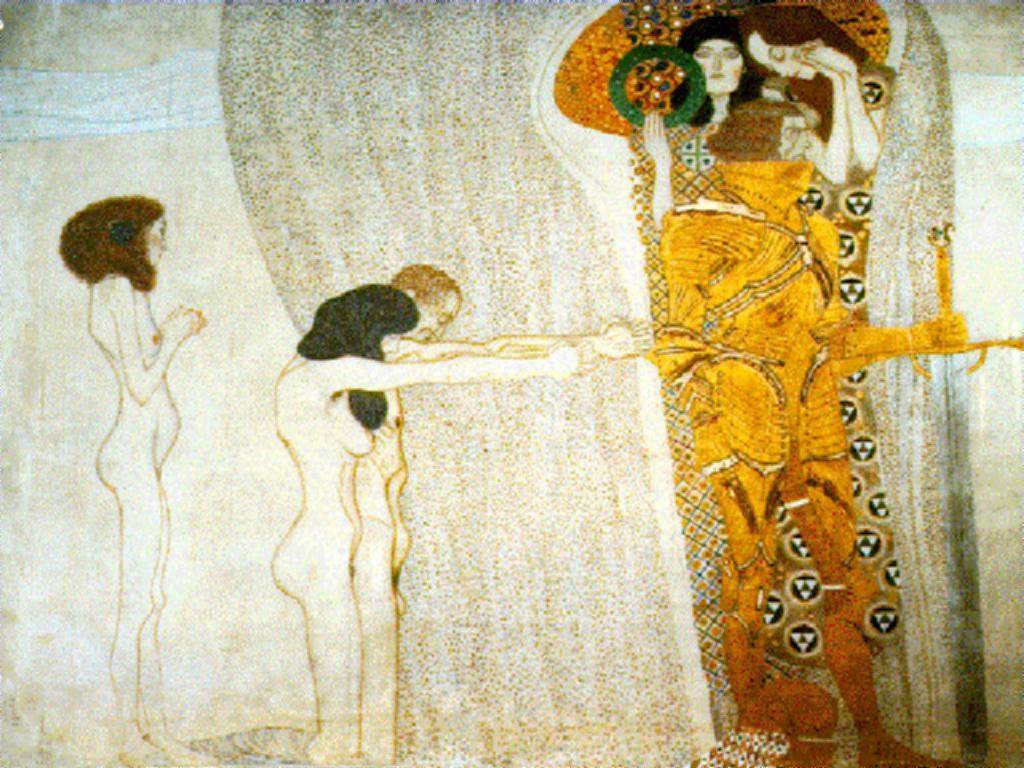
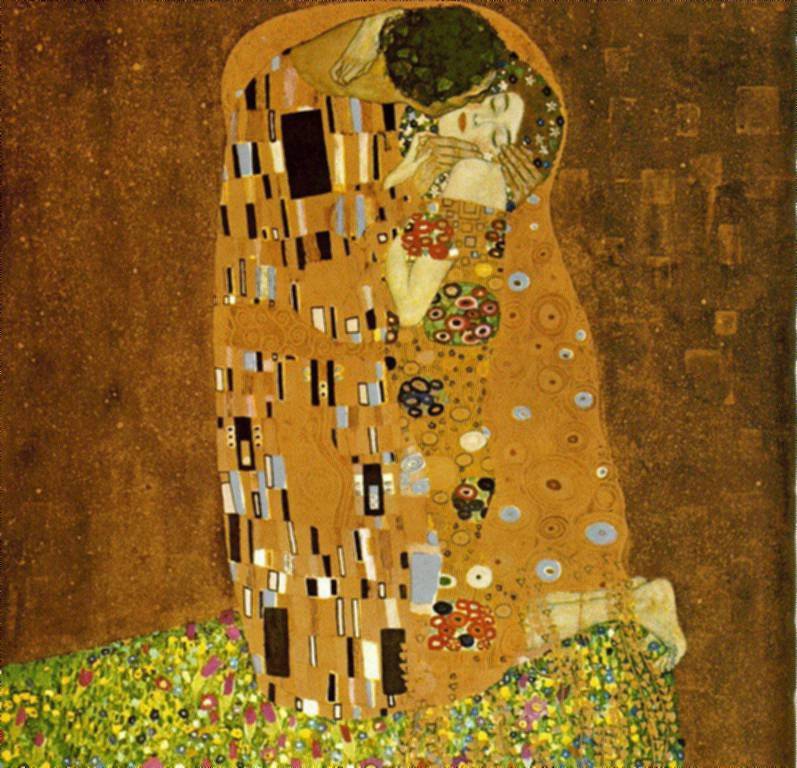
The three allegorical murals Klimt painted for the ceiling of the University of Vienna auditorium were greatly criticized. The erotic symbolism and pessimism of these works created such a scandal that the murals were rejected. His later murals, the Beethoven Frieze (1902) and the murals (1909�11) in the dining room of the Stoclet House in Brussels, are characterized by precisely linear drawing and the bold and arbitrary use of flat, decorative patterns of color and gold leaf. Klimt's most successful works include The Kiss (1908) and a series of portraits he did of fashionable Viennese matrons, such as Frau Fritza Riedler (1906) and Frau Adele Bloch-Bauer (1907). In these works he treats the human figure without shadow and heightens the skin by surrounding it with areas of flat, highly ornamental, and brilliantly composed areas of decoration. Klimt died on Feb. 6, 1918, in Vienna.
Klimt's style drew upon an enormous range of sources: classical Greek, Byzantine, Egyptian, and Minoan art; late-medieval painting and the woodcuts of Albrecht D�rer; photography and the symbolist art of Max Klinger; and the work of both Franz von Stuck and Fernand Khnopff. In synthesizing these diverse sources, Klimt's art achieved both individuality and extreme elegance.
