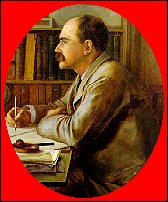
| Rudyard Kipling was born in Bombay, India (1865). He's the author of Kim (1901) and The Jungle Book (1894), and he was the first British writer to win the Nobel Prize for Literature. He was educated in England, but then he returned to India to work as a newspaper reporter, writing stories about British colonial society. He supplied filler and verse to go in the dead spaces between the stories, and it was collected in Departmental Ditties (1886) and Plain Tales from the Hills (1888). The books made him famous in Britain well before he returned there to live. His reputation grew, and he was nominated for many honors, including Poet Laureate. He declined this post, and many others, but he often wrote as if he were the national poet of England, exhorting his countrymen to uphold the Empire. He wrote "Take up the White Man's burden� / Send forth the best ye breed / Go bind your sons to exile / To serve your captives' need. ..." ~Writer's Almanac "White Man's Burden,The" The title of one of Rudyard Kipling's poems. Addressed to the American people as the United States assumed control of the Phillipines at the end of the Spanish-American War, it is a ringing justification for colonization, British-and continental-style, at the end of the 19th and the beginning of the 20th centuries. It declares the whites as a superior race whose moral duty it is to uplift the inferior races, provide paternalistic care for "your new-caught sullen peoples". The point of view was especially popular during the later years of Queen Victoria's reign when the Sun never set on the British Empire. Here it is in Kipling's words: Take up the White Man's burden Send forth the best you breed. Go blind your sons to exile To serve the captive's needs. Today, imperialism has been discredited and the white man's burden is regarded as outmoded racism and elitism. The phrase is used pejoratively to suggest the presence or persistence of a distasteful, unworkable ideology. ~Facts on File Dictionary of Historical and Cultural Allusions. |
 |
 |