 |
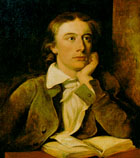
| English poet John Keats, born in London (1795). Keats's short life was marked by the deaths of friends and family members. His father died when he was nine, and one year later his grandfather died. When he was fifteen, his mother died of tuberculosis, the disease that eventually killed his brother and, later, Keats himself. Keats said he felt "a personal soreness which the world has exacerbated." He began writing poetry after he had started his career as an apothecary in London. His first book, Poems (1817), was not well received. His publishers dropped him, but other poets saw promise in his work. His breakthrough poem was a sonnet called "On first looking into Chapman's Homer." Keats had stayed up all night reading George Chapman's translations of the Iliad and the Odyssey with a friend. They stopped reading at 6:00 A.M., and by 10:00, Keats had written the poem and set it on the breakfast table for his friend.
Keats fell in love with Fanny Brawne, a young woman whom he met shortly after the death of his brother. He was at first unimpressed, describing her as "ignorant--monstrous in her behaviour flying out in all directions . . ." But a relationship quickly developed, and they were engaged in 1819. The two wrote frequently to one another, but did not spend much time together. Keats was already fighting his own ill-health. In one letter, he wrote, "I have two luxuries to brood over in my walks, your Loveliness and the hour of my death." Keats wrote most of the poetry for which he is famous in one twelve-month period, from September 1818 to September 1819. He wrote "Ode on a Grecian Urn," "Ode to a Nightingale," "Ode on Melancholy," "La Belle Dame Sans Merci," and "To Autumn." One of Keats's sonnets foreshadowed his early death. He wrote, "When I have fears that I may cease to be / Before my pen has glean'd my teeming brain, / . . .�then on the shore / Of the wide world I stand alone, and think / Till love and fame to nothingness do sink." (1818). He died three years later, in a small bedroom in a house in Rome. His tombstone reads, at his request, "Here lies one whose name was writ in water." Keats wrote in a letter to a friend, "Nothing startles me beyond the Moment. The setting sun will always set me to rights�or if a Sparrow come before my Window I take part in its existence and pick about the Gravel." And he wrote, "If Poetry comes not as naturally as the Leaves to a tree it had better not come at all." A poem by Keats: I had a Dove I HAD a dove and the sweet dove died; And I have thought it died of grieving: O, what could it grieve for? Its feet were tied, With a silken thread of my own hand's weaving; Sweet little red feet! why should you die - Why should you leave me, sweet bird! why? You liv'd alone in the forest-tree, Why, pretty thing! would you not live with me? I kiss'd you oft and gave you white peas; Why not live sweetly, as in the green trees? |
 |