
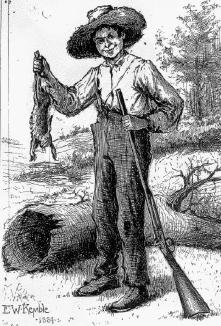
The Adventures of Huckleberry Finn is one of the most enduring and beloved books in American literature. Written by Mark Twain and published in 1884, the book is narrated by Huckleberry Finn, a youngster whose artless vernacular speech is admirably adapted to detailed and poetic descriptions of scenes and narrative renditions that are both broadly comic and subtly ironic.
Huck runs away from his abusive father and, with Jim the runaway slave as a companion, begins a long and frequently interrupted voyage down the Mississippi River on a raft. During the journey Huck encounters a variety of characters and types in whom the book memorably portrays almost every class living on or along the river. As a result of these experiences Huck overcomes conventional racial prejudices and learns to respect and love Jim. Huck Finn is the prototypical American struggling with the overriding problem of racism in the country.
The book's pages are dotted with idyllic descriptions of the great river and the surrounding forests, and Huck's good nature and unconscious humor permeate the whole. But a thread that runs through adventure after adventure is that of human cruelty, which shows itself both in the acts of individuals and in their unthinking acceptance of such institutions as slavery. The natural goodness of Huck is continually contrasted with the effects of a corrupt society.
~Britannica Student Encyclopedia. 2003.
This is what Ernest Hemingway had to say about "The Adventures of Huckleberry Finn:
All modern American literature comes from one book by Mark Twain called Huckleberry Finn.... American writing comes from that. There was nothing before. There has been nothing as good since.

