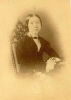
| Poet Emily Dickinson was born in Amherst, Massachusetts (1830). She grew up in a wealthy, religious family, and rarely left Amherst. She went to college at Mount Holyoke and then went back to her parents' house, where she spent the rest of her life. In a letter to a friend, she wrote, "You ask of my companions. Hills, sir, and the sundown, and a dog large as myself, that my father bought me. They are better than beings because they know, but do not tell; and the noise in the pool and noon excels my piano. . . . I have a brother and sister; my mother does not care for thought, and my father, too busy with his briefs to notice what we do." Dickinson dressed completely in white, refused most visitors, and rarely left the house. During the last years of her life, she mourned the deaths of her father, her mother, her nephew, and some of her closest acquaintances. She became known as the "Belle of Amherst," the "New England Mystic," and the "Woman in White."
But even though she didn't go out much, she wrote hundreds of letters. She once wrote, "A letter always feels to me like immortality because it is the mind alone without corporeal friend." She wrote to a man at the Atlantic Monthly named Thomas Wentworth Higginson, about publishing her poetry anonymously. Higginson advised her not to publish, but the two kept in contact for years. When he asked her what she looked like, she wrote back, "I . . . am small, like the wren; and my hair is bold, like the chestnut burr; and my eyes, like the sherry in the glass that the guest leaves." Dickinson and Higginson finally met one night at her father's home. Higginson later said, "I never was with any one who drained my nerve power so much. Without touching her, she drew from me. I am glad not to live near her." Dickinson also wrote dozens of passionate letters to a woman named Susan Gilbert. Dickinson and Gilbert became close friends around 1950. A few years later, Gilbert married Dickinson's brother, and the couple moved into a house next door to Emily. Her letters to Gilbert are full of declarations of love, and lamentations that they're not together. Dickinson wrote, "If you were here�and Oh that you were, my Susie, we need not talk at all, our eyes would whisper for us, and your hand fast in mine, we would not ask for language." And she wrote, "If this life holds not another meeting for us, remember also, Susie, that it had no parting more, wherever that hour finds us, for which we have hoped so long, we shall not be separated, neither death, nor the grave can part us, so that we can only love." Most early biographers ignored these letters or said they weren't unusual for the Victorian period. But more recent biographers have suggested that Dickinson and Gilbert were more than just close friends. Dickinson wrote over 1,700 poems, but only seven of them were published in her lifetime. In 1862, Dickinson wrote 366 poems, or about one per day. She wrote on scraps of paper and old grocery lists, but she compiled her poetry and tucked it away neatly in her desk drawer. Her sister found the poems after Emily's death, but they were heavily edited and weren't published until 1890. For a while, Dickinson was considered an interesting minor poet. In 1955, a more complete edition of her poetry was published, with the original punctuation intact. She's now considered one of the greatest American poets ever. Dickinson wrote: I'm Nobody! Who are you? Are you�Nobody�Too? The there's a pair of us! Don't tell! they'd advertise�you know! How dreary�to be�Somebody! How public�like a Frog� To tell one's name�the livelong June� To an admiring Bog! ~Writer's Almanac |
 |
 |