
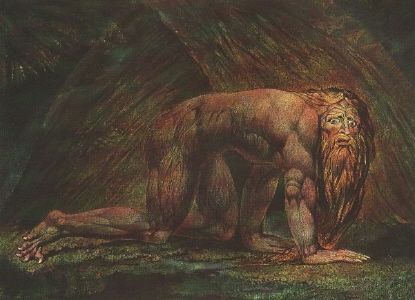
He lived in poverty, ignorant of the rest of the literary world of London, scraping out a living from his trade as an engraver, and writing and drawing under inspiration he considered divine. He said about his long poem Milton, "I have written this poem from immediate dictation, twelve or sometimes twenty lines at a time, without pre-meditation and even against my will." He lived in a world of dreams and visions. One day he and his wife were sitting naked in their garden, reciting to each other passages from Paradise Lost. Blake was not embarrassed when a visitor came by. He said, "Come in! It's only Adam and Eve, you know."
William Blake was a poet, illustrator, engraver, draughtsman, writer and painter whose efforts, due to their idiosyncratic and unorthodox nature, were largely unappreciated in his own lifetime. The knowledge Blake gained from working as an engraver enabled him to produce his own work in which he surrounded one of his poems with his own hand-coloured illustration. A powerful imagination is evident in every aspect of Blake's work. Among his most important works are the Illustrations of the Book of Job (1825), and the hundred or so watercolours to Dante's Divine Comedy.
A deeply mystical man, Blake claimed he had visionary experiences that prompted him to invent his own belief system in which the creator of the universe, whom he renamed Urizen, wrought vengeance on mankind through Jesus, renamed Orc. His social and political conscience railed against the prevailing academic painting of the eighteenth century. He saw it as representing all that he came to despise about the rational, materialistic age in which he found himself."
Independent through his life, Blake left no debts at his death on August 12, 1827. He was buried in an unmarked grave at the public cemetery of Bunhill Fields.
Wordsworth's verdict after Blake's death reflected many opinions of the time: "There was no doubt that this poor man was mad, but there is something in the madness of this man which interests me more than the sanity of Lord Byron and Walter Scott."
Blake's influence grew through Pre-Raphealites and W.B. Yeats especially in Britain. His interest in legend was revived with the Romantics' rediscovery of the past, especially the Gothic and medieval. In the 1960s Blake's work was acclaimed by the Underground movement.
T.S. Eliot wrote in his essay on Blake that "the concentration resulting from a framework of mythology and theology and philosophy is one of the reasons why Dante is a classic and Blake only a poet of genius." (from Selected Essays, 1960)
