GEMINI (Japanese DVD)
Shinya Tsukamoto is one of the most successful of
the new wave of Japanese directors in the West. He made the Super8 shorts
PHANTOM OF REGULAR SIZE (1986), a dry run for TETSUO, and the fantastic
ADENTURES OF ELECTRIC ROD BOY (1988) before making his name with the underground
black-and-white 16mm hit TETSUO: THE IRON MAN (1989) which quickly became
available in the West due to its ground-breaking originality, energy and sheer
weirdness. He followed this up with HIRUKO THE GOBLIN (1990), his most difficult
to see and mainstream film. Next came TETSUO II: BODYHAMMER (1991), a colour
remake of sorts of his original hit. Tsukamoto then took a break from film
before returning full force with 1995's TOKYO FIST, his last film to get proper
Western distribution. 1997 saw Tsukamoto returning to the raw, black-and-white,
hand-held approach of his early work with BULLET BALLET, the film most fans (me
included) agree is his best to date. His most recent film is GEMINI (1999), a
total departure from his usual style. GEMINI is a period piece set in the early
part of the 1900's (the late part of the Meiji restoration) and is filmed in a
lush, colourful style very different to his other work.
Tsukamoto is perhaps the greatest 'auteur' currently at work in the world of
cinema - he takes multiple roles behind the cameras, as well as acting in most
of his films (the exceptions being this film and HIRUKO) and also in other
director's work (check out his brilliant turn as a demented yakuza magician in
Takashi Miike's DEAD OR ALIVE II (2000)). He directs, photographs, edits,
lights, writes and does special effects work on his films. On GEMINI he adapted
a story by Edogowa Rampo ("The Twins"), the oft-filmed Japanese master
of the macabre. GEMINI has been criticised by some fans for its linear approach
to the story (unusual for Tsukamoto) and its commercial feel, but I hope to
right the balance somewhat with this review.
The film opens with an image that has become as much of a Tsukamoto trademark as
his shaky camera work; rotting, maggot-infested flesh accompanied by an
amplified rotting, gnawing sound. This image has no relevance to the rest of the
film, and its almost as if Tsukamoto wanted to put his signature on the film
right at the start, just to reassure the audience that his heart's still in the
right place! We're introduced to Dr Yukio Daitokuji (played by Masahiro Motoki,
also to be seen in Takashi Ishii's GONIN (1995) and Takashi Miike's BIRD PEOPLE
OF CHINA (1997)), a rich doctor living in a lovely house in private grounds,
amidst a slum town. Yukio is a kind, refined man and tries his best to help the
people. We learn that he recently returned from serving as a doctor on the
frontline of a battle. He lives with his wife, Rin (played by the ethereal Ryo),
his parents and some servants. His parents die mysteriously and one day he is
out walking in the grounds of his house when he is suddenly accosted by someone.
That somone turns out to be his doppelganger, and Yukio is promptly thrown down
a deep well in the garden (the idea of living in the bottom of a well seems to
be evry common in Japanese mythology and film, cf. RING (1998) et al). The
doppelganger, Sutekichi (also played by Motoki) promptly assumes Yukio's life,
carrying out his marital duties with Rin with gusto and taunting Yukio, whilst
dropping food down the well to keep him alive. However, things are not quite as
simple as they first seem, and the doppelganger's relationship to both Yukio and
Rin is not at all what it first seemed...
The film,as I have mentioned before, is filmed in luscious colour, with an
over-saturated pallet of primary colours that recalls Argento's work in SUSPIRIA
(1976) and INFERNO (1980). Overall, Tsukamoto uses a calm photography style, but
there are several great sequences, most notably a bizarre setpiece featuring the
doppelganger's first appearance, cart-wheeling slowly down a hall past Yukio's
terrified mother, and Yukio's head-first tumble down the well. The costumes and
sets are splendid, and it's clear that Tsukamoto had a much larger budget than
he is accustomed to and has made it show. The scenes involving Rin and Sutekichi
in the carnival town are particularly impressive, a whirl of bright colour and
energy. Both of the leads put in excellent performances, and Motoki handles the
twin roles of cultured doctor and wildman with effortless ease. I'd still have
liked to see Tsukamoto acting in this though, as I always find him very
entertaining.
The other key element in the film's appeal to me is Chu Ishikawa's amazing
score. Ishikawa is a career-long collaborator with Tsukamoto, and has provided
scores for all of Tsukamoto's feature films (except HIRUKO), as well as other
films such as Takashi Miike's FUDOH (1996) and CITY OF LOST SOULS (2000). Here,
Ishikawa contributes an innovative, original score featuring a deafening chorus
of voices to create a chilling, apocalyptic ambience. Some critics have cited
the music as one of the film's faults due to its power and seemingly
over-the-top dynamic, but to my mind it is just perfect. I should probably admit
that Ishikawa is my favourite film composer and as such I am probably somewhat
biased, but I stand by my opinion.
GEMINI is probably Tsukamoto's most accessible work to date and this fact is
emphasised by the fact that Warner Bros are responsible for this stunning DVD
presentation. Seeing the words Shinya Tsukamoto and Warner Bros on screen
together is a bit like seeing David Lynch and Disney together, and of course
this has also happened. Whilst some might bemoan this 'sell out', I for one am
gratfeul since Warner have produced what has to be one of the best DVD's ever
conceived, but more on that below. Sadly, GEMINI has had only a very brief art
house run here in the UK, and hasn't been released either in the UK or the USA
on VHS/DVD. Why this might be I cannot say, particularly given the current
upsurge in interest in Japanese film (and particularly horror film) in the West,
but it is a real shame. BULLET BALLET also remains unreleased in the West, and
can only be seen subtitled on a (admittedly excellent) bootleg of a festival
print, though a Japanese language only DVD is available. One can only hope that
Tsukamoto's recent work will eventually come to light on DVD in the West in the
near future, as he, along with Takashi Miike, is easily the most exciting
director at work in contemporary film today.
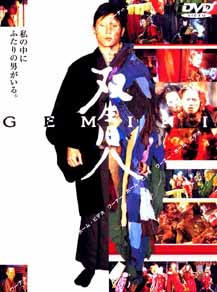 DVD Specification
Original year of release - 1999
Approximate running time - 84min.
Aspect ratio - Widescreen 1.85:1
System - NTSC (colour)
Rating - Unrated
Sound - Dolby Digital (5.1) (2.0) (1.0)
DVD release - Warner Bros Home Video
Region Coding - Region 2
DVD Extras
Documentary ('Tsuamoto Goes Rampo - Making of Soseiji', supervised by Takashi
Miike, 17min)
Footage from Venice Film Festival (17min)
Make-up demonstration by Isao Tsuge (16min)
Interviews (19min)
Trailers
TV spots
Ryo's photo gallery
Still gallery of promotional materials
Production diary by producer
'Follow the Gemini' feature which allows you to jump to making of the scene
| Masahiro Motoki |
Yukio/Sutekichi |
| Ryo |
Rin |
| Yasutaka Tsutsui |
Shigefumi |
| Renji Ishibashi |
Beggar at gate |
| Akaji Maro |
Kakubei |
| Tadanobu Asano |
Man with sword |
| Naoto Takenaka |
Rich man |
| Shiho Fujimura |
Mitsue |
| MAIN CREW |
|
| Director |
Shinya Tsukamoto |
| Producer |
Futoshi Nishimura |
| Associate Producer |
Tomoyuki Tsuruoka |
| Executive Producer |
Toshiaki Nakazawa |
| Production Designer |
Takashi Sasaki |
| Executive Production Designer |
Yohei Tanada |
| Screenplay |
Shinya Tsukamoto |
| Based on the novel by |
Edogawa Rampo |
| Music |
Chu Ishikawa |
| Cinematography |
Shinya Tsukamoto |
| Editing |
Shinya Tsukamoto |
DVD Ratings (out of 5)
Picture - 5
There is only one word that can possibly describe the transfer used for Warner's
DVD: magnificent. This is the most impressive DVD I've ever had the pleasure to
see, and the anamorphically enhanced vista-vision picture is so clear that it
literally hurts the eye! Japanese DVD's tend to be of an extremely high standard
and it is therefore a great pity that they cost so much and, even worse, are
extremely difficult to source. Colours are perfect, there is no grain or print
damage and the image is perfect at all times. I use this disc to demonstrate my
DVD player and widescreen TV to friends, and I always get an amazed gasp when
they see the image for the first time. If you really want to see what DVD is
capable of, get this disc. Perfect.
Sound - 4
An incredible mix has been created for the film, and
Ishikawa's score, as previously mentioned, is literally deafening in places. It
would have been a shame to get the picture quality so right if the sound wasn't
up to scratch, but no such worries. This is an amazing track and really should be
played very loud. There's no hissing or distortion and both the low bass and
high vocals sound great.
Extras - 5
Once again, Warner have gone all-out with the extras for this disc, giving us a
seriously impressive line-up of documentaries and features (62 minutes in all!).
The best for me was the Takashi Miike documentary; very interesting stuff. There
are two problems with the extras - one is that they're not subtitled and the
other is that it's very difficult to navigate the Japanese menu screens to find
all of the features. However, these are small complaints and for a Japanese
cinema fanatic like me, the extras on this disc are worth the price alone.
There's a couple of good trailers and an interesting fx short. Footage of
Tsukamoto at a festival (wish I could understand what's been said here) and some
good interviews, plus other bits'n'bobs make up the rest of the features. The
only thing missing is a commentary by Tsukamoto, but this would be very unusual
on a Japanese disc, and wouldn't have been subtitled anyway. Bravo!
Overall Rating - 5
As good a release as one could ever hope for of an
excellent 'mainstream' Tsukamoto film. If only other Japanese films could get
this treatment. The subtitles are excellent and are in 'proper' English, unlike
HK discs which don't bother getting correct subtitles produced. It should be
noted here that there is also a (much cheaper) Hong Kong release of the film
available from Ocean Shores. This is region 3 and features just the film,
without any of the extra features. It's also not anamorphically enhanced. I
haven't seen the disc so I can't comment on image quality etc, but it features
burnt-in Chinese and English subtitles (presumably the English sub's are up to
HK's usual terrible standards!). A comment about the HK disc that I found on the
internet: "Typically bad Ocean Shores disc. The print used is in fairly
decent shape but the transfer is rough. Dull and lifeless with the usual color
smearing (especially in the night scenes as with Chungking Express). Overly dark
and lacks any color vibrancy. At times the picture looks fairly good, but it
varies too much for my tastes". If you can't afford the Japanese disc, or
aren't too sure whether you'll love the film then go for the cheaper option.
However, if you're a fan of Tsukamoto or contemporary Japanese cinema in general
then you can't really go wrong with the Japanese disc. I also guarantee that it
will be one of the best DVD presentations you've ever seen, aside from being a
fantastic film. Very highly recommended indeed.
AKA
'Soseiji' (Japanese title = 'Twins')
Alternative versions
As mentioned above, there is an inferior Hong Kong DVD available, released by
Ocean Shores. The film hasn't been released in the West on VHS or DVD to date.
Awards
Won - Catalonian Inernational Film Fesitval, Stiges, Spain
(Chu Ishikawa for Best Soundtrack), 2000
Nominated - Los Angeles International Film Festival (Grand Jury Prize, Shinya
Tsukamoto), 1999
Official site
http://sedic-inter.com/geminihtml
Also: http://www1.odn.nejp/~aaa48350/e/gemini.html