Tools
Flogging does not even require a "flogger" -- a length of rope, braided laces, or knotted cord
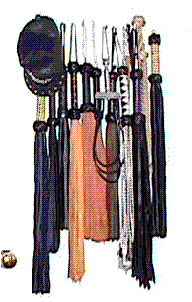 would
do. But commercial floggers build on the experience of the floggers and the
floggees. Grim's reference (listed at the end of the sheet) has ample information
on flogger material and construction. A serious player may own 8-10 floggers
of different properties, and know intimately the effects of each. An eager sub
appreciates such variety. Three issues will be dealt with in this section: material,
length and number of tails, and construction.
would
do. But commercial floggers build on the experience of the floggers and the
floggees. Grim's reference (listed at the end of the sheet) has ample information
on flogger material and construction. A serious player may own 8-10 floggers
of different properties, and know intimately the effects of each. An eager sub
appreciates such variety. Three issues will be dealt with in this section: material,
length and number of tails, and construction.Material: Most floggers are leather. Each leather has a unique feel and set of properties. There are also fabric, horsehair, plastic, rubber, rope, and metal (and mixtures of these materials) floggers. Each will provide a different mix of sting and thud, depending on material details, and also on how the flogger is used. Start with a light leather flogger, and then progress to heavier leathers (and different leathers) as you become more involved. Save the exotics for the crazy people; learning to use them properly is difficult, and most subs cannot accommodate them in any case.
Length: The longer the tails of the flogger, the more leverage is obtained in the stroke, and the greater the heft and the impact. But control of longer floggers becomes progressively more difficult. Most floggers are 15-22 inches in length, with the shorter ones used for close-up work and the longer ones used for broader, heavier strokes. Small floggers may have as few as 15 tails; heavy floggers may have twice that many. More tails equals more impact, but the thickness and density of the leather itself plays an equally important role. The large number of combinations (length, leather type, and number of tails) explains why there are so many different floggers. Start with a short lighter flogger to perfect your technique, and then move to longer and heavier floggers. Above all, get something that you like and enjoy using. When the Dom likes the flogger being used, the sub usually reflects that enthusiasm. Do not be hesitant about trading out a flogger that you do not enjoy.
Construction: There are many issues of appearance that are personal decisions (color, decoration, handle design). The tip of the flogger is where the action for the sub is. The smaller the contact area, the greater the impact of each tip as it hits the sub. Wider tails thud, while narrow tails sting. Knotted end floggers and floggers with popper tips sting a LOT (and can easily break skin). Better quality (at least higher cost) floggers usually have tails with rounded edges and tips. The action for the Dom is in the handle. Issues to look for are the diameter of the shaft, and its length (shorter for control, longer for leverage), balance, size of the knob, and whether there is a wrist strap. Try any potential flogger and see how it feels. Take practice swings before you purchase anything; if you are unsure, ask about returns or exchanges. Each of these properties of a flogger is best shown by inspection; a variety of floggers will be available to examine in this demonstration. A flogger does not wear out (at least not before the sub does). Buy quality for the long term.
Scene
What you need for a basic flogging scene: 1) a Dom 2) a sub 3) flogger(s) 4) a plan 5) a safe-word 6) first-aid kit. What you might also have: 4) more floggers 5) restraints (with quick releases) 6) a cross (or equivalent) 7) drinking water 8) alcohol spray 9) paper towels 10) helpers and other participants 11) more advanced first aid, gloves, and disinfectants 12) background music (not so loud that you cannot hear the sub's breathing or responses).
Planning for the scene depends on the general BDSM experience of both players, and their prior flogging experience. If the sub is new, then prior negotiations should be extensive -- what will be done, for how long, and to what point. What levels of intensity are sought? What residual marks are to be expected/tolerated? Are there relevant medical issues?
Set up the mental scene as well as the physical one. Flogging is familiar from movies, from religion, and from history. A sub usually has some preconceived notions. A flogging does not have to be a scourging, but it is not a tickling scene either. The motivations of both the Dom and the sub (masochistic? sensual? spiritual?) should be understood as clearly as possible. In flogging, there is sensation, there is energy, and there is process through which "pain" can be transformed into pleasure. Know what will be occurring, and what is expected.
Process: the logistics and the mechanics
For the sub: Blindfolds focus the senses and protect the eyes. Restraints and a cross establish the position of the sub so that the strokes are accurately targeted by the Dom. The sub's face
 has to be down (if flogging the back).
Hanging a flogger around the sub's neck helps keep his head down, gives him
a continuous smell of leather, and helps to prevent wrapping around the neck.
If flogging the front, the face has to be held up and not dropped. Feet of the
sub should be spread. Emphasize the importance of NOT moving after a stroke
is received. Bare chest minimum, jock strap and boots preferred.
has to be down (if flogging the back).
Hanging a flogger around the sub's neck helps keep his head down, gives him
a continuous smell of leather, and helps to prevent wrapping around the neck.
If flogging the front, the face has to be held up and not dropped. Feet of the
sub should be spread. Emphasize the importance of NOT moving after a stroke
is received. Bare chest minimum, jock strap and boots preferred.For the Dom: Since the Dom is doing almost all of the physical work, he will get tired during a long scene, and have a tendency to rush things. Learn to flog as if you had all the time in the world. Think of the sub as your gift to enjoy for the length of the scene, and his back as a palette rather than a target. Take the time to create a composition in sensation for your sub.
Beginning: Start slowly. Use your hands on a sub's back as well as your floggers. Introduce each new flogger to the sub by draping it over his face so that he can feel and smell; drape it over his back so that he gets a preview of its heft. I like to touch on the back where I am going to be flogging; the sub soon learns to process this information (and that then can be made part of the "game"). Start with lighter floggers and then work to heavier floggers. Within each series, start with lighter strokes, and then move to heavier strokes. Play as long as you wish with each flogger, and gauge the sub's reactions (Is it a thud or a sting that the sub likes? How long can he deal with the sensation, and at what intensity?). Remember that the flogger is "talking" to your sub, but the Dom can use words as well to help reach the goal. "I just got this new flogger that you haven't seen before, and I can't decide if it is a thud or a sting. You let me know." Take your time. You are composing; take time between each flogger to inspect your work. This is also a good time to check sub's restraints, circulation, temperature, offer him water, or afford him a slight pause with encouragement.
Stroking: These vary as much as pitches in professional baseball. Use what works (is comfortable for both the Dom and effective for the sub). When it works, it looks good and it feels good. The basic strokes are a) forehand b) backhand c) figure 8 and d) punch. Each will be demonstrated. Learn a comfortable style and then use it to generate a hypnotic rhythm. The sub will learn to anticipate strokes once you do so, and the scene can progress to greater intensity.
Two measures of success for a flogging stroke are accuracy of placement and intensity of sensation. For accuracy, keep the tails of the flogger together in the air. The Dom takes a position where accuracy can be maintained (and change position as needed!). Usually, marks do not show up fast enough to indicate the landing positions of the tails. If the Dom is unsure, slow down, and back off. The distance may be such that the tails just barely touch the back, or closer so that the tails splay out across the back. The Dom must be mindful of which is appropriate where. Avoid wrapping (the tail tips are fast, hard to see). Once the Dom is comfortable with the stoke, this can be avoided by using lighter first strokes. If you (the Dom) are unsure, use clothespins as markers. If you are unsure, pause and reassess. If you must, tell the sub that you are doing so; he will appreciate the concern for his safety far more than regret a slight interruption.
The intensity of the stroke is determined not only by the construction of the flogger (heft, length, material) but also how hard it is swung, and the stroke used. How does the Dom tell how intense the stroke is? Listen to the stroke (another reason why music should not be too loud), watch and listen to the sub, look for a mark. Start slowly, and then work to the maximum capability of the flogger and the sub during each series. Trace a pattern of strokes on the sub's back, and (usually) do not repeat strokes in one spot. This pattern need not be announced; the sub will deduce it soon enough (even subconsciously). For example, four on one shoulder, four on the other, then repeat (perhaps with a different stroke). Note that the figure 8 stroke (or winding stroke) is more or less continuous.
Ending: Unless the sub uses the safe word, it should be the Dom that ends the scene
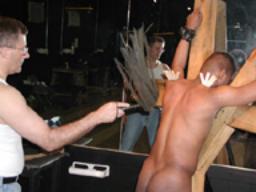 (and
when it is ended, it is over). When you reach the level you wish to reach, or
if you are tired, or you sense that the sub is near his limits, announce clearly
how the scene is going to end. "Ten more strokes with the bison flogger and
then we will be done." The sub will do anything to complete the scene, and it
helps the sub focus if he counts the strokes out loud (the Dom will also be
able to judge the stress in the voice of a sub getting close to limits). When
those ten strokes are administered, the scene is over. Leave the sub on the
cross for a minute. Offer water, a caress, indications of physical evaluation
and/or concern, praise, tell him what happens next (see section on Aftermath)
(and
when it is ended, it is over). When you reach the level you wish to reach, or
if you are tired, or you sense that the sub is near his limits, announce clearly
how the scene is going to end. "Ten more strokes with the bison flogger and
then we will be done." The sub will do anything to complete the scene, and it
helps the sub focus if he counts the strokes out loud (the Dom will also be
able to judge the stress in the voice of a sub getting close to limits). When
those ten strokes are administered, the scene is over. Leave the sub on the
cross for a minute. Offer water, a caress, indications of physical evaluation
and/or concern, praise, tell him what happens next (see section on Aftermath)Safety: A common area for flogging is on the upper back on either side of the spine. Avoid wrapping tails around the neck. Avoid heavy hits directly on the spine. Avoid hitting on the kidneys (lower back on either side of the spine). The sub's butt can be flogged (butts are different; avoid the tailbone) as can the thighs (use a smaller and lighter flogger). Front flogging should use lighter and more accurate floggers -- the chest and the nipples can be flogged lightly, but usually small paddles and crops are more effective tools here.
A flogger reddens the skin, it can bruise the skin, and it can break the skin. The Dom has the responsibility for providing proper precautions in the case of broken skin, blood, or contamination with body fluids. The references list means (not proven) of disinfecting floggers. If breaking skin is your goal, personalize your floggers.
Style
A flogging scene carried out with style becomes a memorable scene for both Dom and sub. Use variations to keep a flogging scene from being the "same old thing" again: 1) two-handed flogging 2) simultaneous flogging 3) subs tied together 4) guess the flogger 5) front flogging 6) butt/thigh
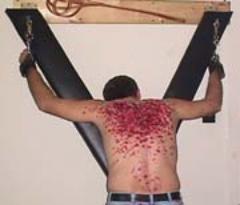 flogging
7) cock-and ball flogging 8) foot flogging (bastinado) 9) flogging to remove
wax 10) flogging to remove clothespins 11) clothespin counters 12) outdoor flogging
13) competitive flogging 14) flogging in an interrogation scene 15) flogging
to orgasm 16) flogging with purposeful marks 17) flogging to surrender
flogging
7) cock-and ball flogging 8) foot flogging (bastinado) 9) flogging to remove
wax 10) flogging to remove clothespins 11) clothespin counters 12) outdoor flogging
13) competitive flogging 14) flogging in an interrogation scene 15) flogging
to orgasm 16) flogging with purposeful marks 17) flogging to surrenderNo doubt you can think of your own variations, some of which require prior negotiation or notification of the sub, and some of which should not. Some require other participants; that's fine, as a good flogging scene is fun to watch. The relevant issues are always safe, sane, and consensual. Don't make flogging a chore; have fun.
Aftermath
Physical: The sub should be removed from restraints slowly, one arm at a time. Instruct that the arms released be kept at his side. When the sub is ready to stand up (from a cross, for instance), be prepared that he may be off-balance. If there are heavy marks, a light spray with isopropyl alcohol will both cool (emphasizing the warmth of the skin), maybe even sting a little, and help to disinfect. Some use a mixture of hydrogen peroxide and witch hazel solution (may stain clothes). Note that colors and marks will continue to develop even after the flogging has ended. If the marks are heavier than intended, then first aid (ice, usually may be needed. It is unwise to flog the same sub again until after all marks have faded/healed (always start with a clean palette).
Mental: The Dom has to be ready to give whatever emotional support is needed. A sub may react to a flogging in many different ways; he may be indifferent, stoic, or go (stay in) into mind-space, depending on the intensity of the scene, his expectations, and his mood. After the flogging is finished, begin positive reinforcement while the sub is still restrained. Most subs will want to see
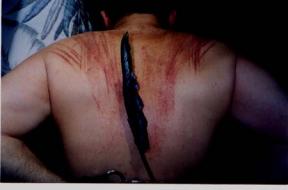 their back
sometime during the decompression period; this is a good opportunity to work
with the sub on feelings about the physical sensations and get some feedback.
An indifferent (or an experienced) sub may seem to decompress quickly and effortlessly,
but still deserves reinforcement and support, and the Dom still needs to watch
over him. Carefully monitor the stoic sub -- all that energy that you put into
him is still compressed inside, and you will find it coming out later, maybe
when you don't expect it. The sub coming out of a genuine mind-space can exhibit
all sorts of reactions (as in any other intense scene). He may laugh, or cry.
He may want to hold and cuddle, or withdraw physically to process new feelings
and sensations. A blanket is good if he starts to shiver. Subs can be "broken"
on a cross in an intense flogging; if that is the goal, be prepared for those
consequences. Have some plan for what to do after the scene; know that what
comes next may not be sex.
their back
sometime during the decompression period; this is a good opportunity to work
with the sub on feelings about the physical sensations and get some feedback.
An indifferent (or an experienced) sub may seem to decompress quickly and effortlessly,
but still deserves reinforcement and support, and the Dom still needs to watch
over him. Carefully monitor the stoic sub -- all that energy that you put into
him is still compressed inside, and you will find it coming out later, maybe
when you don't expect it. The sub coming out of a genuine mind-space can exhibit
all sorts of reactions (as in any other intense scene). He may laugh, or cry.
He may want to hold and cuddle, or withdraw physically to process new feelings
and sensations. A blanket is good if he starts to shiver. Subs can be "broken"
on a cross in an intense flogging; if that is the goal, be prepared for those
consequences. Have some plan for what to do after the scene; know that what
comes next may not be sex.References
Michael Fleming, Sensual Flogging from the Top, Checkmate 23, pp 10-11. [Look for the picture of the braided cat]
K. L. Kendrick, The Basics of Flogging or How to Flog Someone So They'll Come Back for More, http://www.iron-rose.com/IR/docs/basics_of_flogging.htm
Grim's Guide to Flogging, http://www.sexuality.org/l/bdsm/grimflog.html
An Introduction to Flogging, http://www.sexuality.org/l/bdsm/floginst.html
[This is long and may be difficult to print]
J. W. Bean, Choosing Whips: A Compendium of Uncommon Knowledge, Sandmutopia Guardian, Issue 12. [Look for the picture of the rigging-rope cat made by Don Minnerly]
Your own experiences
Copyright 2001 by Tawse. Prepared July 2001