Clever Girl... >> Writing >> Girl Thing
The video clip for British pop group Girl Thing's debut single, Last One Standing, attempts to construct the five 'girls' (in fact aged between 17 and 22) as feisty modern feminists. Both the aural and visual elements of the clip borrow heavily from the 'girl power' discourse typified by mid-1990s icons the Spice Girls, as the girls demonstrate their fun-loving, independent, and somewhat rebellious natures by interrupting a wedding ceremony and destroying the reception. Girl Thing's dramatisation of what Germaine Greer terms "girls on top" (present day Rachel's note: that actually ended up being the title of their second single) feminism is not, however, without paradox - both within the clip itself (the girls are portrayed as being both childlike and "physically demanding") and between the feminist ideology presented in the clip and the powerless reality of the manufactured pop world.
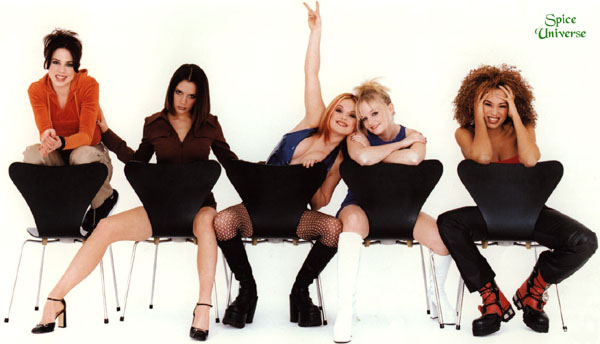
The phenomenon of 'girl power' has long been present in popular culture - from girlgroups of the 1960s such as the Ronettes, the Shangri-Las, and the Crystals, to 80s pop sensation Cyndi Lauper, quoted in the lyrics of Last One Standing ("Cyndi was right - girls just wanna have fun"). Upon one viewing of Last One Standing however, it is immediately apparent that the most significant influence upon the clip is the Spice Girls. Not coincidentally, both groups were put together by the same set of managers. The song repeatedly makes reference to the Spice Girls, seemingly in an effort to simultaneously distance and associate Girl Thing with the group. They espouse Spice Girls slogans ("move over", "power to the girl" - indeed, "It's a girl thang" [sic] is one of the slogans on the inside sleeve of the Spice Girls' debut album) while at the same time insinuating that they intend to displace them ("Pull your baby nearer, it's the end of an era, and we're the last ones standing"; "It's our time"; "Round one is over, hear the bell ring") and, creating even more tension, attempting to assert their individuality ("Don't get me wrong, we're not trying to throw 'em"; "We've got the mic and we're gonna rock it our way"; "This is our game"). Both the visual style and narrative elements of the clip draw largely from the Spice Girls' clip for their debut single, Wannabe, with both groups trying to assert their 'power' and independence through destruction - the Spice Girls of what appears to ba a restaurant and Girl Thing of a wedding ceremony and reception.
as a reaction to "busloads of greased, conked and nasty boys") and the 1990s 'riot grrrl' movement, led by bands such as Hole, L7, and Bikini Kill. Riot grrrls deliberately cultivated "various 'girlish' identities in their music, style, and stage acts - such as childlike vocals (evident in the childish and obnoxious tone of Girl Thing's rapping), songs about childhood, and childlike clothing, such as Courtney Love's infamous 'kinderwhore costume'.
Girl Thing also sport childlike clothing in Last One Standing, their bright and colourful attire similar to that worn by the presenters of children's television program, High Five. What made the riot grrls part of an effective feminist movement, however, was the stark contrast between the image of the artists and the music itself - something which could not be attributed to either Girl Thing or their predecessors, the Spice Girls. The three tracks on Girl Thing's first single prove to have rather limited themes - Girl Thing's impending success and 'girl power', love, and partying.
The riot grrrl movement was also characterised by (sometimes gratuitous) rebellion - which Girl Thing attempt to emulate in the mindless destruction of Last One Standing. The attempt to pass of behaviour akin to that of stereotypical loutish males has been a feature of the popular manifestation of feminism for the past decades, particularly within those forms of popular culture most closely related to consumerism - magazines for teenage girls and young women that "trade in attitude", popular music, and advertising. The problem with this representation of feminism is best described by Germaine Greer's comment on British magazine Minx: "Minx magazine advertises itself as for 'girls with plenty of balls', but what this means is simply that girls who read it will be encouraged to take liberties rather than fight for them."
the people in front of them - all while a wedding ceremony is taking place. The girls are evidently so overcome by the boredom of attending a function that is "so last century" (as 'Pink Thing' puts it in the opening sequence) that, upon sharing a mutinous glance, they jump into the aisle to scream in unison "It's a girl thing!" and burst into song.
They continue their path of disturbance and destruction at the wedding reception, dancing on top of the bride and groom's dinner table and throwing flowers, food, cake and plates into the crowd. 'Wild Thing' even goes so far as to steal the bride's tiara and place it on her own head, indicating that the motive behind Girl Thing's behaviour might be their need to be the centre of attention at all times. Indeed, they proceed to usurp the band on stage - snatching the musicians' instruments, kicking in the drums, and destroying the set. Girl Thing routinely display agressive behaviour towards anyone who dares to get in their way - with 'Pink Thing' making obnoxious and agressive signals at a man, 'Young Thing' and 'Dutch Thing' stealing people's hats, 'Animal Thing' snatching the table cloth from a guest's table, and the group grabbing an old man while 'Wild Thing' smears cake on his face.
It is hard not to question the purpose of this destruction. Obviously the producers thought it would serve to present Girl Thing as a fun-loving girl gang, scornful towards tradition, the patriarchy, and the attempts of the older generation to control them. This portrayal of the group corresponds with their representation in other media. Seventeen year old Jodie (aka 'Young Thing') told teen pop magazine Smash Hits (readership consisting primarily of females aged between 8 and 13 - Girl Thing's targeted audience): "There isn't a teenager in the country that hasn't sneaked out to a club at one point", while Anika (aka 'Dutch Thing'): "When we are out we don't stand around trying to look cool and pretty!"
Girl thing are, on one level, living out the dominant pre-teen girl fantasy before "the intrusion of heterosexual romance and its spin-offs - sexual competition and sexual rivalry" - they live together in a house where they supposedly watch movies, go dancing, and have food fights. They are also able to turn seemingly boring chores into fun events without repercussions (in Last One Standing, the priest does not look in the least bit annoyed that the girls have interrupted the service, rather he dances along to the beat of the music), and in this sense they possess more power than the girls whose fantasies they embody.
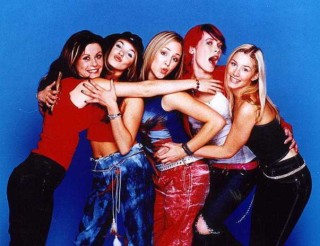
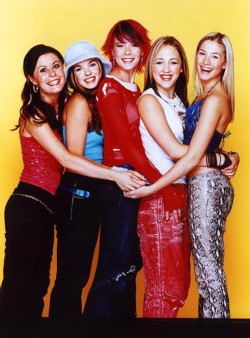
coquettes. The girls are made up to look younger than their years, dressed to look like members of the cast of High Five, and each sport a childish hairstyle - plaits, pigtails, pink hair, hair on top of head, and a big hat. They pop bubble-gum, rap in childish, obnoxious voices, and spout lyrics that reek of naivety ("stars in our eyes and smiles on our faces" interestingly has a keyboard rifff to the tune of the taunt "ner-ner-ner-ner-ner" in the background - insinuating immaturity). However, while they assert their independence from men ("When it comes to love we love to do it our way"), they allude to coquettishness ("a wink and a smile so it's worth your while") and a sexuality ("some say we are physically demanding", "we've got feminine touch in all the right places") years beyond the rest of their image. This paradox makes it difficult to place Girl Thing - are they encouraging pre-teen girls to get involved with boys at a young age or are they merely adding to the multiplicity of their image by adding boys to those under their power?
The other significant paradox in Last One Standing is that between the representation of Girl Thing and the reality of the lives of manufactured pop bands. Lyrics such as "we've got the mic and we're gonna rock it our way" and "this is our game" insinuate that the girls have control over their lives and careers, as do the victorious hands punched in the air, the high-fives, and the control they seem to have over people obviously older than them (note the differences in dress between Girl Thing and the others attending the wedding). There are, however, subtle allusions to the reality of the music industry within the lyrics of the song - "no matter how many times you hear this you wanna hear this song more" alludes to consumerism, as "the world's a merry-go-round" to the cyclical, faddish nature of the industry. Consumerism is also present in the recurring imagery of the mobile phone, with 'Young Thing; holding hers up to the camera at the end of the clip, not unlike a model in an advertisement.
opportunity to indulge in such behaviour themselves. As a result, they are likely to merely take in the underlying idea that it is important for girls to be independent and fun-loving, rather than wreak havok and cause mass destruction. Little emphasis is placed on the physical appearance of Girl Thing, nor are they packaged as overt sexual or domestic objects. For this reason, despite their inherent consumerism, Girl Thing's shouts of girl power are likely to expand and consolidate the belief young girls have in feminism.
What on earth is this bitch talking about?
back |