Lasers, Blasters, Disruptors, and Phasers
The four primary types of ranged energy weapons in Star Trek primarily differ in
energy efficiency and sophistication, but all are
notable for their ability to (in most cases) not only produce results in excess of
the energy directed, but to constrain (at most settings) the effect to the target itself
("vaporizing" an object by phaser results in practically no residual heat or
damage to the surrounding area - which cannot be said for melting and boiling that
same object by a conventional EM device (such as a laser)). In a
posting
to rec.arts.startrek.tech
on 4/30/98, Chris24061
speculated that phasers (and the energy weapons of Star Trek in general) were
actually ion-based weapons:
"Actually the best real physics weapon that could accomplish what a phaser
does would be a weapon that fires electron streams (perhaps with the electrons
placed in phase with each other). At low settings such a stream would result
in disruption of the nervous system. At higher settings it would begin to
induce heating effects as target becomes ionized. At still higher settings the
electrical repulsion caused by the additional electrons added to the system
would cause it blow apart. Of course such a stream of electrons would not
travel at the speed of light, but then it doesn't appear to in the series
either.
"Coincidentally, a phaser as an electron firing weapon fits nicely with the
acronym PHASed Energy Rectification, since phased electrons would transfer
energy and rectification is the act of converting an alternating current (such
as would be found in the electro-plasma system) into a direct current (such as
a stream of high-energy electrons would be).
"Then too I suppose it could be a proton based weapon, using similar
ionizing and electrical repulsion effects as described above. Indeed, page 134
of the Tech Manual indicates that 'rapid nadions produce a pulsed protonic
charge in the heart of the device.'"
Despite the apparent contradiction in the TNG Technical Manual regarding the
use of electrons vs. protons in phasers, it is noteworthy that it states
that the term "Phaser" applied to the "original process" (emphasis
added) of phased energy rectification (and that it was "something of a
holdover acronym"). As a result, this allows for the original phasers to be,
as Chris24061
speculated above, directed-electron weapons, while current
phasers are directed-proton weapons - the latter is evidenced by the TNG tech
manual equating a phaser's beam intensity with its protonic charge levels
and the DS9 tech manual stating that modern phasers direct a beam of "superheated,
rarefied plasma" - which is basically atomic nuclei without electrons.
Given that the three primary energy weapons of the Star Trek universe (the blaster,
disruptor, and phaser) all direct their energy by the phased energy rectification
of nadions, it's somewhat understandable that "phaser" is sometimes used to
refer to disruptors and blasters as well. However, unlike its less sophisticated
counterparts, the phaser (proper) generates its particle stream via the rapid
nadion effect (how this is done is "explained" in the Star Trek: The Next Generation
Technical Manual) - which comes at a relatively high cost in equipment complexity
and maintenance requirements. Even so, Starfleet has readily accepted the penalties of
phaser technology because of its advantages - and not just because of its unequaled energy
efficiency. Not only can its settings be precisely - and even fractionally -
adjusted ("Homefront" [DS9]), but it is also very adaptable to a number of different
roles, such as a forcefield generator ("Extreme Risk" [VOY]). As such, phasers
are more than just weapons to Starfleet, but versatile tools whose utility more
than compensates for their maintenance demands (which Starfleet is more than
capable of accepting due to the high number of extremely capable engineers
within its ranks). In addition, the phaser's efficiency has allowed the development
of the linear phaser array, which combines most of the advantages of large single
emitters and multiple banks of emitters while retaining few of the
disadvantages of either.
In contrast to phasers, disruptors (also known
as phase-disruptors), generate a particle stream (usually protons, though the
Jem'Hadar use polarons) via a phased energy rectification of standard nadions
that adjusts its power not through varying the relative proportion of protonic
charge, but by boosting the energy field per particle beyond stable
levels. On contact with matter, this energy is easily and rapidly released, disrupting
matter contacted by the beam. Though this process is considerably simpler
than the Starfleet phaser, it is significantly less controllable and energy-efficient,
and its comparatively limited ability to concentrate the protonic
charge of its generated beams precludes dematerialization effects by small-scale weapons.
Furthermore, despite massive efforts
by the Romulan and Klingon Empires in both R&D and espionage, the inherent
inefficiencies of the disruptor proved to be an insurmountable obstacle to
linking individual disruptor emitters into a linear disruptor array via force coupling
(even on Borg vessels, where energy is not a limiting factor). Nonetheless, the relative
simplicity and reliability of the disruptor has led it to be adopted by
all major powers (including the Jem'Hadar and the Borg) outside of the Federation.
As for the blaster, it is the crudest of the three major classes of phased energy
weapons. By utilizing the phased energy rectification of slow nadions, blasters generate
a beam or bolt of semi-coherent plasma. Thus, compared with disruptors, blasters
have exaggerated advantages (simplicity and reliability) and disadvantages (power inefficiency,
restricted high-NDF effects in small scale units) relative to phasers. As such, it is used as a
starship combat weapon primarily by minor naval powers (such as the Gorn Alliance and the
Tholian Assembly).
In Star Trek, the term "laser" covers weapons (i.e. blaster cannon, plasma cannon,
neutron cannon, phased plasma cannon, pulse cannon, phase cannon) similar in characteristics to blasters
and disruptors (the "lasers" carried by the Enterprise away team in "The Cage" [TOS]
were disruptor-like in performance, and undoubtedly were evolved versions of the
phase-modulated energy weapons of "Enterprise"), though they dispense with nadions altogether and
instead use a laser to generate and support the plasma stream or bolt (though in pre-warp
societies, personal-scale weapons are commonly referred to by the names
of their nadion-using counterparts, with "laser" reserved for vehicle-scale weapons).
Although much simpler in any of its forms than even the blaster, the laser's simplicity
is its undoing against most modern opponents. Though it is reasonably effective against simple
electromagnetic and graviton defensive grids (such as those used on pre- and early-warp starships),
the laser beam critical to focusing (and supporting) the particle stream is easily warped and
dispersed by graviton fields amplified by subspace (and, except for phase-modulated lasers,
hyperspace) fields, regardless of how powerful the laser is (rendering it useless against
warp-technology navigational/tactical deflectors and, except for phase-modulated lasers, even the hyperspace-amplified
graviton bands of 'impeller wedge'-type gravity drives). Furthermore, against unshielded
hulls augmented by advanced structural integrity fields, the phase-modulated laser's kinetic
energy multiplier is reduced to its square root against subspace-amplified SIFs, with the KE multiplier
of standard lasers reduced similarly against hyperspace-amplified SIFs and further reduced by its square root
again against subspace-amplified SIFs. (This link leads to a chart that shows this graphically.) Thus, the laser, especially in its unmodulated form,
has been rendered hopelessly obsolete for modern 24th century ship-to-ship combat. (Note: Borg ships still
use the phase-modulated laser as a precise cutting tool against starships whose shields and mobility have
already been neutralized, but its ineffectiveness as a combat weapon was demonstrated by a Type-11 phase hyperdisruptor
taking 50 seconds merely to penetrate both the outer and inner hulls of an immobilized, unshielded Galaxy-class
starship. ("The Best of Both Worlds" [TNG])). As for the assertion that the impermeability of Star Trek shields to lasers applies
only to real-life lasers, and not "lasers" that project sublight,
visible particle bolts, Graham Kennedy
had the following remarks in a posting to rec.arts.startrek.tech
on 6/21/99:
...Lasers as shown in virtually every sci-fi production
look and act almost nothing like real lasers would. They
are almost uniformly shown as a solid glowing line from
weapon to target which travels at a miniscule fraction
of lightspeed - in fact, they usually travel at around
the speed of a rifle bullet...
And when a sci-fi laser hits, it often does things that
a real laser would not do. Look at the laser weapon used
in "Loud as a Whisper" which kills the mediator's translation
team. They seem to disintergrate, leaving glowing bones
hanging in space for a moment before they too vanish. More
like the kind of thing a phaser or disrupter style weapon
might do.
Now when we can find a reasonable explanation for this kind
of FX glitch, fine - all sorts of wacky stuff has been
proposed to explain phaser-style vapourisation, for example.
But when a weapon is specifically stated to be a laser, I
tend to think that it's just silly to claim that it isn't
because it doesn't look like one on screen. And that applies
equally to Trek, B5, Star Wars, and anything else.
The table below shows the energy input/effective kinetic energy output attained
by a plasma-based blaster at varying settings - and the highest percentage of the weapon's
maximum power that can be utilized at a given setting. It should also be noted that
phase-modulated and nadion-based blasters achieve 10 and 100 times respectively the
kinetic energy multiplier of a plasma-based blaster for a given setting - and that
disruptors and phasers achieve a further kinetic energy multiplier of 10 and 100
times respectively. (Note: The table is based off how a Star Trek phaser can, at the
"heavy stun" setting, heat a cubic centimeter of water 100°C with just 1 J of
directed energy - or, with a 0.2-second blast at maximum power, destroy a
humanoid-sized object at the quantum level at the "dematerialize" setting.)
Plasma-based Blaster Setting Comparison
| Setting |
Stun |
Thermal |
Disrupt |
Vaporize |
Disintegrate |
Dematerialize |
Annihilate |
| KE Multiplier |
1 |
100 |
104 |
106 |
108 |
1010 |
1012 |
| Max Power |
10-4 % |
10-3 % |
0.01 % |
0.1 % |
1 % |
10 % |
100 % |
Not all settings are available to all weapons of a given size - smaller
scale weapons typically do not have the higher settings available to larger
ones (in which case, the energy weapon is simply unable to fully utilize the
power that it is theoretically capable of).
In the chart below, "Vehicle" refers to all planetary and non-FTL
capable vehicles.
Maximum Available Weapon Settings
| Setting |
Blaster |
Disruptor |
Phaser |
| Stun |
Personal |
Personal |
Personal |
| Thermal |
| Disrupt |
| Vaporize |
| Disintegrate |
Vehicle |
| Dematerialize |
Starship |
Vehicle |
| Annihilate |
Starship |
Vehicle
Starship |
The power that a modern starship's energy weapons can direct is considerable -
typically it is between 1019 and 1025 Watts (though the
Prometheus-class starships can direct phaser energy in the 1029 W
range, and Sovereign-class starships in the 1034 W range).
Combined with the aforementioned augmentation, this enables a few major starships
to obliterate an entire Class-M planet in less than a day (at full power,
the Defiant's phasers are described as "strong enough to cut a planet apart"
("The Way of the Warrior" [DS9 Novelization])). Even a small military
starship (such as a Klingon Bird-of-Prey) is capable of destroying a Class-M planet
("The Final Frontier") - and as far back as the 2260s, Starfleet had codified the
procedure for a starship captain to destroy a planet in a General Order
(Number 24, to be exact - "A Taste of Armageddon" [TOS]). Fortunately for "planetlubbers,"
conservationists, and Stellar Cartographers, there appears to be an
unspoken agreement among Star Trek powers not to destroy each other's moons,
planets, and stars. As such, naval engagements tend to be
fought in deep space, where stray shots are far less likely to have devastating
consequences. (Furthermore, the kinetic energy augmentation is not analogous to
a linear increase in kinetic energy - the effect of an augmented energy beam is
confined to its "setting," and thus an energy beam set on "annihilate" that
isn't powerful enough to completely reduce a stellar body into energy will not be able to
shatter it via overcoming its gravitational binding energy either - it will "only" affect
a fraction of the target at the weapon's setting.)
Of course, this does beg the question as to why in "Star Trek: First Contact," the Class-5
Long-Range Tactical Vessel (a.k.a. large Borg sphere), with its dozens of Type-10
superdisruptors, didn't simply eradicate the entire state of Montana
(aside from that Montana is Mr. Braga's home state), given the urgency of the
Borg in preventing Cochrane's warp flight. The dramatic decrease of the
size of the energy bolts between their firing from the Sphere and their impact at ground zero,
however, suggests that there was a severe attenuation of the Sphere's energy bolts in both
raw energy (effectively down to that of a Type-3, if the bolt size was any indication)
and energy magnification (probably reduced to pure EM from the relatively light conventional
destructive effects - Dr. Lily Sloane mistakenly attributed the bombardment
to that of an early 21st century Earth military) during their trajectory through the atmosphere.
One possible explanation is that Borg starship weapons were simply never intended to be
fired through an atmosphere - ground targets are to be assimilated instead of
bombarded, and the lack of an intra-atmosphere requirement would make rebuilding
destroyed weapons much faster and easier. Furthermore, the sphere was likely
damaged - the Cube was blowing up as the Sphere was making its escape - and
no drones were beamed down to the surface, suggesting that the Sphere's
external energy emitters in general were significantly compromised in their ability
to project energy through an atmosphere.
Energy Weapon "Type"
In Star Trek, "Type" is a logarithmic measurement of a weapon's size,
used in much the same manner as a ballistic weapon is measured by its
caliber. Type-1 is the baseline (representing a palm-sized hand weapon), with
each increment 10 times as large (and powerful) as the one before - a Type-2
can direct 10 times as much energy as a Type-1, but is one-tenth as powerful as
a Type-3. Advances in directed-energy weapon technology have increased the
amount of energy than can be directed by an emitter of a given Type -
while an early 21st century blaster pistol could
direct 100 watts, a 2266 Starfleet Type-2 phaser directed 20 gigawatts,
which had increased to 200 GW in 2305, 2 terawatts in 2344, and 20 TW by 2364 (which,
according to quantum physics circa 2377, is the upper limit of an enhanced
energy weapon's power density without either "annihilate" settings
or certain augmentations for starship phasers,
disruptors, and blasters). The following
chart shows the various type classifications of Star Trek energy weapons,
along with their roles and theoretical maximum sustainable power
(Note that this does not take into account how effective
a particular weapon is for a given amount of energy):
Energy Weapon Type/Role/Power c. 2377
| Type |
Personal/Land Role |
Ship/Station Role |
Maximum Power |
| 1 |
Hand Weapon |
|
1013 W |
| 2 |
Pistol |
2*1014 W |
| Rifle |
3*1014 W |
| 2a |
Pistol |
4*1014 W |
| Rifle |
6*1014 W |
| 2b |
1.2*1015 W |
| 3 |
Shuttlecraft
Runabouts |
3*1015 W |
| 3a |
6*1015 W |
| 3b |
1.2*1016 W |
| 4 |
Vehicle |
4*1016 W |
| 5 |
5*1017 W |
| 6 |
Artillery |
Starships
Starbases |
6*1018 W |
| 7 |
Planetary Defense |
7*1019 W |
| 8 |
8*1020 W |
| 9 |
9*1021 W |
| 10 |
9.75*1022 W |
| 11 |
9.9*1023 W |
| 12 |
|
9.95*1024 W |
| 13 |
|
9.97*1025 W |
| 14 |
|
9.98*1026 W |
| 15 |
|
9.99*1027 W |
Note: The above table is by no means the most extreme measure of the power of Star Trek weapons. In "A Taste of Armageddon" [TOS], the Enterprise's shields were capable of resisting sustained fire by a planetary disruptor that could generate "Extremely powerful sonic vibrations. Decibels - eighteen to the twelfth power." This translates into a power intensity of 10((18^12)/10 - 12) Watts per square meter, or 10115,683,138,142,476 googlewatts per square femtometer (and the weapon's fire was described as "potshots" by Montgomery Scott). As such, due to the sheer magnitude of the estimate (the implausibility of directly using sonic waves as a space combat weapon aside), I'm inclined to categorize the measurement as a "splicing" flub, with the second sentence of the quote 'actually' being, "Four hundred twenty-one decibels - eighteen to the twelfth power petawatts per square meter."
Turbophasers, Superphasers, Hyperphasers, and Megaphasers
Aside from its unequaled effectiveness, one of the major advantages of phaser
weaponry is that the usual constraints imposed by quantum physics on enhanced energy
weapon density can be overcome to an extent through four techniques developed in
the 23rd century:
The turbophaser was the first of the "turbocharged" phaser weapons
developed by Starfleet. Although the advent of reliable ZPE-enhanced
power systems and phased plasma weapon technology had rendered the classic (and
well-respected) 21st century turbolaser and superlaser obsolete
long before the advent of laser-proof navigational shield technology,
greatly improved energy densities (and minimized leak rates) of power cells
enabled the elimination of independent power generator from the concept, leading
to the first (semipractical) application of the turbolaser concept to phaser
technology in 2263. The resulting weapon utilized an oversized emitter crystal
along with rapid-discharge EPS capacitance banks and high-speed focusing coils
to provide between two and ten times the firepower of a standard weapon.
The superphaser was a subsequent refinement of the turbophaser. First fielded
in 2267 on Starfleet's starbases, the superphaser was directly energized from the
platform's power plant via a dedicated high-energy EPS conduit. Not only did this
enable the superphaser to dispense with the turbophaser's bulky capacitance banks, but
this also enabled the emitter to augment its directed energy by the square of the
turbophaser's boosting (and thus rendered the turbophaser concept obsolete).
The hyperphaser was the next technique Starfleet developed to significantly
boost phaser power. First fielded in 2271 on the newly refitted starship Enterprise,
this was a superphaser that channeled its power through the warp engines, which magnifies
the phaser's power by a further square of the superphaser's augmentation (which at the
time effectively made the hyperphaser the equivalent of a standard phaser 2 types larger).
The megaphaser was a further development of the hyperphaser. First fielded in 2275 on the refitted
Avenger subclass of the Miranda-class starships, this adds an independent
power source designated a "phaser engine" to a hyperphaser to boost the structural
integrity of the hyperphaser and thus magnify the amount of power it can channel - the
first versions of the megaphaser had five times the power and seven times the range of
its hyperphaser equivalent.
In their first incarnations, though, these techniques had numerous drawbacks that eventually
resulted in their withdrawal from service. The megaphaser was not kept in service for more than a
decade - the phaser engines of that day were not only very bulky, but also generated significant
amounts of radioactive exhaust, which meant that they had to be mounted externally. As a result,
improved power transfer systems resulted in the Avenger's Type-6 megaphasers being replaced
with standard Type-7 hyperphasers. Furthermore, although the hyperphaser was standard on all
front-line Federation starships in the late 23rd century, the advent of linear phaser arrays and
improving power densities of conventional directed energy weapons in general provided the firepower
of the original hyperphaser without the increased maintenance requirements of the latter, and so
they were gradually de-rated (and replaced with uprated standard phasers). By 2350, the hyperphaser,
superphaser, and the turbophaser had been fully withdrawn from starship service (as a standard phaser
now could provide the firepower of a 2271 hyperphaser), though the superphaser remained a staple
armament of starbases.
However, the discovery of the Borg Collective resulted in the augmented phaser technology
being revived and updated with modern technology. High-energy EPS conduits and improved
SIF systems for phaser prefire chambers permitted turbophasers, superphasers, and hyperphasers
to attain energy densities one, two, and four orders of magnitude higher than standard phasers.
The USS Defiant was the first to employ the updated phaser technology - with its original
armament of 4 Type-8 and 4 Type-7 turbophaser cannons, it carried ten times
the firepower of the far larger Galaxy-class starship (which had 440 Type-10 phasers). Unfortunately,
the immense power of the updated turbophasers proved too much for the Defiant's structural
integrity fields, and it took several months of experimentation before the Defiant's SIF
system was properly reconfigured to handle the full-power firing of its weapons. In addition,
by this time, the turbophaser cannon's range advantages had become deficits compared to the
linear arrays which had become standard on Federation starships, and the fixed nature of its
unidirectional emitters have resulted in the Defiant-class ships suffering a deservedly
poor (for a Starfleet ship) reputation for accuracy.
Whatever the shortcomings of the Defiant's turbophaser cannons were, though, they
demonstrated the viability of augmented phaser technology, and accordingly it was followed
by efforts to integrate it with more typical phaser mountings with decreasing emphasis on simplicity.
The first stage was to integrate the augmented phaser technology to a more typical multidirectional
emitter, which involved the updating of the original turreted Type-8 hyperphaser. Over two dozen
of these weapons were mounted on the USS Lakota during its refit in late 2371, where they
demonstrated that it was indeed feasible to attain modern hyperphaser-level firepower while retaining
the precise fire control typical of Starfleet ships. Following the success of the updated Type-8
hyperphaser, the next stage was to adapt augmented phaser technology to the current state-of-the-art
in standard phaser technology - the linear phaser array (which mandated the adaptation of the
array's force coupling capabilities to entirely supplant the beam-focusing coils of less advanced
augmented emitters). This first involved the development of a Type-6 superphaser array,
which utilized a single power conduit to power the entire array (as one might expect, longer
arrays required larger power conduits). First installed on the Defiant along with the
ship's ablative armor during the ship's refit following its first mission into the Gamma
Quadrant in 2371, the linear superphaser array not only benefited from the firepower and
range enhancements of both of its parent technologies, but it retained all of the
accuracy/tracking abilities of the linear array as well. As a result, the technology was
subsequently utilized in Deep Space Nine's refit in 2371, which enabled a station
that once could not hope to defend itself from a single Galor-class warship to hold
its own with a 200-ship Klingon fleet. ("The Way of the Warrior" [DS9])
With the success of the superphaser array, the development of the linear hyperphaser array for the Prometheus-class ships was accelerated, which proceeded so quickly and smoothly that the project was expanded to adapt the compact emitter configuration of planetary defense arrays to the lengthy, curved arrays typically used as a starship's main phasers as well. This not only reduced the external cross section of the hyperphaser emitter segments by 75% (and their external size to that of an emitter segment 1 Type smaller), but compacted the emitter length to 3.75 meters, thus enabling Type-8, -9, and -10 arrays to mount more emitter segments for a given array length (eight times as many in the case of the Type-10). At this point, the project moved into its final phase - the development of a linear megaphaser array. Such a weapon had become possible with the development of a closed-cycle phaser engine in 2368, which not only permitted the megaphaser to be safely mounted inside of a starship for better protection, but permitted its use in linear arrays (though the physical length of the array would preclude the exclusive use of a single central phaser engine per array - long megaphaser arrays would require multiple equidistant phaser engines). Furthermore, phaser engines could now be built with a much higher power density, enabling it boost hyperphaser power by a full two orders of magnitude. Indeed, the megaphaser array proved so successful in its final tests that its technology was quickly earmarked for adaptation to the Type-11 and -12 phaser emitters (the largest directed energy emitters the Federation had ever constructed) planned for the Sovereign-class starships. In particular, the Type-12s would be an upscaled (and starship-optimized) version of the Type-11 planetary defense phasers. By utilizing the densely-packed configuration of the latter, the Type-12 linear array would not only have the same external emitter width as a theoretical standard Type-11 phaser array of equal length, but eight times as many emitter segments as well. By 2372, the first Type-11 and Type-12 megaphaser arrays were
installed on the Sovereign-class starships, where they quickly proved an unqualified success against even the largest of Borg Cubes.
During the Dominion War, however, the Dominion made a number of technology transfers to the Cardassians, which inspired the latter to make an ingenious attempt to circumvent the technological restrictions on disruptor energy density in their Orbital Defense Platforms. By having each network of platforms powered from a central energy source separate from any of the platforms, each platform could supplied with a level of power grossly out of proportion to their small size and technology without the limitations imposed by the physical energy conduits the Dominion was capable of building - and thus, the inefficiency of the disruptor in attempts to augment its power could be overcome through the sheer excess of energy. As such, the maximum amount of energy that could be directed by each of the three Type-10 superdisruptors of an ODP was 100 times that of a standard Type-10 disruptor. While this made the ODPs effective against far larger Alpha Quadrant starships, their mandatory dependence on a remote power source proved to be vulnerable, and certainly impractical to employ on starships.
Blaster, Disruptor, and Phaser Cannons
Despite considerable efforts in both R&D and espionage since 2267, the Klingon and Romulan empires were unable to field a practical "turbocharged" disruptor in reply to Starfleet's augmented phasers for well over a century. As a result, it was decided in the late 2270s to experiment with another approach - a "cannon" version of the disruptor. Unlike the blaster and laser cannons of pre-warp starfaring navies (which were essentially extended range, sustained fire versions of standard and phase-modulated weapons), the disruptor cannon utilizes oversized power transfer conduits that feed directly from the ship's power plant into a similarly enlarged particle generator in order to boost the emitter's maximum directed energy by two orders of magnitude. While this confers the desired increase in firepower (indeed, to the degree of the original hyperphasers) at less overall system bulk than a conventional disruptor of equal power, a lengthy extra-emitter "barrel" of beam-focusing coils is required to stabilize the overpowered disruptor beam. As a result, the cannon is significantly limited in its arc of fire, not to mention being considerably bulkier, complex, and wasteful of energy than its standard counterpart. As a result, a ship's disruptor cannon armament is practically limited to a small number of axial mounts - but this concentrates the ship's energy weapon power to a degree not far short of a linear array (consequently, cannon-armed capital starships tend to employ tactics typical of much smaller ships).
First fielded in the early 2280s on the L-42 Bird of Prey, the disruptor cannon proved so successful that every other disruptor-using naval power in the Alpha Quadrant armed all of their subsequent warships with disruptor cannons (with the exception of the newest Romulan warbirds, which utilize superdisruptors and hyperdisruptors instead). Indeed, the success of disruptor cannon technology has not only also inspired many minor powers (such as the Tholian Assembly and the Gorn Alliance) to develop and field blaster cannons (for a tenfold increase in firepower), but has also recently prompted Starfleet to begin development of equivalent phaser weapons as well (which boosts firepower by three orders of magnitude). The first (and most famous) examples of the phaser cannon are the short-barreled Type-8 and Type-7 turbophaser cannons (also known as the "pulse phaser cannons") that arm the Defiant-class escorts, but other forms of the phaser cannon are currently under development as well. One proposed example is the megaphaser cannon (also informally known as the "phaser lance"), which is essentially a single megaphaser emitter that employs enlarged prefire chambers and multiple phaser engines along with an extended-length "barrel." While the megaphaser cannon is unlikely to be employed on future Starfleet warships due to the advantages of the linear megaphaser array in terms of fire arcs, accuracy, and resistance to battle damage, it promises a relatively convenient way of upgrading the firepower of Starfleet's front-line starships via external mounts. Among the proposed projects to employ the megaphaser cannon is a 3-nacelle version of the Galaxy-class armed with a Type-10 megaphaser cannon and Type-10 hyperphaser arrays (just like what Picard saw in the "anti-time" future shown to him by Q).
Antiproton Weapons
As effective as phased energy weapons (which includes proton, plasma,
and ion torpedoes) are at producing impressive results with relatively minimal energy
input and wastage, the nature of their augmentation reduces their effectiveness against celestial bodies (which is regarded as
an advantage by Starfleet) - a weapon that can reduce a significant fraction of a planet into energy
is unable to "carry over" the augmentation to shatter the planet through defeating its gravitational
binding energy (even though it theoretically has the energy to do so via its "annihilate" setting).
The electric force that is key to the effectiveness of phased energy weapons provides a means by which
the gravitational binding energy of such immense, relatively solid objects can be efficiently overcome
- a significant increase in the electron ddensity (on the scale of 1 added electron per less than
5 billion tons) of an object held together by gravity (such as a planet) will cause it to literally
disintegrate from the mutual repulsion of its like-charged electrons. However, even the use of protons in phased
energy weapons does not fully exploit the use of electrical repulsion as a means of countering
gravitational binding energy. A more efficient means of destructively increasing an object's
electron density is to saturate it with antiprotons. The effect such particles would
have is twofold - not only do the antiprotons explosively annihilate the protons of the target
(which also minutely reduces the target's gravitational binding energy), but the exclusive removal
of the target's protons increases the electron concentration in the target planet until the
electrons' mutual repulsion literally shatters the planet. As a result, against celestial bodies,
an antiproton weapon has for a given setting a KE multiplier the square
of its conventional counterpart. However, their means of generating an energy beam differs significantly
from that of standard directed energy weapons - the fundamental nature of antimatter makes it impractical
to use a physical prefire chamber to concentrate and focus the antiparticle beam, and thus an immaterial
"prefire chamber" of energy must be used instead (such as those used by Bajoran and Cardassian phase
disruptors and the (turbo)laser artillery of some advanced pre-warp cultures). This is accomplished by the
sequential establishing of an initial, relatively low powered seven- to eight-stranded energy beam (as opposed
to the three to six strands of more conventional particle weapons) that, in effect, serves as an energy-based
prefire chamber (and is usually a visible characteristic of antiparticle beam weapons). Once the multistranded
energy beam is established, it is followed by an amplified discharge of the main emitter that uses the initial
beam to focus the primary energy onto the target.
Interestingly enough, three of the most well-known examples of antiproton beam weapons
were not only designed and built by civilizations outside of the Milky Way Galaxy, but
also vary significantly from the typical configuration (for a visual comparison of those
three weapons systems, click here):
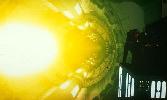 Note 2: Given that some modern
Starfleet planetary defense networks, space stations, and starships mount
hundreds, even thousands, of Type-11 and/or Type-12 phaser emitters, it is
understandable if the notion of the Death Star superlaser being a Type-11
energy weapon sounds downright absurd on the surface, especially since (the
Expanded Universe aside) the immense bulk of the Death Stars was almost
exclusively dictated by the volume required by its prime weapon system -
indeed, the sheer size of the station and the superlaser's exterior muzzle
diameter seem to argue for at least a Type-18 classification.
However, for visual evidence that the superlaser is "only" a Type-11, one only
need look at the interior firing sequence of the superlaser - namely, as
seen in the upper right-hand image, the
discharge of a turbolaser beam down a focusing coil past two members of a
gunnery crew. Given that the gunnery crew were right next to the focusing
coil (indeed, they were so close that they had to turn away and cover their
faces during the firing process), it is obvious that the interior diameter of
the focusing coil (which produces one strand of the multistranded energy beam
characteristic of the superlaser) is no more than 5 meters in diameter. Even
with the inclusion of the focusing coil's cooling system (from the "Superlaser
Firing Station" diagram provided in WEG's Death Star Technical Companion)
to yield an overall diameter of 1115cm, and using the 4cm diameter Type-2a
DLT-19 Stormtrooper heavy blaster rifle as a baseline, the focusing coil measures,
at most, as a Type-10 turbolaser - which in turn yields a Type-11 superlaser
weapon with all eight components combined and amplified. It should be kept
in mind that plasma-based turbo- and superlaser type weapons are considerably bulkier
and more massive than their standard counterparts due to the extensive
hardware needed to supercharge the energy beams generated by their
baseline energy weapon with the energy built up in the weapon's
capacitors (not to mention the equipment needed to keep the weapon within
safe operating temperatures while firing) - and the Death Star superlaser, as the
embodiment of the Star Wars plasma turbolaser concept taken to its limits, would
accordingly have extremely small primary directed energy components relative
to the rest of its hardware. (return)
Note 2: Given that some modern
Starfleet planetary defense networks, space stations, and starships mount
hundreds, even thousands, of Type-11 and/or Type-12 phaser emitters, it is
understandable if the notion of the Death Star superlaser being a Type-11
energy weapon sounds downright absurd on the surface, especially since (the
Expanded Universe aside) the immense bulk of the Death Stars was almost
exclusively dictated by the volume required by its prime weapon system -
indeed, the sheer size of the station and the superlaser's exterior muzzle
diameter seem to argue for at least a Type-18 classification.
However, for visual evidence that the superlaser is "only" a Type-11, one only
need look at the interior firing sequence of the superlaser - namely, as
seen in the upper right-hand image, the
discharge of a turbolaser beam down a focusing coil past two members of a
gunnery crew. Given that the gunnery crew were right next to the focusing
coil (indeed, they were so close that they had to turn away and cover their
faces during the firing process), it is obvious that the interior diameter of
the focusing coil (which produces one strand of the multistranded energy beam
characteristic of the superlaser) is no more than 5 meters in diameter. Even
with the inclusion of the focusing coil's cooling system (from the "Superlaser
Firing Station" diagram provided in WEG's Death Star Technical Companion)
to yield an overall diameter of 1115cm, and using the 4cm diameter Type-2a
DLT-19 Stormtrooper heavy blaster rifle as a baseline, the focusing coil measures,
at most, as a Type-10 turbolaser - which in turn yields a Type-11 superlaser
weapon with all eight components combined and amplified. It should be kept
in mind that plasma-based turbo- and superlaser type weapons are considerably bulkier
and more massive than their standard counterparts due to the extensive
hardware needed to supercharge the energy beams generated by their
baseline energy weapon with the energy built up in the weapon's
capacitors (not to mention the equipment needed to keep the weapon within
safe operating temperatures while firing) - and the Death Star superlaser, as the
embodiment of the Star Wars plasma turbolaser concept taken to its limits, would
accordingly have extremely small primary directed energy components relative
to the rest of its hardware. (return)