The white strings of change and restoration: Baci
Somsack Pongkhao
The popular Baci or Sou Khuan ceremony is a ritual that restores the natural
order of things and brings communities closer together. The Baci is held by
people nationwide to ask for good luck, riches and long life in the dry season,
during festival time or after events that change people's lives.
"We believe that pain and sickness will be gone after organising the ceremony,"
said one elderly woman who organises a Baci every year during the Lao New Year
celebrations.
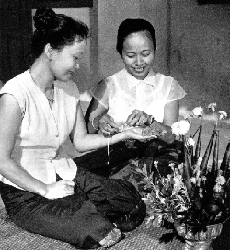
This ceremony appears to have become more of a cheerful formality than just a
simple ritual, but few Lao people would dare to undertake a long journey or
initiate an important enterprise without participating in it.
They are afraid that they would be unlucky or their business would be bankrupted
if they failed to organise the ceremony. It is a ceremony of prayers and good
wishes. It can be performed for a variety of reasons such as farewells,
marriages, greeting family members or relatives after a long absence, greeting
newborn children, honoring achievements or recovering from illness.
The Baci ceremony is the most charming face of all Lao customs. It is believed
that the ritual serves to call people's souls back to their bodies so that they
would have only happy and enjoyable thoughts.
The ceremony is usually held for a particular person and participated in by
relatives and friends. Participants
sit in queues eagerly waiting to tie white
strings on the wrists of the key participant and offer them well wishes.
The ceremony is mental food, encouraging people to understand the value of their
lives so that they could overcome all of the obstacles affecting their
participation in society.
photo:
http://diwww.epfl.ch/~samout/Laosarts/Baci.gif
"Good mental health is a special kind of medicine to overcome all of the
diseases that may threaten to destroy us," said Phra Maha Bounyouk, a former
teacher at the Sangha College at Ongteu temple. "If you don't have good mental
health, you will get older more quickly and be sad all the time."
Today, the Baci ceremony is becoming more and more popular among people in the
society. It is still used on official occasions.
Lao officials like to organise it to receive foreign guests, extending them
wishes of good luck during their visit. The ceremony helps to create solidarity
for people in the community while they conduct activities together.
In practice, a number of people sit around the Pha Khuan (a centre piece), which
is decorated with flowers, folded banana leaves and branches with white cotton
strings hanging down; bananas, boiled eggs, chicken, pastries, cookies (Lao
style), liquors, drinking water and money are placed surrounding the base of the
Pha Khuan as offering to the soul in attendance.
The ceremony is always conducted by a Mor Phon, usually an elder who has spent
some time as a monk in the past. He lights the candles, which have been placed
on top of the Pha Khuan. He then gives prayers while all in attendance hold
their hands in a prayer-like, palm-together pose.
If there are too many participants for everyone to reach the base of the Pha
Khuan, it's permissible to touch the elbow of some, who can reach it, thus
forming a human chain.
The Mor Phon would call people's soul to come to the flower arrangement by
saying Ma Yeu Khuan Euy "please come, soul !" and participants then repeat after
the Mor Phon. Participants touch the flower arrangement with their hands to
welcome the soul. Each participant will also touch the upper arm or back of the
person closer to the flower arrangement, or of someone whose wrists are being
tied with strings to ensure that the good luck transfers to them as well.
Everyone takes a white string and ties it around each wrist of the honoured
guests while whispering a short, well-wishing recitation.
Food and drinks are served after the ceremony, followed by a party.
"Before people tie a white string around the wrists of each guest, they tie a
knot in the string. It is believed that the string would firmly tie the soul
with their bodies. They also like to put food or drinks on the person's palm
while tying their wrists to ensure they will have a lot of things to eat and
drink in the future," Maha Bounyouk said.
He explained that the person who ties the string will move it along the
recipient's hand and say Hai Kuat Nee (bad things leave) and Dee Kuat Khao (good
things come) three times to bring auspicious meaning to the recipient. The
recipient will raise their right hand up to their chest level in the prayer-pose
to show their respect for the person who is tying the string.
At first, the Baci ceremony might look a bit like your average drinking contest,
but a Baci ceremony is an ancient rite used as a blessing, to perform a
marriage, to say welcome or farewell, or to honour achievement. Ceremonies vary
in formality, but most are inclusive by nature. Foreign visitors might be
invited in, offered a seat in the circle on the floor, and offered plates of
food.
The ceremony itself is slow, taking one or two hours. People come and go and
casually chat over the sound of chants and singing. Participants sit in a circle
around a bouquet of flowers or offerings of food and join hands, saying prayers
and blessings in both chanting and song.
White strings tied around all celebrants' wrists are to be worn for 3 days
thereafter for good luck.
The Baci ceremony originated from the Hindu religion in India. It went to
Cambodia at the time when a young boy Konthonyaman went to marry the daughter of
the Cambodian king. The ceremony was practiced in Cambodia for quite a long time
and then it was brought to the Land of Million Elephants during the reign of the
King Fa Ngum, who united the country.
Source:
http://www.vientianetimes.org.la
Back to SSEAYAA-Laos
