
Why Homosexuality Can be Portrayed in Young Girl's Anime in Japan
by Amanda Sage
Gender, Race, Media
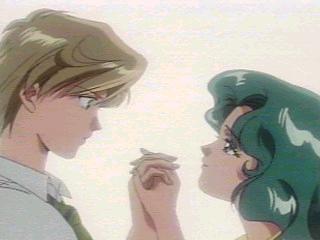
Anime (Japanese animation) is becoming popular in the United States. Many popular cartoons in America, such as Pokemon, Digimon, Cardcaptors, and Sailor Moon were originally animated in Japan and then brought to America and redubbed for a young American audience. However, while being redubbed, many shows lose some of their original context. One thing often dubbed out of the American versions of these shows is any trace of homosexual relationships. This study looks at the differences in American and Japanese acceptance of homosexuality, especially in shojo (girls) anime, and whether the changes made in the dub are necessary and/or harmful to the content of the show.
Introduction
Anime first came to America in 1964, when the show Astro Boy (originally Tetsuwan Atomu) was introduced to American audiences. Since then many animated shows have come to America. Some of these shows, such as Cardcaptors (originally Cardcaptor Sakura), were also reedited so that they could be aimed at a different audience. Thus, while Cardcaptor Sakura was originally a shojo anime, or anime targeting girls, it was presented in the United States as a boys' show, starting not with the actual first episode, but with the first episode featuring the male lead, originally the eighth episode.
Bishojo Senshi Sailormoon (Pretty Soldier Sailormoon, known as Sailor Moon here) was not changed as drastically when it was brought to America, but there were many modifications made to the show when it reached American TV. Much of its editing came from an effort to hide any hint of homosexual relationships. When possible, some characters' gender was changed, such as Zoisite, whose relationship with Kunzite (Malachite in America) stayed intact in the English dub because he looked so much like a woman that the writers of the dub could pull off changing his sex to female.
In other cases, the relationship itself was changed. The most obvious case of this is Haruka and Michiru's relationship in Bishojo Senshi Sailormoon S, the third season of Sailormoon. Although Haruka looks and acts a lot like a male, she is also Sailor Uranus, who wears a skirt and clearly is developed like a woman. So instead of changing her gender, which would suggest transexuality or transvestitism, hers and Michiru's relationship is changed from one of lovers to that of cousins.
RQ1: Why can young children in Japan be exposed to homosexual images when children in America cannot?
RQ2: Has American dubbing gone too far to the extreme to hide homosexual hints from anime's American audience?
Method
Shojo anime episodes were watched for this study. There was an intense comparison of the subtitled and dubbed versions of Bishojo Senshi Sailormoon S (Sailor Moon S). Other shojo anime examined were the subtitled versions of Cardcaptor Sakura, Shojo Kakumei Utena (Revolutionary Girl Utena), and other seasons of Bishojo Senshi Sailormoon.
These programs were examined using context from articles and books on anime and on Japanese views of homosexuality. These texts were used to examine the difference between the Japanese and American cultures, in an attempt to discover why young girls in Japan could be exposed to homosexual images when young girls in America could not.
Shojo Anime and Sailor Moon:
Many anime shows are inspired by manga (Japanese comics). Shojo manga and shojo anime often deal with relationships, whereas shonen (boys') manga and anime tend to focus more on action. One can generally tell shojo anime and manga by the size of the character's eyes, since larger eyes can show more emotion. Originally, shojo manga focused only on emotion with little plot. "Plots were weak. Eyes, however, were enormous. Almost nothing happened, but you certainly knew exactly how everyone felt about whatever it was that wasn't happening" (Levi 9). As time went on, plots became better in the shojo manga, so that now, shojo anime has combined emotion with action.
Since shojo anime focuses so much on emotions, many different types of relationships are portrayed in these shows. Often homosexual themes will be presented. In Shojo Kakumei Utena, the show is premised around Utena's relationship with Himemiya, both of whom are female. At least in the first season, Utena makes it clear that although she has accidentally won Himemiya, who is the Rose Bride, in a fencing duel, she does not actually want a romantic relationship with her. However, other characters in the show, such as Jury and Wakaba, who makes her intentions towards Utena clear, are undeniably homosexual. Others are slightly more ambiguous, such as the Rose Bride herself, who simply must do whatever her "champion" wishes.
Even shows that are specifically tailored toward young girls, such as Cardcaptor Sakura and Sailormoon, present homosexual relationships. Sakura, the main character in Cardcaptor Sakura, is only in the fourth grade. Yet she seems to be surrounded by homosexual crushes. Not only is she in love with Yukito, her brother's male best friend, but so is her brother and Li, her male rival. Furthermore, her best friend, Tomoyo, is in love with Sakura, and Tomoyo's mother used to be in love with Sakura's mother. Except for Li's crush on Yukito, Sakura is mostly clueless about all the homosexual activity going on around her.
