Mal Reilly
Mal Reilly developed a reputation of being of the most feared players
in the game in his time. He was a champion players in England and
in Australia for Manly, winning every available honour the game had.
His successes continued when he started coaching in the 1970's. In
1995 Reilly accepted the coaching job with the Newcastle Knights.
Surviving the ARL - super league battle, Reilly took his Knights to a premiership
in 1997 and came through a drug scandal in mid 1998.
At the end of 1993 Reilly was looking for players to play in his english
club Halifax. Reilly decided to contact Michael Hagan was looking
to finish his career somewhere in England. Having signed Hagan,
two other Newcastle players were signed also, David Boyd and John
Schuster. All black Schuster was apparently out of favour with Waite and
Boyd was interested in playing out his career in England. In the
end, all three players were signed to Halifax.
Reilly resigned as Englands Test Coach to take over the Knights position,
bringing him back into the competition he had seen back in the 1970's when
he played for Manly. Reilly had instant success with a revitalised
side and the club finished fifth on the points table after starting the
season with nine straight wins, and 12 from 13, then finished with 17 wins
for the season. The Knights then beat Norths sydney 20 - 10 and Cruonulla
19 - 18 before bowing out in the final 4 -12 to Manly. The Knights next
season only managed 10 wins to finish ninth position, missing the final
eight for a play off spot after being beaten 22 - 0 by Cronulla in the
final round. Reillys aim was for the team to perform at a constantly high
level , up to 90%, which would make the side very competitive.
The aim is to never fall below the 90% rate. In 1996 the players
lost their confidence. The external distractions in 96 did not help
either, especially the formation of another team in Newcastle. By
the end of season 1996 the majority of the football staff took a pay cut
and Newcastle lost three key players to St George, Ainscough, Tangata -
Toa and Treacy.
AT LAST, REILLY CONFIRMED TO GUIDE KNIGHTS - 22
Aug 1994, Sydney Morning Herald
Great Britain Test coach Mal Reilly, was last night appointed by Newcastle
for the next two years, confirming David Waite as the season's third coaching
casualty. Waite, who took the Knights to their first finals series
only two years ago, will end a seven-year association with the club after
Friday night's game against Illawarra at Steelers Stadium. Waite last night
declined to comment and said he would not do so "for several days".
Reilly, meanwhile, faces an agonising wait as officials at Britain's
Rugby Football League deliberate on whether to sack him from this year's
Ashes series following his decision to walk out on the remaining year of
his contract with the national team. "I don't think that will happen,"
the 46-year-old former Britain, Manly and Castleford back-rower said in
a telephone hook-up at last night's media conference. "I have to wait until
(RFL chief executive) Maurice Lindsay gets back from America this afternoon."
Reilly said that if he was sacked, it would not discourage him from
taking the Knights job, for which he has been negotiating for two weeks.
Newcastle chief executive Brad Mellen refused to comment on whether the
decision had been unanimous. Another of the contenders, current Knights
reserve-grade coach Robert Finch, was named football manager. In early
1994 Reilly considered coaching in Australia, feelers were put out
by his mate Ken Arthurson. a couple of clubs were interested but Newcastle
were prepared to meet Reilly almost straight away. By June 1994 (england
off season) the Newcastle interest was developing. Reilly meet the
chairman and general manager of the Knights in hong kong to discuss the
possibilities. Reilly still had his two year club committment and
was the current great brittain coach, in a season where the australian
kangaroos were touring. Reilly's appointment represented a huge financial
gamble by the Newcastle club which at that time did not have a major sponsor
and started the season $2 milion in debt with accumulated losses of a further
$1.5 million. "Malcolm Reilly once told me that Newcastle was the capital
of the rugby league world. It is something the club and the players are
proud to claim."
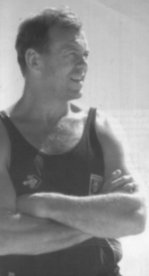 |
"I came out here to coach guys like Paul Harragon,
the Johns brothers, Jamie Ainscough and the rest."
Player - won challenge cup twice with castleford
in 1969 and 1970
Player - won sydney premiership twice with manly
in 1972 and 1972
Coach - won challenge cup with castleford in
1987
Coach - won sydney premiership with newcastle
1997 |
Seventh Crusade - 1995
The team Reilly was taking over had been fifth place only seven rounds
out from the 1994 semi finals under David Waite, only to lose their
way badly and drop the last seven games. The 1995 season brought
Malcolm Reilly to Newcastle. He was a feared man as a player and
when he walked into the first training session with his trademark sunglasses
(as worn by prison guards in Hollywood movies) he became a feared coach
as well. Mal believed the team was quite tactically sound but saw a team
of boys trying to compete in a man's game. He proceeded to turn us
into a team that came within a whisker of a grand final appearance that
year. Mal has an amazing aura, one you could even sense when watching him
on television.
When news broke in Newcastle that Great Brittan Test Coach Malcom Reilly
was appointed coach of the Knights there was a negative vibe around newcastle.
A few questions were asked about the signing of an English coach, even
of Mals credentials. Mal as a player was aggressive and had a vast
array of skills, he was going to bring professionalis to the team also.
Reilly had every little detail taken care of and the players were looked
after. Reilly would not let his players play a match if injured,
at times the players would have to beg him to play. One of the first
pre season training exercises was a run around the Broadmedow race track
on a hot sticky summers day, running into a strong wind the players
brought in some slow times. Each player received a letter from Mal
saying that the training was unacceptable and if it was to continue, they
could pack their bags. Over a short period of time, the players accepted
Mal and showed the respect he deserved.
Superleague war certainly played a part in the 1995 season, confusing
and angering the league population. Not a day went by without a mention
of the ARL - super league split. It was April 1st, 1995. The day
that people knew of "super league". The day the most controversial story
in rugby league history broke. Super League had planned to start in 1996
but legal action prevented it. A 220-page court decision went in favour
of the ARL - A decision that was dramatically over-turned in an appeal
almost one year later. Then it happened - Super League was here.
1997 was the year that we had 2 competitions. Most people were not interested
in what was going on in the matches, they were more interested in when
the game would once again become together.
Newcastle came within one game of making the grand final in 1995 and
with the ARL-SL split, many Newcastle players cashed in on Test jumpers,
Harragon, both Johns brothers, Jamie Ainscough, Adam Muir and Robbie O'Davis
all winning World Cup berths in 1995. It was April 1st, 1995. The
day that people knew of "super league". The day the most controversial
story in rugby league history broke. Super League had planned to start
in 1996 but legal action prevented it. A 220-page court decision
went in favour of the ARL - A decision that was dramatically over-turned
in an appeal almost one year later.
The start of the season was a dream of Reilly, Newcastle winning
the first nine games straight, a club record. The first game against
Cronulla was a hard and fast game, the Knights winning 6 - 4 away from
home. There were some big wins, 54 against the Western Reds,
48 against Auckland, and a strong win against St George after Ainscough
was sent off. Newcastle were playing with a different style, a more
open game. Newcastle played with a format, and when the fundamentals
were right, the team played football openly and aggressively. In
round 6 against Western suburbs, the Knights won in the last minute with
a Ainscough field goal, 32 - 22 away. The Newcastle players
responded to Reillys coaching and were a premiership contender. Then Newcastle
got a little confident and lost one they shouldn't have, against
South Queensland Crushers. after 13 rounds, Newcastle had 12
wins. Newcastle experience a late seasons slump, then won against
Norths 20 -10 and a struggling win against Cronulla 19 - 18, with a Mathew
Johns field goal. The following win Newcastle lost to Manly in a
crunch game, 12 -4. Newcastles season was over for 1995.
Manly knocked the Knights out a game away from the 1995 grand final.
Looking back that young Newcastle side was still learning and maturing.
There was some satisfaction in making it that far, and defeat was much
easier to accept that the 2000 seasons final loss against Easter Suburbs.
Reilly states that the team was below strength levels of clubs like Canberra
and Brisbane. boiling down to the fact that the players hadn't been
doing specific training. The knights were a few seasons behind some of
the clubs in physical preparation. Over the next three years it was
reillys aim to peg back this difference. leg strenght and explosive
training was used, and the players dropped body fat and were more effective
as a result.
Season 1996
The following year, 1996, Reilly was in charge of the Knights - and
not just in coaching terms, as officials and administrative staff bailed
out en masse to join Super League's rival Hunter Mariners outfit. Superleague
broke rugby league in two, with the people in the Newcastle area having
to pick between two home teams and competitions. The Newcastle Knights
or the Hunter Mariners. Mal brought a professional attitude to the club,
every minor detail was taken care of and the players were allowed to concentrate
on their football. Even though 1996 was a bad year for the knights,
they played well below their best, and there was alot of room for improvement.
During the mentioned losing streak, Jamie Ainscough and Darren Tracey learnt
through a newpaper rather than from the club, that they were no longer
wanted at the knights and would be released at the end of the season. Andrew
Johns spent a few weeks of the off season on a surfing sabbatical on a
remote island in the phillippines. Making the most of the surf, sun
and solitude, he came back to the knights with the right attitude. It was
unknown to Reilly how much hidden anger Mark Sargeant had for him. In 1995
Sarge was the Newcastle Captain, a foundation player at the club, immensely
popular and well respected. He was moving into the latter stages
of his career as a front rower. Sarge was used as an impact player,
with the 10 meter rule is was difficult playing Chief and Sarge together
as their defence was limited. Playing the captain, Sarge off the
bench offended him. This did not surface until Sarge moved to superleague,
getting off the bus at Swansea instead of travelling down to Sydney to
sign with the rest of the team.
Newcastle finished the 1996 season on ninth, with a record of 10 -
10, collapsing in round 2 like a pack of cards, losing seven
of eight matches in succession. Players who had tasted success in
1995 were struggling to handle the success. The day Balmain beat
Newcastle in April at Marathon, where the players were jeered off their
home turf. The papers said, "The supporters booed, the coach was
appalled and the players seemed lost." Their was a chance to make
the semi finals in round 19, a match against Parramatta where they lost
18 -16 in a Monday night game. The last round newcastle were thrashed
22 - nil against Cronulla.
Why the Knights went downhill 1996
13 Aug 1996 Sydney Morning Herald
What caused Newcastle's spectacular crash? According to several senior
Knights players, one key to the downfall was the decision to release centre
Jamie Ainscough and lock Darren Treacy at the end of this season. Monday
night's 18-16 loss to Parramatta left the Knights without a win in eight
weeks, and even three wins in their remaining games will not guarantee
them a finals spot. Mid-season, they were tipped to make the top four.
Knights captain Paul Harragon yesterday re-signed for three years, but
fullback Robbie O'Davis, who was expected to commit himself to the club
yesterday, did not do so. O'Davis was one of several players who yesterday
claimed the July 21 announcement that Ainscough and Treacy would be cut
so other players could be retainted had been disruptive. "Learning that
a couple of players were going to be sacked certainly didn't help," O'Davis
said last night. "At the time we had one win from our previous six games
and it was added pressure we didn't need. "I think they should have tied
up 'Chief' (Harragon) and I more than a year ago, and should be concentrating
on the Johns boys and Adam Muir now. "Instead, they're still trying to
tie up blokes who are off contract at the end of this year and seem to
be throwing around money they don't have."
Lock Marc Glanville agreed: "When the club announced they were going
to brush Jamie despite his three-year contract, it had to have some effect.
"A lot of us are on long-term contracts. What does that say for us? It
doesn't make you feel very secure. But I don't think we can blame management
for what has happened. We are the ones out on the field and most of the
blame must rest squarely on our shoulders." Knights football manager Dave
Morley, who broke the news to Ainscough and Treacy, admitted Ainscough's
relationship with management had soured. "There is no problem between the
players and Malcolm (Reilly, coach), but I don't thing Jamie is too happy
with management," Morley said. "I'm comfortable with my role, I was the
bearer of bad news, and I've got to accept that.
Other reasons for the Knights' poor results late in the season include:
* The toll of the representative season on several players, most notably
halfback Andrew Johns; * An angry response to the results from a small
band of militant supporters who made it clear they resented the sums players
were being paid; * An expectation on the part of the players that their
1995 form would naturally continue, without the required effort; * A sizeble
blow to players' confidence after they played well enough to beat Brisbane
and Canberra in rounds 14 and 15 - but lost; * Increased awareness of the
Knights strengths and weaknesses by opposition players and coaches; * A
tendency to "peak too early" in the season. In announcing his decision
to stay with the Knights for the rest of his career, 27-year-old Harragon
said yesterday: "At this stage of my career if I can't win a premiership
in Newcastle, I don't want to win one." Reilly last night again declined
to make any changes to his side for the game against the Roosters this
weekend, although centre Brad Godden is in doubt with a shoulder injury.
Prop Glenn Grief (foot) is expected to miss the rest of the season.

"The approach today is scientific and specific."
Season 1997 - Premiers
1997 saw Super League and the ARL go head to head in Australia for
the first time. The ARL won the war due mainly to the stronger club football
scene which had been built up over decades of tradition. ARL games were
generally closer, more exciting and more interesting. The Super league
club football was always going to be a problem since it had to introduce
two new teams just to make the competition table of ten teams. Newcastle
started the season with three new buys, Wayne Richards, Adam
Mac Dougall and Leo Dynevor, all were to play key roles in the up coming
season. The club's junior development program has always been a nursery
for players. Eleven of the players from the 1997 grand final team came
through that system.
For the Knights, the season 1997 started with pre season in Coffs Harbour.
There were certain expectations of the Knights with the competition being
reduced and a top 7 play off format. A combination of injuries to Andrew
Johns and Paul Harragon threw the gauntlet down to the other players. Andrew
Johns missed alot of football through 1997 with a badly injured ankle in
an early season trail against Manly in Coffs Harbour. Johns had only
played 40 minutes of football by round 14, but was selected in the
NSW state of origin side and was still carrying an injury as well.
Johns got through the game and started his come back with the Knights.
Andrew Johns played only 11 games during the year, but contributed
to the Knights cause immensely. The chief was struck down by severe
migraines which caused him to miss 6 games.Leo Dynevor also played half
back during the 1997 playoffs and the majority of the premiership matches
as Andrew Johns was injured. Dynevors efforts were and are forgotten
with the grand final celebrations, and the fact that Joey sent Darren Albert
in for the winning try.
Brett Grogan, who thought he would never play again, hopes to return
to rugby league within two months. Grogan was struck down by bacterial
meningitis and has lost 14kg in two weeks. He was thought to be under consideration
for Queensland Origin selection. Very early on a racial oath was directed
at Owen Craigie by North Sydney's Chris Caruana, the incident became
public knowledge by the media and Caruana apologised. A distraction
was the media hype of would Mathew and Andrew Johns stay in Newcastle.
By this stage, Andrew Johns represents much of the team, general
kicking, goal kicking, field goal kicking, general leadership, and
combining with Matthew Johns as play makers. Adam Muir and Mark Glanville
played their last home game against Balmain. Muir was off to
North Sydney and Marc Glanvill was off to England to play with Leeds.
The Knights steam rolled Balmain and won 34 - 10. The Newcastle forwards
lifted and smashed the highly regarded forwards of Balmain.
As the Knights headed into the final series they were on a roll with an
air of confidence.
The first semi final 97 - Trailing 18 –
0 after 18 minutes against a Parramatta side that could do no wrong, the
Newcastle Knights somehow dug themselves out of a deep, dark hole to conjure
up a remarkable 28 – 20 victory over parramatta at the Sydney football
stadium. Andrew Johns scored a brilliant solo try, stepping and swerving
his way past six defenders to score the try that leveled the game at 20
all. John in the process suffered a bad rib injury as he was
driven into the ground. Johns ribs were to be the subject of many
headlines leading up to the grand final. During the second half of
the match Matthew Gidley was injured with a broken leg and Robbie O'Davis
was badly concussed. Newcastle winning this match 28 - 20.
Semi final Two - For a game not supposed
to mean anything, it had everything. Manly beat the knights 27 –
12 to earn the right to play Sydney City the following week for a place
in the grand final. Newcaste rested O'Davis, Johns, Gidley, Grogan
and Clements.
Semi final Three - A last minute field goal
to Matthew Johns broke a 12 all score line with under two minutes remaining
in the game. The Knights scored after full time from an intercept from
Paul Harragon to make the final score 17 –12. The Knights realized a life
long dream by going into their first grand final against manly. A memorable
moment in the match was Darren Albert chasing Matt Seers from the opposite
side of the field and cutting him down centimeters from the line, and tackling
him into the corner post and saving a certain try. Going into the
1997 Grand Final, Manly dominated Newcastle in their recent history, having
won the last elevan games.
Sydney Morning Herald by Steve Mascord.
If you are looking for winners out of the Super League war, look no
further than Newcastle. Three weeks before the 1997 grand final Newcastle
chairman Michael Hill set off for an urgent meeting with Australian Rugby
League chief executive Neil Whittaker in Sydney. He got to the Hawkesbury
River Bridge when his mobile phone rang. Whittaker was in negotiations
trying to stitch the game back together and would not be able to reschedule
a meeting for a month. "I was going to tell him that we needed urgent funding
or we were not going to be able to pay our players," Hill said yesterday.
The Newcastle Knights were at death's door. "Three weeks later we won the
grand final and it didn't matter." With winger Darren Albert's try with
six seconds left in the ARL decider against Manly, merchandising, prizemoney
and sponsorship propelled Newcastle back into the black. "What we got out
of the win elevated us into the top quarter of the competition," said Hill,
"and we have been there ever since."
Specialist on stand-by at decider for Joey's bung lung
By BRETT KEEBLE, 23 Sep 1997. Newcastle Herald
A LUNG specialist will be on stand-by at the Sydney Football Stadium
on Sunday in case Newcastle Knights halfback Andrew Johns suffers a recurrence
of his collapsed lung in the Optus Cup grand final against Manly. The match-winning
playmaker was still in hospital last night and although coach Malcolm Reilly
rated him a better-than-even-money bet, Johns is desperate to play in the
decider and will not hear of anything else.
Johns and Leo Dynevor were bracketed at halfback for the game of the
Knights' lives, while injury concerns over hooker Brett Clements (groin)
and centres Matthew Gidley (lower leg) and Brett Grogan (ankle) meant they
were named on the bench and will have to pass fitness tests later in the
week. Bill Peden was named at hooker with Adam MacDougall in the centres
and Mark Hughes on the wing, although MacDougall and Hughes swapped those
positions in last Saturday's 17-12 victory over North Sydney.
Johns will be released from hospital today but will return tomorrow
for tests with specialists to check his rate of recovery. `I'll play, no
two ways about it. I'm off the morphine and I'm feeling heaps better,'
Johns said. `I'm coming back in on Thursday to do some tests on the treadmill
to see if my lung stays inflated and won't collapse again. `One of the
lung specialists will be at the game and the worst-case scenario is if
it happens again, he'll be there to reinflate it.'
Reilly will give Johns as long as possible to prove his fitness but
would also consider using him in short bursts off the bench. `He can only
go forward from here. The doctor said he should be fine by Thursday and
then he's got another two days to recuperate,' Reilly said. `If anybody
can do it, Andrew can. `If he's not 100%, there will also be a chance
for us to use him on occasions and that will be contemplated also.'
Reilly said he would probably start Clements if he passed a fitness
test, which would mean moving Peden to the second row and Wayne Richards
back to the interchange bench. With the spotlight on Johns and his
damaged ribs and lung this week, Knights captain Paul Harragon was confident
it would not adversely affect the team's preparation. `It won't be distracting
to him because it will probably take his mind off the game a bit,' Harragon
said. `Maybe because he's such an important part of the team there's
a possibility of it affecting us a bit but with blokes like Leo Dynevor,
who did a great job there for us last game, and Matthew (Johns) we don't
lose too much. I'm sure Mal won't let it worry us at all.'
Meanwhile, Harragon believed the huge interest in the game among Newcastle
fans and the weight of expectation from the city could only have a positive
effect on the team. `I don't think we're feeling any pressure at all,'
he said. `Manly are the championship side of the last two or three years
so they're going to feel all the pressure. We've got a very inexperienced
side and no-one's played in a grand final. `Mal's our only grand final
experience. He's played in a few. `We haven't got any pressure on us and
it's tremendous that we've got the whole town riding on our back and pushing
us. `At the end of the day I think that will make the difference.'
Reilly threat to sue ARL; Sun Herald. Jul
6, 1997.
SOMETHING very funny transpired at the Phillip Street headquarters
of the Australian Rugby League last Friday night. Three players from the
third State of Origin game had to front the ARL judiciary of Alan Sullivan
QC (chairman), Kevin Brasch (Queensland) and David Barnhill (NSW).
Gladys has discovered that Newcastle Knights coach Mal Reilly made
some very substantial threats about Andrew Johns, his halfback and major
playmaker.
Reilly told guests at a dinner party in Newcastle earlier in the week
that he would initiate legal proceedings against the ARL if Johns were
injured.
Reilly was angry that Johns was playing with painkillers. He took the
view that if Johns were hurt playing for NSW and unable to take the field
for Newcastle at the weekend against the Crushers, the ARL would be liable.
Gladys has also discovered that Newcastle considered using the "Nuremburg
defence" in order to get Johns off the fighting charge after the Origin
game. This is the "acting on higher orders" argument used by Hitler's generals
after World War II. In other words, someone at Newcastle considered using
the argument that Johns was told to go the knuckle if fighting broke out
on the field. As events transpired, this was not mentioned during the hearing.
For the record, Knights football manager Dave Morley, who drove Johns to
the hearing, says he knows nothing of this defence. But a major figure
who observed the three hearings on Friday night told Gladys that "a defence
was withdrawn". Geoff Bellew, the counsel used by all three players
- Johns, St George's Wayne Bartrim and Goold Coast's Jamie Goddard - quite
rightly refuses to comment. St George chief executive Brian Johnston and
Gold Coast boss Paul Broughton say they know nothing of any defence to
blame higher orders for the fighting on the night. But they are concerned
about their clubs being penalised for actions beyond their control. Gold
Coast lost Goddard for three games during the series, then another two
for his suspension. It seems Johns got off very lightly. He will miss only
one match because of the split-round situation, yet he was involved in
three fights with Goddard.
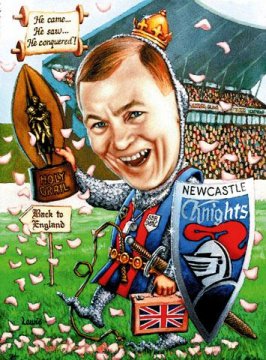 |
Great Britain captain Andy Farrell asked Matty
Johns last year: "Isn't Malcolm a bit of a legend up there in Newcastle?"
"Legend? Mate, if he came home tomorrow
and ran for lord mayor he'd win in a landslide." |
The Knights of their lives
TERRY SMYTH, 27 Sep 1997. Sun Herald
ON the locker-room wall at the Knights' home ground is a sign which
says it all: "Our town, our turf, our team." After 10 tough years, the
Newcastle Knights finally get a shot at the brass ring today, and the town
which bore them is beside itself. After celebrating a bicentenary in a
year haunted by the banshee of steel-making, this is the shot Newcastle
needs.
Everything in the city is blue and red. There are streamers, balloons,
banners and paint on office buildings, shops and homes, schools and churches,
cars and buses. Cake shops are baking red and blue pastries; fast-food
joints are making red and blue hot dogs; pubs are pulling red and blue
beer. At the Knights' merchandise shop, fans have been in a buying frenzy
all week, snapping up T-shirts, caps, flags and car streamers. On just
one day, 2,500 T-shirts were sold by noon and a further 4,000 due later
in the day were already spoken for, while suppliers were fast running out
of jumpers and flags.
After a mad scramble for tickets in Newcastle, an estimated 15,000
Novocastrians are bound for today's ARL grand final by bus, train and car.
It is all about being there, it seems, and not just for the fans, but for
the team itself. Even the most die-hard fan will admit that in their early
years the Knights were all catch and kill, and it is still said that their
game is more about tenacity than tactics. The bitterness of the ARL-Super
League war lingers on in Newcastle and hackles have been raised by claims
that the Knights would not have made it to the grand final had there been
a united competition. Still, the city's mood is such that nothing can spoil
the party - not even Manly.
To Novocastrians, Manly is not just the team everyone else loves to
hate but the Knights' nemesis. Manly has beaten them in 11 straight games
and, in 1995, ended their only previous premiership hope by knocking them
out in the semis. Winning. It would be a bonus, people say. But mostly
it is as though no one dare think it aloud, as if that might jinx the team's
chances. On a flying visit to his parents before the big game, Knights
captain Paul "the Chief" Harragon reflected on carrying the hopes of a
quarter of a million people on his shoulders. "It's no weight to carry,"
he said. "In fact, it's uplifting, like they will be carrying us. "A win
would be great and we'll do our best. We'll do it, but it'sno burden because
they're all very proud of us."
At a roadside chicken outlet, Ringal Valley, passing motorists hooted
approval for signs such as "Sea Eagle fillets, slightly off!" and"Battered
Sea Eagles". But the main attractions are a red and blue striped car sporting
Harragon's No 10 and a mannequin of his arch enemy, Manly's Mark "Spud"
Carroll, battered and bleeding.
At the Cricketers' Arms hotel, owned by Knights first-grade manager
Dave Morley, everything is ready for the after-match celebration, including
the biggest bottle of bubbly in town, a 12-litre magnum of champagne. At
about $4,000 a pop, it has been donated by Moet Chandon to toast the team,
win or lose. "They will win," said cellarman Brett Fairclough, willing
to risk the jinx. "Ten years is a long time to wait to get a shot at it,
so they're pretty motivated."
Clutching red and blue beers, Steve Wilson, Scott Lyne and Paul Delany
could not agree more. All junior Knights with first-grade dreams, they
were preparing to join the army of fans heading south for the game. "We've
got everything," said Mr Wilson. "We've got our flags and paint for our
hair and we're ready to go." Mr Delany said there was no need to be coy
about the outcome. He was emphatic: "They're going to win!" Win or lose,
she said, the great joy for Novocastrians would be to see their team run
out on to the field. There will not be a dry eye in town.
Knights and their faithful find the holy grail
Author: GEOFF WILSON, Date: 28 Sep 1997. Newcastle Herald
IT was 9am and the red-and-blue army was on the march yesterday. The
hopes and dreams were there, but none could have imagined what drama lay
ahead. There they were: car after car, mini buses, coaches. Just about
every mode of transport possible was heading south, all bearing red and
blue . . . and plenty of it.
By the time they started streaming into the Sydney Football Stadium
the drama was already unfolding. The Knights cheer squad had been locked
out of its dressing room and the girls were mad. `It was a great honour
to be picked and this is every bit as big a day for us as it is for the
players,' Renee Robinson said. `I just hope everything works out.' It did.
Outside the fans were streaming in, and most of them were Newcastle supporters.
Sam Stewart, the man who led the Knights at the beginning of the club's
career, wore his original Knights jacket just for luck. And he wore it
with pride. At 12.51pm Manly's bus pulled up. They got a cheer and a few
raspberries. Leading the Manly players out was Jim Serdaris, the man suspended
in last week's final. `Have a great game Jimmy boy,' one brazen Knights
fan shouted. Well, it got a cheer from the Knights fans anyway. At 1.20pm
the Knights coach lobbed. Stuck to the front window was the Faces of the
Aces cut-outs from The Newcastle Herald. Then a sight, well some would
even say a sign of what was to come. The doors of the coach opened and
a beaming Andrew `Joey' Johns jumped out and grabbed his gear. The man
that had been in hospital most of the week was ready to go. The cheer
as the Knights players made their way to the stadium was deafening and
extra security guards were called to clear the way. They went as a team,
well almost. Straggling behind was Adam MacDougall, who seemed to be soaking
up all the atmosphere. The ground filled quickly. The stands were packed
with the 42,482 fans by the time the pre-match entertainment started. The
usual go here lots of kids, songs by Christine Anu and Jimmy Barnes and
a presentation of former greats from the clubs. Representing Newcastle
were Gary Wurth, Les Johns, John Cootes and Sam Stewart. Yep, and Slammin'
Sam still had on that lucky jacket. Just as well.
At 2.59pm Manly ran on with a lot of cheers and a lot more boos. Minutes
later the Knights ran onto the field. Now this was a lot like going to
the Melbourne Cup. When the field jumps on the first Tuesday in November
the crowd erupts. You know it is going to happen but it still gets to you
when they yell themselves hoarse. The Knights had a tidal wave of support,
and the fans let the players know with one almighty roar. It was
something special. By half-time things were looking dicey but the Knights
fans remained optimistic. `Don't count us out yet,' Barbara Davis, who
had been lauded by the ARL for her support, said. This was going to have
to be one for the true believers . . . one for the diehard fans.
And that is how it worked out. By full-time the impossible had occurred,
the Knights had come from a seemingly impossible position to win.
In the dressing rooms, the Knights basked in glory and sang a song. Take
Me Home, Country Road, they crooned very badly. To the fans, a song never
sounded so beautiful. And the army was back on the move, the war won. And
to the victors go the spoils.
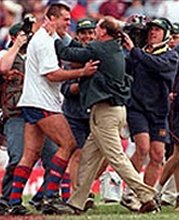 |
Harragon and Reilly at the end of the ARL Grand Final.. |
First crusaders up where they belong - 26 Sep 1997,
Newcastle Herald
The chance to take on and beat the best teams in Sydney was one of
the goals that drove the Newcastle Knights in their first crusade back
in 1988. Actually being good enough to beat them all often enough to win
a premiership was but a dream. That is why tomorrow's grand final against
Manly takes on extra significance for the four remaining `Originals', Tony
Butterfield, Marc Glanville, Paul Harragon and Stephen Crowe. Injuries
aside, Glanville and Butterfield have been regular first-graders since
the beginning and have played more games than anyone else in the club's
history. Harragon and Crowe began in Newcastle's under-21 squad.
Harragon, now the club captain and a regular in NSW and Australian
sides, has since emerged as the Knights' most decorated player and Crowe
has battled back from more injuries than he can remember to again be part
of the top squad. Fittingly, all four played in last Saturday's 17-12 win
over North Sydney to send the Knights into their first grand final. In
Sydney earlier this week for the Australian Rugby League's grand final
breakfast, the four men with almost 800 games in all grades for the club
between them, reflected on the importance of being in a premiership decider.
`It's very difficult to put into words what it means. It's more in the
heart,' Butterfield said.`You've busted everything in your body to get
to this stage, hung around probably longer than maybe you should have,
but now we're in a grand final.'
Crowe said the game would make the `bumps and troughs' of the long
journey worthwhile. `After the siren against Norths, when the Newcastle
fans were going berserk in the stands at the (Sydney Football) Stadium,
my thoughts honestly turned to the pubs and mines of Newcastle and how
much everyone would be rejoicing,' Crowe said. `Seventy per cent of this
side are local blokes and if you count blokes like MG (Glanville), Buttsy
(Butterfield) and Robbie O'Davis, who have been here so long we've adopted
them, it would be even higher than that. `We've all come through the grades
together, we've battled it out in successful lower-grade sides, and now
we're on the verge of something great.' Glanville leaves the Knights after
tomorrow's match, bound for English club Leeds, having played a record
188 first-grade and 204 grade games in the blue and red. `This is pretty
special for the blokes who've been here since the start. It's been 10 years
of blood, sweat and tears,' Glanville said. `I'm sure it means a lot for
the blokes who first ran out in 1988 as the pioneers of the Knights, and
all those that have played for Newcastle since then. I've been here for
10 years and am now a life member, so hopefully my last game in the red
and blue will be a grand final win.'
Butterfield's thoughts have also turned to some of his team-mates from
the early days, many of whom have called him this week to wish him and
the side the best.
`The big winners are the boys who participated in the formation of
the club,' he said. `All the old mates that have been through the training
sessions, the grind through the early years, standing up to the referees
and standing up to the more powerful clubs when our budgets were pretty
low. We've climbed the ladder ever so gradually and this grand final is
for all the ex-players and people who've contributed as much as it is for
the players at the moment.'Harragon believed only the players that had
been involved from day one could genuinely appreciate what went into reaching
the championship game. He said: `Having been here from the start you understand
it's been 10 years of hard work by a lot of people.'
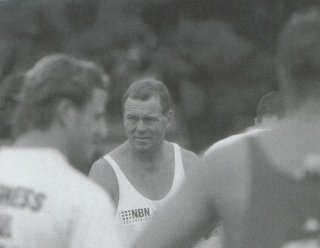
Great Britain captain Andy Farrell asked Matty Johns last year:
"Isn't Malcolm a bit of a legend up there in Newcastle?"
"Legend? Mate, if he came home tomorrow and ran for lord mayor
he'd win in a landslide."
Season 1998
Newcastle slowly wound down the celebrations from the premiership win
and started to concentrate on 1998. Season 1998 The loss of Adam
Muir and Mark Glanville did not help. Both the Johns brothers re
signed for another three years. Sponsorship and merchandise sales
were high for the year after the grand final. However, every move
the players made were headlines in the local papers. Andrew Johns said,
`I've been dying to play all off-season, it's a new challenge, not only
for myself but for the whole side. A lot of people are going to say, "Yeah,
you won the comp but it was when it was a divided competition", so we can
really lay those critics to rest if we have a very big year.' Matthew Johns
said, `I've never seen us train so well, our ball work and our skills and
everything we've done, and I think we're really ahead of ourselves. `Whether
we can maintain that through the season is another thing and something
we've got to work on, but coming into this game I'm looking no further
than ourselves. `To play to our ability week-in week-out is a tough ask
but I think if we do that, it's going to take a good side with a fair share
of luck to beat us. `It's not so much arrogance but if we play to our ability,
the cards will fall in the right places for us. We've improved at least
10 or 15 per cent on last season.'
With many injuries during the season of 1998, the Knights faltered
away in the semi-finals despite Andrew Johns having the best season by
any individual in many years. The Knights still kept their Home ground
advantage for the season by winning 66% of their home-games. Andrew Johns
carried the injury riddled and suspended reduced Knights to a top two finish
before bowing out in the finals. Coach Mal Reilly had a disappointing farewell
to Newcastle's Marathon Stadium when the Knights collapsed to lose 26-15
against Sydney City. With many injuries during the season of 1998, the
Knights faltered away in the semi-finals despite Andrew Johns having the
best season by any individual in many years. Despite a disappointing
year for the premiers, Newcastle had the highest consistent crowd averages
for the season and a 66% home-game winning average. While running on the
mini trap, the chief stepped off and came crashing down. A bone spur
snapped and was jammed in his knee making it impossible to walk or move.
Due to complication, the chief did not play until the start of the semi
finals. The knights lost Darren Albert when he went over his ankle
on a wet day during pre season training. A minute fracture on the
outside of his foot put him out before a game was played in 1998. A few
minutes into his come back game in late April, Albert opened up the fracture
again and was out for another three months. Matty Johns hurt his hamstring,
Troy Fletcher shoulder, bill pedan ankle, owen craigie knee, mark hughes
glandular fever, Brett grogan ankle. The second last game against
balmain was played to keep pace with Brisbane for the minor premiership,
the knights played without 13 regular first graders. The knights won.
During the season, all knights supporters will remember Andrew Johns
and Lee Jacksons dummy spit. During the televised game against Souths
at Marathon, after a few way ward passes from Lee, Joey was heard
to yell to the trainers on the side line to "Get him off." As the
knights headed to the finals, it became apparent that the team chemistry
was not what is should have been. To help this problem, Danny Buderis
was picked as hooker for the final series. Marc Glanville was in his last
season with the knights, heading to england at the end of the year. He
had been voted the players player more times than anyone else. Having
fought two knee reconstructions during his career.
Blue and red, never dead - 11 Jun 1998, Newcastle
Herald
A PHRASE coined by Newcastle Knights tough nut Tony Butterfield many
moons ago. Approached by a long-faced reporter after a Newcastle loss early
in the Knights' history, an upbeat Butterfield greeted him with: `Cheer
up mate! Blue and red, never dead.' Knights coach Malcolm Reilly has preached
the theme of mental toughness to his troops since arriving from England
in 1995 and slowly, but surely, the message is sinking in. `Honestly, we've
got one of the best offensive teams in the competition and yet we're still
not playing to our potential in that area,' said Reilly, issuing a warning
to rival teams that the National Rugby League leaders can only get better.
`I think there's a little bit of arrogance in the fact that we know we
can score tries. `So if we can keep teams under 12 points, then there's
every likelihood that the opposition will succumb to pressure. `I think
that's what is underpinning the team's success. They realise that if they
do the fundamentals and get back on track with the basics, they've got
the class and ability to put together two or three tries.'
Reilly has honed their mental muscles with the help of leading sports
psychologist Jeff Bond from the Australian Institute of Sport. Again, the
coach believes the players are yet to realise their full potential in that
area. `I think we're only half-way there at least,' he said. `Jeff's
been very good for us. `Along with the coaching staff, he can help them
prepare themselves and focus and sustain concentration longer and be more
single-minded about what they want to do but the secret is for them to
do it themselves. `It's just like working out in the gymnasium to improve
our strength or on the track to improve our speed.'
REILLY said the prevalence of youth, especially in the back-line, should
not be mistaken for inexperience or immaturity. At 25, fullback O'Davis
is their elder statesman. Take him out of the equation, tally up the years
on this earth of Owen Craigie, Matthew Gidley, Darren Albert, Adam MacDougall,
Jason Moodie, Brett Grogan and Mark Hughes, divide it by the number of
players and you get an average age of just 22. And the only ones in that
group not sporting premiership rings from last year missed out because
they were injured. `Our experience across the board is pretty good,' the
coach said. `Matthew (Johns) made the point in the press conference after
the Cronulla game that we'd conceded two tries and 12 points but the guys
realised the game was far from over and we have the ability to come back.'
MacDougall credited the efforts of Reilly and the rest of the coaching
staff for the team's new-found quality of fearing no opponent.
`It probably was a big confidence-booster coming back last year in
a lot of games. We gained a lot of experience and confidence out of it
and that's started to show this year,' the State of Origin winger said.
`I know it's had a big bearing on my mental preparation and toughness and
I'm sure a lot of the guys would agree with that. `By winning the grand
final last year we proved ourselves at another level and the mentality
of the guys now is that we are a champion side. We do have a world title
belt to protect as such.'
Anthony Butterfield said, "But it's an 80-minute game and the teams
that don't panic and adapt better to the situation will usually come out
on top. `You've got to hang in there until your chances come, even if that
takes until the last few seconds.' Andrew Johns explained. `It shows our
ability to hang in there and just wait for something to eventually come.
When it does, we're hungry enough to get it.' MacDougall said the
Knights knew that teams were going to lift a notch to try and beat the
ladder leaders but the players were ready for that and enjoyed the challenge.
The Newcastle Knights played well for most of the season. The
knights were a one man show - Andrew Johns who had his best seasons ever.
He carried the injury riddled and suspended reduced knights to a top two
finish before bowing out in the finals. Johns won just about every
major club award available in 1998. Matthew Gidley cemented a permanant
first grade spot with an injyry free year playing in all 26 matches. Three
players caught in the one year using performance drugs will forever cast
a bad shadow over the Knights 1997 ARL premiership and any matches in the
future. Nothing more needs to be said, it was very sad for the game and
will forever tarnish both the Knights and the game.
Former Great Britain coach Mal Reilly had a disappointing farewell
to Newcastle's Marathon Stadium when the Knights collapsed to lose 26-15
against Sydney City. Newcastle led 15-0 at half-time before the Roosters
ran in three tries within 11 minutes of the restart. Sydney City finished
with six tries for the half. "I've told the players that was probably their
best performance," said coach Phil Gould. "We had to believe we could do
it. We were down by 15 but it could have been 20 or 30 because they were
just all over us." Newcastle's fans gave a rousing national anthem before
the kickoff and hung around for Reilly's lap of honor at the end. Reilly
decided to leave at the end of the season to move home to England. "It
was embarrassing," said halfback Andrew Johns. "At 15-0 up, we should never
have let them back in the game."
Newcastle should focus on what they did in the first half. A near perfect
half of football, almost no handling errors, sensational defence, and crisp
attack. What was in their half time drinks I don't know but they weren't
the same side in the second half. The Johns brothers were again lethal,
while Glenn Grief, Tony Butterfield, Paul Harragon and Peter Shiels were
great in the forwards. Buderus and then Lee Jackson were outstanding around
the ruck in the first half but the second half effort was nowhere near
up to scratch. The dislocated shoulder for Buderus won't help the club
already struggling with injuries.
It was an unfortunate way to farewell successful coach Mal Reilly, who
took over the Knights in 1995. He guided them to their most successful
finals series to date that year, finishing in the top four. 1996 was a
disaster, but in 1997 he provided the struggling town with their greatest
glory: their first premiership. A fairytale event that saw hundreds of
thousands of fans swamp the streets to salute their heroes. 1998 was a
triumph of grit and determination in the face of adversity, and it was
a tearful farewell to a man who brought pride to an ailing club and has
set it up for a bright, successful future.
The 1998 Elimination Semi-final between Canterbury and Newcastle was
one of the most superb and exciting games of football I have ever witnessed.
Because of the euphoria of Canterbury's win a week later against Parramatta
this game was overshadowed and is a little less remembered by non-Canterbury
fans, but it was up till that stage the best game of the season....if not
the best in the past three or four seasons. It was a sensational game,
it had everything you could ever possibly want to see in a football game.
It was tense, full of excitement for the entire 100 minutes and it was
just great sudden death football. From pin point kicking to end to end
sets of six and brilliant stand out performances by players on both teams
it was a game for the ages. Coach Steve Folkes rated the win as one of
the greatest he has been involved in, in his entire 25 years association
with the Bulldogs. He was spot on.....these types of games are the rarest
of all in football and to have two in a row like this in semi-finals football,
its the greatest memory to have and to treasure. The Doggies were breathtaking,
showing their finals brilliance to knock out second placed Newcastle, coming
from 16-0 behind and winning spectaculary in extra time with two tries
in the 93rd and 96th minute. Again the Bulldogs rode high on emotion, pride
and passion and it was too much for the injury plagued yet very gallant
Newcastle side. It was incredible and exciting football and it looked
inevitable that the Dogs would run out winners. In the first period of
extra time, the Knights threw everything they had left in their tanks.
They attacked our line for about 3 sets and some of the greatest defence
I have ever seen by the doggies kept them out. Johns had a few opportunities
to set for the shot but like the Bulldogs they took the shot at a try when
the defence rushed up and it almost came off on a number of occasions.
There was no joy for the Dogs in the first period, but they were content
just to hold the knights out.
In the second period of extra time, the Dogs sealed the match with
two great tries. The lead up to the try was one that we long live in my
memory. Johns put a precision kick into the ingoal with the ball pulling
up right on the dead ball line forcing Silva to pick the ball up and run
it out. I reckon the knights would have sealed the match had we have been
forced to take a drop out. But Silva swept past defender after defender
down the touchline and went all the way to the the halfway line. From there
the doggies promoted the football and played some awesome footy. Talua
went within inches of the goaline and touchline on one play, with Norton
again being cut down inches short. Sterlo then said on the commentary:
'Oh, they've goto score!!', and they did 3 seconds later when Britt swivelled
past a defender and placed the ball down under the posts. He looked up
disbelievingly at his teammates, because he had finally snatched the match
sealing try. Off the kick off the Bulldogs onslaught continued with
the dogs taking it the full 100 metres to send Rod Silva over for a much
deserved try and a 28-16 classic extra-time, sudden death football victory.
No one took much notice of the last six minutes, with supporters in continual
scenes of tremendous celebration. Knights finished 2nd place in the minor
premiership before crashing in the finals. It will be remembered
as the year that Andrew Johns stamped himself as one of the elite players
in the game today.
Season 1998 - Knights finished 5th
Reilly tackles tragedy; Knights mentor comes to grips with his grief
- Herald. Apr 9, 1998.
IT was Malcolm Reilly's worst nightmare, the death of one of his parents
while he was on the other side of the world. As one of the game's original
hard men, he has never been one to show fear but this thought privately
haunted him since arriving in Newcastle more than three years ago to coach
the Knights. It was the reason why Reilly was making this his fourth and
final year at the helm of the Knights, so he could go home to the north
of England to be with his parents for the last years of their lives. But
private anguish became public grief last month when his father Robert died
of a massive heart attack. Reilly rushed home to attend the funeral and
to help his mother Annie and sister Jennifer through the tragedy, sparking
speculation about his future with the Knights. A fortnight after returning
to Newcastle and he is still coming to terms with the loss of his father
and close friend. `It's very difficult but you've just got to work your
way through it,' Reilly said, taking a deep breath to control a slight
waver in his voice. `You're constantly reminded of it or involved in situations
where you're emotionally affected. It's not something that goes away. I
think it's the worst thing that's ever happened to me, being over here
whilst this has occurred. It was something of a nightmare that always worried
me and that was the reason I was going back. If my parents were a lot younger
or if they weren't part of the equation, I wouldn't be leaving. I'm only
going back because of them and another one or two issues. It's been that
difficult.'
It had been suggested that Reilly might not come back to Newcastle,
that the pain of leaving his mother alone would have overpowered any desire
to complete his duties with the Knights. He said that was never a consideration
but his father's death only strengthened his resolve to head home at the
end of the year.
`Absolutely. At the moment my sister is looking after things but I
just want to get back now and make sure everything is all right and spend
some quality time with my Mum,' he said. The former Great Britain Test
coach might investigate the possibility of returning to the national team
post now the Super League war is over, or find a position with an English
club side. I would love another opportunity (with the Test team) but that's
for the powers that be and I know that they're well down the track with
maybe putting their money on another horse,' he said. `As for a club side,
there have been one or two inquiries but obviously at this stage I'm not
really too interested and I won't be chasing anything.'
The Knights' maturity in the area of mental toughness has been apparent
this season as they have followed last year's Australian Rugby League grand
final victory with four wins from as many games to lead the new National
Rugby League. No sign of post-premiership hangover yet and Reilly believes
the team can only get better. `We can improve and we will improve, there's
no danger of that. That's why I was so excited at the beginning of the
season because the experience of last year has allowed the players to realise
that it's not an impossible dream,' he said. `They can achieve things if
they work hard in certain areas. There's no lack of skill in the club and
there's no lack of fitness, it's just a matter of them working on their
mental toughness and goal-setting, making sure they're very positive in
relation to what they want to achieve and trying to improve their concentration
skills. To be honest I'm struggling with it in a few cases because they're
very complex personalities and they need dealing with individually. I treat
them all differently but the main objective is to make sure they're prepared
for the competition.'
While it is premature to start reflecting on Reilly's tenure with the
Knights, he feels satisfied with what the club has accomplished but the
hunger remains for further success this year. The next win will be his
50th with the club and if the Knights play at least three games in this
year's finals, he will have coached them in 100 matches. His success rate
of 64% is far greater than that of predecessors Allan McMahon (41%) and
David Waite (45%) but Reilly said it was not his style to take any credit.
Coaching the likes of Matthew and Andrew Johns, Paul Harragon, Robbie O'Davis,
Adam Muir and Jamie Ainscough in most cases players who realised representative
goals under his guidance and brilliant youngsters such as Owen Craigie
and Matthew Gidley was reward enough.
`I don't think it's up to me to form those assumptions and I don't
want to be analysing it all or giving myself a rap,' he said. `That's not
my carry-on. I'm just very pleased to have been able to work with these
kids. `I don't think I've approached this year any differently than what
my objections have been ever since I came to the club and that's to maximise
the potential of the talent we have. Let them express their ability on
the football field without too much structure. I don't want to be telling
them how to play the game because it's a game of seconds. It's a game of
plays and pressure and I'm not on the field at the time. Only they can
react to certain situations and I want them to back their ability but at
the same time to take professional options, to take calculated options
at the right time and make sure that they're playing not for themselves
but for the team.'
More than anything, Reilly wants to leave the Knights in better shape
than when he arrived. `That's right. I want to see a good coach come in
and I'd like to think that my recommendations would be appreciated,' he
said.
Knights aim to keep players' minds on job -
9 May 1998 Newcastle Herald
In his never-ending search for an extra edge, Newcastle Knights coach
Malcolm Reilly has again called in leading sports psychologist Jeff Bond
in the build-up to tomorrow's grand-final rematch against Manly at Brookvale
Oval. Bond, the head of the Australian Institute of Sport's psychology
department, first worked with the Knights in 1996 then again last year
in the run to the Australian Rugby League finals. Reilly said Bond's involvement
was part of an ongoing program to help the players improve their mental
approach to the game. `Jeff's trying to help the guys, just like our nutritionist
is trying to help them in another area. It's all part of the preparation
and we just want the players to maximise the opportunities that are there,'
Reilly said. `The psychological approach to the game is so significant.
It has such a profound effect on your performance. We've been looking specifically
at individual players and their goals on and off the field as well as team
dynamics. `The strength of the team is greater than the sum of the individuals
and the Knights certainly proved that when they won last year's grand final.'
THE DRUG SCANDAL - 1998
A drug bust hit Newcastle in 1998 with O'Davis, Adam MacDougall and
Wayne Richards receiving lengthy suspensions. On June 29, 1998 Robbie
O'Davis and Wayne Richards suspended for 22 matches for using the banned
drugs stanozolol & androstenedione respectively. On July 3, 1998 a
marathon Knights board meeting voted to tear up Richards' contract after
his admission to the NRL drugs tribunal that he knowingly took the anabolic
agent stanozolol to hasten his recovery from an ankle injury. The Newcastle
board retained Robbie O'Davis who was fined $AUS10,000 for misconduct,
had $AUS50,000 deducted from his annual $AUS300,000 salary and sacked as
the Knights' development officer. It was later revealed that a board member
kept the NRL's drug code booklet in his car, and most of the Newcastle
players and trainers were not aware of the changes. The reasons stated
by the board was that Richards Knowingly knowingly took the banned substance
while O'Davis did not, stating that he bought the substance from a New
Zealand sports suppliment company.
Another drug scandle hit Newcastle on July 8, 1998 when Newcastle winger
Adam MacDougall returned a positive test, he was immediately stood down.
On July 28, 1998 Adam MacDougall was advised his sample from a random drug
test on June 6 was positive for the stimulants ephedrine and amfepramone.
MacDougall's two samples recorded an epitestosterone to testosterone level
greater than the allowable 6:1 ratio - indicating the possible use of steroids.
On August 25, 1998 Adam MacDougall pleaded guilty to using one banned stimulant
and was found to have inadvertently used another and received a 11 match
ban, being outed until the Knights' round 12 clash against Souths. MacDougall
later challenging the right of Canterbury club doctor Hugh Hazard to rule
on his application to use a banned substance, applying to continue his
use of Sustanon 250 for health reasons. Another scandal hit Newcastle on
September 29, 1998 when Ben MacDougall, 21-year-old brother of Adam MacDougall
was suspended for 22 matches after pleading guilty to using and anabolic
agent. On July 29, 1998. The National Rugby League revealed that
all samples in its recent blanket testing program (515 players) returned
negative results. The Newcastle Chairman Michael Hill stated, "The Newcastle
Knights are doing all we can to ensure that we get on with the job of playing
football in a drug-free environment," "The Knights are not a team
of drug takers or cheats, I couldn't be prouder of them." Mal Reilly.
Reilly hits back at Raiders' drug reaction;; Herald.
Jun 20, 1998.
NEWCASTLE coach Malcolm Reilly has applauded the likely drug-testing
of all players after tomorrow's game against Canberra at Bruce Stadium
but questioned the motivation of such a call from the Raiders. In the wake
of the Knights' drug crisis, Canberra chief executive Kevin Neil called
on the National Rugby League (NRL) to test all players after the match.
Neil recommended that the winning side be stripped of the premiership points
if any of its players tested positive.
Canberra players and officials had earlier considered boycotting the
game. Reilly returned serve on the Raiders yesterday, and the war of words
helped promote tomorrow's game in the national capital as something of
a grudge match. Canberra football manager Robert Finch, who left the Knights
in 1995 to join Super League's Hunter Mariners before linking with the
Raiders, stirred the pot further with comments in a Hunter Valley newspaper
criticising Newcastle's handling of the Robbie O'Davis affair. Finch and
Reilly also had a very public falling out when Finch quit the Knights at
the height of the Super League war. `I really don't know what their problem
is,' Reilly said. `I can't understand their mentality at all. We'll have
some tests after the game and there isn't a problem. Let's see how many
panes they've got to break. We're all right. It can't get any worse for
us. I hope we are tested. That's what I want and that's what the players
want so we can get the whole thing over and done with.'
NRL public affairs manager John Brady would neither confirm nor deny
suggestions that the Australian Sports Drug Agency (ASDA) would test players
en masse tomorrow. But after the 20 NRL clubs agreed at a meeting yesterday
to allow blanket testing of all players, the league issued a press release
to announce a `massive increase in its random drug testing program, which
will see every player tested in the near future'. ASDA will conduct the
tests with no warning after games and at training sessions.
Meanwhile, Reilly has also welcomed the challenge of trying to beat
the Raiders after the most turbulent and traumatic week in his four-year
tenure at the Knights. Apart from the drugs scandal, the Knights have been
without State of Origin representatives Andrew Johns, Adam MacDougall,
Tony Butterfield and Robbie O'Davis, and Matthew Johns was a late addition
to the Blues' squad yesterday. The Knights have never won at Bruce Stadium
and Reilly has called on some of his younger players to accept more responsibility.
`I don't think there has been a harder week in my time at the club but
then again it's just another challenge, it's just another game and they've
got to get tough with it,' Reilly said. `I really don't know how they'll
be on Sunday. It's been a difficult week, but I think we're capable of
doing it. The players have talked about it and now it's up to them. At
training today, guys like Gids (Matthew Gidley) and Fletch (Troy Fletcher)
were the most senior players within the side and they were the ones making
the calls. Sometimes it falls back on those players and they have to accept
responsibility.'
In terms of injuries unrelated to last night's Origin game, prop Glenn
Grief has battled a badly corked thigh all week while second-rower Peter
Shiels missed training yesterday with an ankle problem. Club sources said
Grief was still in some doubt, although Reilly was confident he and Shiels
would both play. If he makes it in time, Grief will be expected to shoulder
much of the workload up front because of the absence of skipper Paul Harragon
(knee) and the fatigue factor on Butterfield after his Origin debut last
night.
Mal's mission; Reilly takes on Huddersfield job - Herald.
Aug 27, 1998.
OUTGOING Newcastle Knights coach Mal Reilly was last night handed the
reins to struggling English Super League club Huddersfield. Reilly, who
formerly coached Great Britain as well as club sides Castleford, Leeds
and Halifax, will take over at the club when his commitments with the Knights
finish next month.
Caretaker coach Phil Veivers will stay on at Huddersfield as assistant
to Reilly, who is returning to be with his widowed mother. Since confirming
his intentions of returning to England, Reilly had made it clear he wanted
to continue coaching but was always reluctant to discuss speculation about
his next position.
He often spoke of `a few irons in the fire' but never of any firm offers
or details. When asked on Tuesday at the Knights' weekly press conference
whether he had a new job, Reilly said: `Yes, but I've not announced it
yet'.
Before last night's Huddersfield appointment, Reilly had been linked
to leading English clubs Bradford and St Helens. Meanwhile, Canterbury
officials responded to a breakdown in merger talks with Western Suburbs
by initiating negotiations with Parramatta yesterday. Parramatta chief
executive Denis Fitzgerald and Eels president Alan Overton met their Canterbury
counterparts Bob Hagan and Barry Nelson for an hour and agreed to meet
again next week. The Bulldogs were disappointed that discussions with Wests
chief executive Martin Bullock had reached a stalemate over ground and
naming rights, a joint logo and the distribution of control on the board.
Fitzgerald cannot be accused of ignoring merger opportunities as the NRL's
inevitable cut from 20 to 14 teams approaches. After saying last week he
believed no more than 18 sides would contest next season's premiership,
Fitzgerald is holding talks with Balmain, Penrith and now the Bulldogs.
`It was just an initial chat between myself and Alan and Bob Hagan
and Barry Nelson,' Fitzgerald said. League liftout inside.'
End of an era; Coach Reilly's sad farewell - Herald.
Sep 14, 1998.
THE 'best four years of his life' came to a premature end on Saturday
when Malcolm Reilly's Newcastle Knights went down 28-16 to Canterbury in
a heart-stopping extra-time epic at the Sydney Football Stadium. The Bulldogs
fought back from 16-0 down to run the battle-scarred Knights
off their feet and them-selves into next Sunday's National Rugby League
grand final qualifier against Parramatta. One more game would have given
the 50-year-old Yorkshireman a century as the Knights' coach but after
four years and 99 games in charge, for 63 wins, 33 losses and three draws,
he will return to England next month to care for his widowed mother Annie
and to take the reins of Euro League strugglers Huddersfield. Rather
symbolically his replacement, Warren Ryan, will move into Reilly's Bar
Beach residence when he takes over at the Knights in the off-season. In
a sombre dressing-room which only a year ago hosted the Knights' grand
final celebrations, Reilly choked back tears and struggled to find the
appropriate words when asked to reflect on Saturday's game and its result
which abruptly ended Newcastle's tumultuous season.'It's a bit of an anti-climax.
There's not much you can say is there?' Reilly said. 'No profound words.
That's it.'
But captain Paul Harragon, who tore a rib muscle and was one of several
Knights unable to finish the game, revealed what Reilly told his players
behind closed doors. 'As far as Mal's concerned, he was very proud of the
boys,' Harragon said. 'You feel like apologising to the big fella about
the result but that's the way it goes and he's had a great four years;
the best four years of his life he said so that'll do me.'
Like most of the players, Reilly believed the game mirrored the season:
a great start before injuries and other problems became too much to bear.
'I don't know how many people we had missing from last year's grand final
(team) but we certainly missed the class of people like Robbie O'Davis,
Darren Albert, Wayne Richards, Adam MacDougall, Owen Craigie; the list
goes on,' he said. 'I think we've battled through the season pretty well
to be honest but the injuries have just caught up with us. We've got great
depth at the club but not many clubs could have sustained what we've sustained
and given it a go to get this far.'
Reilly gets year of beer; Herald. Sep 18, 1998.
NEWCASTLE Knights coach Mal Reilly received a going-away present yesterday
that may cause him plenty of headaches. Reilly, who is heading home to
England in five weeks, was at Broadmeadow yesterday to present the trophies
to the connections of Joss Sticks. But it was Reilly who was presented
with an amazing gift. Tooheys regional manager Dave Williams gave Reilly
a year's supply of Tooheys beer. `There is a pallette already landed in
England for when you get home,' Williams said. `And there is more to come.'
Reilly was overwhelmed. `I thought it might be tough to get used to the
beer back home but now I won't have to worry,' Reilly said. `I didn't know
this was going to happen but it is certainly a gesture I will never forget.'
The NJC also made a presentation to retiring jockey Wayne Harris.
Coach blasts initial failure to defend O'Davis in drugs
row; Reilly a life in rugby league - Herald. Sep 28, 1998.
By BRETT KEEBLE DEPARTING coach Malcolm Reilly is adamant the Knights'
drugs inferno could have been contained to a brushfire if the front office
got involved with the defence of fullback Robbie O'Davis from the outset.
O'Davis, who returned a positive test to the anabolic agent androstenedione,
escaped punishment through a legal loophole at his first appearance before
the National Rugby League drugs tribunal on June 15. Reilly felt that strategy
only antagonised the NRL, which he said came down heavily on O'Davis at
the tribunal and the Knights in other areas for the rest of the season.
O'Davis eventually was suspended for 22 matches by the same panel, in line
with the Australian Rugby League drugs policy and procedure, a fortnight
later. Team-mate Wayne Richards, who tested positive to the anabolic steroid
stanozolol and pleaded guilty, received the same penalty on the same night.
Pointing the finger at chief executive Ian Bonnette, who he openly criticises
in his autobiography Reilly: a life in rugby league, Reilly believed the
statement in a press release issued a day after the first O'Davis hearing
that `as far as the Newcastle Knights are concerned, the O'Davis matter
is closed' was naive. `(Chairman) Michael Hill is very professional in
his approach in these issues and he speaks really well but he was exposed
to an extent because of the inexperience of the people in the administration
who knew very little about this area and couldn't relate to it,' Reilly
said. `We allowed Robbie to take his own course of action and we shouldn't
have done. We should have said: "Whoa, wait a bit, there's a bit more at
stake than just Robbie O'Davis. What's at stake here is the reputation
of this club. With that in mind, we shouldn't have been sneaking around
corners, we should have been knocking on the front door of the house and
said: "Hey listen, we've got a problem."
`We neglected to do that and they (the NRL) didn't take that lightly.
We were seen to undermine them, to an extent embarrass them, and all of
a sudden our public relations, which had been pretty decent until then,
were blown away. From then on it has reflected on the season, I believe,
and the public perception of the team and the club which is pretty unfortunate
because it's something I didn't want in my last year.'
Reilly said the Richards case reflected badly on O'Davis then Adam
MacDougall, who returned positive tests to two banned stimulants and is
still having an excessive testosterone/epitestosterone (T:E) ratio investigated.
MacDougall was suspended for 11 games after pleading guilty to using the
banned stimulant amfepramone, found in an appetite suppressant, but the
tribunal was satisfied that he inadvertently took the stimulant ephedrine
in energy bars bought at a health food store. The results of MacDougall's
final test on his T:E levels are yet to be announced but there's a possibility
of him reappearing before the drugs tribunal if the NRL is not satisfied
with the findings. Reilly has stood by O'Davis throughout the Queensland
and Australian star's ordeal and jumps to his defence several times in
the book, saying he was not a drug cheat and had been harshly treated.
The `goalposts were shifted' because androstenedione was added to the banned
list after O'Davis had started taking the tablets containing the substance
and the player only became aware of the change in status after he was tested.
`Robbie O is an individual case and the time scale in relation to what
he was taking, when ASDA (the Australian Sports Drug Agency) notified the
NRL, when the NRL got back to us . . . I think he's been very, very hard
done by and I think it was compounded by the fact Wayne was caught,' Reilly
said. `As for my feelings about Wayne, I think he's a lovely man but he
did by his own admission do the wrong thing and it reflected badly on others.
Doogs (MacDougall), I'm really not sure about his situation because not
everything has been revealed yet. But he's got a medical case, a medical
history.'
He was certain O'Davis and MacDougall would have received much more
lenient penalties had Richards not openly admitted using stanozolol, which
Reilly said was indefensible. `I think if you took his (MacDougall's) case
on its merits, without the other two incidents (O'Davis and Richards) and
all the publicity, it would have been handled quite amicably for the NRL,
Newcastle, everyone,' he said. `I think the Robbie O case would have been
the same. That by itself would not have caused too much of a problem because
of the sequence of events, if that could have been proven. But what compounded
everything was the stanozolol charge. That was really the catalyst to all
the problems. We couldn't hide from that. We couldn't argue any circumstances
about it. With stanozolol there was no use arguing the point because it
was illegal and that made all three of them a disaster. It was like they
were guilty by association. `I'm sure people probably think I condone the
use of banned substances but that's not the case, never has been, and couldn't
be further from the truth,' he said. But it would not taint the memory
of his four years in Newcastle and the team's achievements under his guidance.
Mal's book bombshell; Revelations of dark and stormy Knights
- Herald. Sep 26, 1998.
MAL Reilly, the coach who took the Newcastle Knights to their 1997
ARL premiership, is set to stun the Hunter with revelations in his new
book.
Reilly, a life in rugby league, will be released on Wednesday, held
back at the request of Reilly until after he completed his obligations
to the Knights he has coached for the last four years. In a frank account
of his 30-year playing and coaching career, revelations about the Knights
in his book include:
* The night the Knights coach and Newcastle's first international,
Mark Sargent, almost came to blows in the men's toilet at the Cricketer's
Arms Tavern.
* His stormy relationship with the Knights' chief executive officer,
Mr Ian Bonnette, of whom he says: `I don't feel I ever had his support
for some of the things I wanted to do for the betterment of the club and
its players. It just seemed that everything constructive I proposed was
blocked. Our confrontations were on a weekly basis'.
* The end of his friendship with then Knights chairman Mr Terry Lawler
in the middle of the Super League war after Mr Lawler visited him at his
home and told him: `The fact that you have signed with the ARL may not
be in the best interests of the club. In fact we are disappointed that
you have done it when the club has not yet decided the direction it is
going to take.'
* His perception when he arrived in 1995 that there may have been drugs
in and around the club. He organised an in-house test and there were three
positives (for social drugs).
* The `blundering, heavy handed administration an important matter clumsily
mishandled' surrounding the dismissals of Jamie Ainscough and Darren Treacy
in 1996.
The September 1997 clash between Reilly and Sargent almost led to blows
between two of the Hunter's most high profile and popular sportsmen.
Reilly writes that it was only that night after Newcastle beat Norths
to win its way into the grand final that it was driven home to him how
deeply Sargent had been cut by the way he was used in the Newcastle team
in 1995 in short bursts when Sargent was Newcastle's captain, a foundation
player and immensely popular and well respected. Of that September night
Reilly writes: `"Hello Sarg,"' I said, and offered him my hand. He refused
to shake it. So I just told him to piss off, and that I'd be about any
time he cared to make an issue of it. I was fuming; it had been a wonderfully
successful day and I didn't need this. My blood was boiling. And as you
may have gathered, there is an element of latent aggression in me that
can boil to the surface at times like this. `I stood there eye-balling
him from across the room; then Sarg headed towards the men's room and beckoned
me to follow. I didn't need asking twice, I just threw my coat off and
followed him in'. Apart from angry words, nothing eventuated. In Eye of
the Storm, Reilly recalls his arrival in Australia in the middle of the
Super League war.
`I quickly became aware that the club I had joined in this city that
was to be my new home was seen as the jewel in the crown in the war between
the game's two opposing forces. There was the now famous morning when the
Chief, Paul Harragon, loaded the players into a mini-bus and drove them
to Sydney to talk to the ARL negotiators. Aboard the bus Mark Sargent took
a call on his mobile from Knights chairman Terry Lawler. Sarg was one of
Terry's favourite sons. My understanding is that the message was along
the lines of: "This is what's going on and we want you to be part of it
(Super League)". At Swansea, Mark Sargent got off the bus. That trip to
Sydney proved to be a significant event in the ARL "holding" Newcastle.
The club had been widely tipped to go Super League. As Mike Colman reported
in his book Super League - The Inside Story:
"It (Newcastle club) was one of the first to sign a confidentiality
agreement with News Ltd and one of the last to sign the ARL's loyalty contract.
John Ribot and other Super League officials believed it was just a formality
that the Knights would take up a Super League franchise . . . Super League
believed it was a done deal". `Colman's book includes a telling claim from
Super League chief Ribot: "Their board was in it up to their eyeballs.
They were at the meetings we held up to that stage, we thought all along
they were with us. Terry Lawler certainly made us believe that. He talked
tough, he just didn't have the ability to pull it off".'
. . . and a falling-out with Mark Sargent; Reilly
a life in rugby league; Herald. Sep 29, 1998.
THE following is an edited extract from the chapter Sarge and Me from
Reilly, a life in rugby league:
IT wasn't until a long time later that it was driven home to me how
deeply Mark Sargent had been cut by the way I chose to use him in the Newcastle
team of 1995. When that hidden anger did finally surface a couple of years
later Mark and I were suddenly at each other's throats in an incident that
could easily have got way out of hand. In 1995 Sarge was Newcastle captain,
a foundation player at the club, immensely popular and well respected.
He was also moving into the latter stages of an excellent career as a front-row
forward. I used him accordingly in a way that we now (in 1998) mix the
Chief, Tony Butterfield and Glenn Grief. Mark was obviously a very proud
individual and he had a career he was entitled to be proud of. The way
I used him, off the bench when he was captain, definitely rankled a lot
more than I realised. He had obviously been very deeply offended. However,
there was never any great drama on the surface, until a night in September
1997. Up to that time, we seemed to be okay even after he went to Super
League and the great chasm had opened up between the two sides. We'd pass
in the gymnasium and say hello. Mark had told the media in February 1996
after making the switch to Super League: `As far as my relationships with
the Newcastle players are concerned there have been no problems. I guess
the only problem was the working relationship with Mal Reilly became a
little bit tense after my decision.'
There was no evidence of any great problem. But after the North Sydney
game in September '97 the match that earned us a place in the grand final
I bumped into Mark in the Cricketers' Arms Hotel, where we had stopped
for a celebratory drink. `Hello Sarge,' I said, and offered him my hand.
He refused to shake it. So I told him to piss off and that I'd be about
any time he cared to make an issue of it. I was fuming; it had been a wonderfully
successful day and I didn't need this. My blood was boiling. And, as you
may have gathered, there is an element of latent aggression in me that
can boil to the surface at times like this. I stood there eye-balling him
from across the room; then Sarge headed towards the men's room and beckoned
me to follow. I didn't need asking twice; I just threw my coat off and
followed him in. Some of the players had seen what was going on and followed
me in. Eventually, apart from some angry words, nothing eventuated and
I'm glad it didn't. It wouldn't have helped anything, but it would have
been interesting. It's obvious that the situation of 1995 had been eating
away at Sarge all this time. Maybe it was my fault; maybe I didn't explain
things as clearly to him as he required. I honestly thought I did; we certainly
had plenty of talks about it. I definitely didn't want to humiliate the
man. I respected him; he was the captain of the Knights whether he was
on the field or not. But I think there comes a time in every player's career
when they have to assess themselves and say, "Maybe this is the role I
should be playing now." And accept it. On that night in 1997 it became
quite apparent that Mark Sargent had never really accepted the way things
were for him in '95.
Mal Reilly out of line with parting shots; LEAGUE 98;
Herald. Sep 30, 1998.
HE came, he saw and he con-quered, but I hope he dosen't leave a stench
when he heads back to England.
I'm talking about Knights coach Malcolm Reilly and his book Reilly,
a life in rugby league. I think he has a hide taking to task members of
the Newcastle club that lifted him to hero status, when they have few opportunities
to reply, or when to do so would be to the detriment of the club. Maybe
co-writing a book with Ian Heads needed some sensationalism, or is it just
another money grab?
Reilly did better out of his trip to Australia than Captain Cook or
Governor Phillip, yet he leaves with a mouthful of sour grapes. He signed
for the Knights when the club was broke, and leaves next month a multi-millionaire.
Certainly he did his job very well, but his main remuneration came from
his loyalty agreement to the ARL at a time when the Newcastle club's future
looked bleak. Reilly spent four fruitful years in Newcastle, was treated
like a god because his team won a premiership, and is now relating his
side of the story to denigrate long-time Novocastrians. Even more disturbing
is the revelation Knights management listened to his advice not to appoint
Peter Sharp as his successor. It is ironic that Reilly's initial Australian
club, Manly, will get the benefit of Sharp's expertise in years to come
while the Knights use the recycled Warren Ryan. Sharp did more for the
Knights overall in his term before heading for Parramatta than Reilly did
in his four years and those efforts should have been appreciated. Sharp,
along with Robert Finch, David Waite and Keith Onslow, all no longer with
the club, did the hard yards long before Reilly appeared on the scene.
They selected and developed the star players Reilly moulded into the grand
final winners, yet he claimed Sharp showed no loyalty to the club because
he took a better offer from Parramatta. Fancy Reilly talking about loyalty
when he left the Great Britain and Halifax club coaching positions also
without much notice to come to the Knights. And what loyalty did Reilly
have himself to the Knights' sponsors. While driving around in a Ford car
through a sponsorship deal with Klosters, Reilly was doing television commercials
for Newcastle City Holden the opposition. That became more ludicrous when
the Knights switched to car sponsorship deals with Kelly Holden and Reilly
was still plugging the opposition. No doubt Reilly will add to his accumulated
funds through enormous sales of his book, especially in the Hunter Valley.
Let's hope after such a successful and short time in God's country, he
hasn't left a mess in his nest.
Knights now know they have what it takes to become king
of the castle; Reilly a life in rugby league; Herald. Oct 1, 1998.
IF Malcolm Reilly leaves one lasting legacy at the Knights it will
be that he turned a courageous bunch of try-hards into winners.
Predecessors Allan McMahon and David Waite built the club on solid
foundations but Reilly instilled a sense of self-belief into his players
which empowered them to take the quantum leap from finals fringe-dwellers
to champions. Reilly's four-year tenure as the Knights' coach ended two
weeks ago when eventual runners-up Canterbury knocked Newcastle out of
the NRL finals with a remarkable 28-16 victory in extra time. It brought
down the curtain on the most successful period of the Knights' 11-year
history, when they emerged from the middle of the pack to join the likes
of Brisbane, Canterbury, Manly and Canberra as the premiership's elite
clubs. Signed under a veil of secrecy after a clandestine meeting in Hong
Kong with then Knights officials Brad Mellen and Terry Lawler, Reilly arrived
at the end of 1994 as Waite's replacement. Far from being treated with
cautious suspicion as some sort of a Pommy blow-in, the former Great Britain
Test mentor was warmly received by Knights fans and Novocastrians alike.
Despite the unsettling developments of the Super League war, the popular
Yorkshireman guided his adopted Australian home town within a game of the
grand final in his first year in charge. The Knights slumped to ninth place
in 1996 but finally lived up to their potential last year when they celebrated
their 10th season of existence by winning the ARL premiership with a fairytale
victory over Manly in the grand final.
The factors contributing to them slipping up two games before a second
straight title decider this year have been well documented but the framework
is in place for Newcastle to remain a perennial contender. Before Reilly
arrived, the Knights seemed incapable of taking that last step. Winning
the big game took self-confidence and mental toughness as well as talent.
They displayed those characteristics sporadically but not consistently
enough to convince themselves they could be great, not just good. His transformation
of the team's character is remarkably similar to the make-over he performed
on the British national sides, who were whipping boys before he took over
in 1987. Under his guidance they won a Test in each of the Ashes series
against Australia in 1988, 1990 and 1992.
He could not believe the skill levels of players such as the Johns
brothers and quickly compared them with his British Test halves. Reilly
felt the players had been stifled under previous coaching regimes and while
he still wanted some structure, he encouraged them to break the shackles.
`To be fair, I was amazed when I first came to the club at just how much
natural talent there was in the side,' he said. `When you see people passing
left to right and right to left, like Matthew and Andrew and Jamie Ainscough,
or the ball skills of Adam Muir, or the physical attributes of someone
like Darren Treacy . . .
`I coached people like Shaun Edwards and Andy Gregory and they were
two of the best ball-playing halfbacks over there for a long while,' Reilly
said.
`But these lads (the Johns boys) were playing in a club side and had
every bit if not more skill than they (Edwards and Gregory) had. `I thought
if you were going to restrain them, then what's the point in these kids
having these skills?'
The club's junior nursery and talent identification program has since
produced highly promising players such as Matthew Gidley, Owen Craigie,
Danny Buderus and Darren Albert. `They've just got such natural ability,'
he said. `They weren't difficult kids to coach.'
Apart from the team's maturity into success, seeing so many of his
players achieve representative honours has been particularly pleasing.
`I've got to be satisfied (with the club's achievements in the past four
years) because people came to the forefront and played international football;
people like Adam Muir,' he said.
`When I first came here there were only Chief (Harragon) and Sarge
(Mark Sargent) playing international football but since then we've had
Adam Muir, Andrew and Matthew, Robbie O'Davis and Jamie Ainscough all go
through and play international football. `Adam MacDougall could still play
for Australia, Darren Albert can get there, Matthew Gidley can reach those
heights if he continues to progress. He (Gidley) is going to be an awfully
good player and his prospects of becoming a full international are realistic.'
Reilly is leaving Newcastle with great reluctance but has satisfied
himself that it is the right decision. His worst nightmare came true earlier
this year when his father Robert died of a heart attack. Reilly returned
for the funeral, which only strengthened his resolve to go through with
his departure plans at the end of the season so he could care for his widowed
mother Annie. So as he hands over the reins to Warren Ryan, Reilly is confident
the Knights are in good shape. `I think the self-belief in the team is
going to be a feature to any success they have in the future,' he said.
el,2mvcf,hen,7 Reilly, a life in rugby league was released yesterday.
REILLY a life in rugby league - Malcolm Reilly with Ian Heads - Pan
MacMillan $24.95
Coach says red-and-blue wins through; Reilly a life in
rugby league - Herald. Oct 1, 1998.
By BRETT KEEBLE IT takes a committed fan to follow their footy team
through the bitter chill of an English winter.
Malcolm Reilly knows of thousands of league lovers who have peered
through a thick Yorkshire fog and endured sub-zero temperatures to support
their side.
Reilly said they still don't compare to the blue-and-red army which
packs into Marathon Stadium or follows the Knights to wherever for away
games. He never ceased to be amazed at the lengths they would go to or
the wild weather they would put up with just to cheer on their side. Reilly
can understand fans hero-worshipping players but has been blown away by
the warmth and affection afforded to him. Of the three coaches in the Knights'
history, Reilly is the only one to have left the club of his own accord.
Foundation coach Allan McMahon quit midway through 1991 amid speculation
about dissatisfaction from some players about his team selections and other
issues, and David Waite instigated legal action when the club chose not
to reappoint him at the end of 1994. `I certainly wasn't accustomed to
the adulation that the Newcastle people have shown,' said Reilly, who will
have been guest of honour for at least six farewell functions by the time
he returns home to England later this month. `It's not something I'd choose
but it's not that so much, it's the people in the street, the Joe Bloggses,
who will come up to you very frequently just to say, "Well done", or "Thanks,
you're doing a good job".'
Reilly can relate to the fighting qualities and spirit displayed by
the Knights and Newcastle because they are personality traits which have
characterised his own life.
But the club and the city will also occupy a special place in his heart
because it was here that he felt he proved himself as a first-class coach.
`It was a challenge when I came out. I was still finding out about myself
as well, so it wasn't just the team,' he said. `I'd coached a team to Wembley,
in front of 80 or 90 thousand people, and having played there too I know
that's a great achievement, but I wanted to test myself. Winning close
games against Australia, against the best in the world, that was very satisfying
too but I still had some reservations about myself as a coach. That's why
I came out. It's been pleasing to be associated with the side but I've
been pleased with myself too because it's been a great experience for me
as a coach. There's been some difficult times, particularly with some situations
with the club's administration and at times a lack of backing and support
from certain quarters. But the team and the town have been great.'
What was, what might have been; Reilly a life in rugby
league; Herald. Oct 1, 1998.
ONE of the greatest frustrations for a coach as passionate about his
football as Malcolm Reilly was sitting back helplessly watching his wounded
troops limp through the second half of this year's NRL season. Even
at 50 years old, Reilly is fitter than many men half his age and often
confided to close friends that he would have loved to have pulled on the
blue-and-red and had a run with Harragon, Butterfield and the Johns brothers.
Reilly harboured high hopes for his Knights when the season kicked off
in March and would not hear of a post-premiership hangover, despite Newcastle's
tendency to follow a great year with an ordinary one.
But the drugs crisis which struck mid-season rubbing out grand final
heroes Robbie O'Davis, Wayne Richards and Adam MacDougall and the steady
loss of other key players through injury proved too much to overcome during
the finals series. Such is the depth of talent in the club, the Knights
still managed to tie with Brisbane at the top of the table after the regular
season and were in winning positions in both their semi-finals against
Sydney City and Canterbury before fatigue took its toll. Reilly also believed
the club's initial ham-fisted handling of the drugs affair put it offside
with the powers-that-be at the NRL.
`My expectations this year were higher than last year, they truly were,'
Reilly said. 'I believed the learning curve we went on last year
with the grand final, the maturity and the experience we took from that,
would have seen us through. But I think it was a big ask once the drugs
scandal raised its head and the hammering we took from the NRL. They really
came down on us heavy and we've got a fair bit of public relations work
and some bridges to build at the moment.'
Before Reilly arrived there was a feeling in the Knights' camp that
they often received a raw deal from referees. By establishing a friendly
rapport with referees coordinator Mick Stone, he helped change a perception
among some whistle-blowers that the Knights were an undisciplined team
but
Reilly sensed a swing back against them as the season unwound. The Knights
had a slightly positive (149-146) for-and-against penalty differential
after the preliminary rounds but lost the penalties 8-3 (Roosters) and
10-3 (Bulldogs) in their two semi-finals. `I thought we'd really turned
that around from those early stages,' the coach said.
`The referees were pretty fair, everything was fair dinkum and I had
a good relationship with Mick Stone. I still have but I think Mick's been
restrained to some extent. `Having won the battle, overall I think the
war was badly lost.'
Reilly does not blame refereeing decisions for Newcastle's demise and
would be the first to congratulate the Broncos on their premiership success.
`Dead-set, I hold the same feeling as the players, and if we'd have had
our full squad on board this season and hadn't been struck down by injuries
we'd have given any team a shaking,' he said. `We beat Parramatta up here
and Sydney City wouldn't have been a trouble for us. `At their best, we
were 15 points up then we closed shop and just lacked personnel at the
end. Canterbury was a similar story. The penalty count was a factor too
but I don't want to whinge on those issues. No club had to go through what
we did, going without 11 or so first-team players at different stages.
All credit to Mark Hughes and the others but Robbie O is a pretty special
player.
`You can virtually guarantee in any game he's going to create a try
out of something. We missed the work-rate of Wayne Richards and the yards
on play two and three from Adam MacDougall. To be denied one of our best
go-forward players in Doogs (MacDougall) was a big blow.'
Mal factor convinces Mac to stay;; Herald. Nov
18, 1997.
THEY say money speaks all languages, but for Adam MacDougall the chance
to play another season under Newcastle Knights mentor Malcolm Reilly was
just too good to pass up yesterday. MacDougall, 22, finally signed with
the Australian Rugby League premier for a further three years after speculation
he would do so last week. Reilly's contract with the Knights is up at the
end of the next season when he he expected to head back to his home land,
England. However, MacDougall said he turned his back on several tempting
million-dollar contracts because he wanted to play under the former English
rugby league legend and now premiership-winning coach. `Winning the competition
was a major factor but so was Malcolm,' MacDougall said yesterday. `I've
got a lot of respect for Malcolm as a coach and as a person. Also the fact
that I believe that Malcolm and the team as a whole can help me to achieve
my goal for next year, which is to play rep football.'
Reilly was a little taken aback by MacDougall's glowing praise. `That's
very flattering of Adam and I appreciate that because he is a good player,'
the Knights' coach said. `He had a bad year as far as injury concerns go
and a few people lost their patience with him. I've been around the sport
a lot of years now and I appreciate what he was going through, the anxiety
of wanting to play and be there, but he was unable to participate. But
he came good at the right time and the games he did play he's always been
one the best on the park.'
MacDougall, who rejoined the Knights at the start of the 1997 season
after a stint with Sydney City, only managed a handful of first-grade games
after being constantly hampered by a nagging ankle injury. However, the
powerful winger or centre is ready to put those injuries behind him and
aim for representative honours next season. MacDougall said he had been
approached by several clubs in Sydney, where he originally hails from,
as well as a number of other cities.
He revealed he also was extremely interested in an offer to play with
the Super League-aligned Canberra Raiders under former champion centre
Mal Meninga.
Reilly buries all his Hunter hatchets; League;
Herald. Nov 8, 1998.
OUTGOING Newcastle coach Mal Reilly has appealed to Knights supporters
not to carry out threats to oust chairman Michael Hill. And Reilly has
buried the hatchet with former Hunter Mariners figureheads Robert Finch
and Graham Murray - even recommending Finch for the Knights' chief representative
post. A militant group of Newcastle supporters have threatened to "express
their views at the ballot box" over Hill's refusal to reinstate drug offender
Wayne Richards. "Michael Hill is a good chairman," said Reilly, who was
feted during the week as Huddersfield's new coach. "His heart and soul
is in the club. He's taken a stance, which he's had to do. "Wayne is a
quality player, so I've got mixed views. But I believe Michael Hill is
the man for the job. He gave me a great deal of help while I was there
so I've got nothing but praise for him."
Reilly caused a storm in Australia before his departure for Britain
with a book in which he was highly critical of Knights chief executive
Ian Bonnette. There are unconfirmed reports that if Bonnette was not to
stay on, his replacement would be Finch, the Canberra football manger.
He and Reilly had a bitter falling-out when Finch left the Knights for
Hunter, taking several players with him. "Robert would do a good job -
I wouldn't have any qualms about Robert," Reilly said. "Robert and I fell
out because of Super League, which was inevitable. "I fell out with some
very close friends. You know, Michael Hagan . . . I hope our long-term
relationships are never affected." In a strange twist of fate, Reilly
is now a neighbour of Murray - coach of Leeds - in a small village near
Castleford in Yorkshire.
Mal rules, OK; 100 Years in the Hunter The Last 25 Years
1976-2000; Herald. Dec 28, 1999.
SINCE entering the rugby league competition in 1988 the Newcastle Knights
have had four coaches: Allan McMahon, David Waite, Malcolm Reilly and Warren
Ryan. Allan McMahon, the first coach, was, at the time of his appointment,
the reserve coach with Canberra Raiders. He moved to Newcastle in 1987
to help prepare the Knights for the 1988 Winfield Cup season. In all, McMahon
coached the Knights for 81 games with 33 wins, 42 losses and six draws.
The first season the Knights finished 14th. It finished seventh in its
second season; and was beaten by Balmain in a play-off match for fifth
position in the third season.
The second coach was David Waite. In 1992, Waite's first full season
as coach, the Knights qualified for the play-offs for the first time and
beat Wests 21-2 in the first semi-final before losing to Manly. Waite's
record with the club shows that he coached the first grade team for 76
matches, winning 34, losing 40 and drawing two. The third coach was Malcolm
Reilly who resigned as coach of the England rugby league team to take over
the Knights. Reilly's reign began with nine straight wins and Newcastle
finished the season (1995) in fifth position. The pinnacle of Mal Reilly's
term as coach came in 1997 with the grand final win over Manly. Reilly
was replaced with Warren Ryan who so far has had one reasonably successful
season.
Reilly a serious contender for coaching job; Jun
10, 2000.
MALCOLM Reilly, Newcastle's only premiership-winning coach, is still
in the running as a possible replacement for retiring Knights mentor Warren
Ryan.
Reilly's Newcastle-based manager Mike Tyler addressed a Knights board
meeting at chairman Michael Hill's Charlestown office last night. Knights
chief executive officer Ian Bonnette confirmed this week other leading
candidates Michael Hagan and Terry Lamb had been interviewed on Tuesday
night. Hagan, a former Knights captain and assistant coach to Ryan this
season, is the favourite for the position. Lamb is coaching the Bulldogs
first-division side this season.
The Knights received 12 applications for the coaching position after
Ryan announced in April he would be retiring at the end of the season.
Bonnette said the selection of the coach would be made by the full board
of the club, not a sub-committee. It is not known if a decision was made
last night. Hill did not return calls from The Herald. Reilly coached Newcastle
from 1995 to 1998, winning the Optus Cup in 1997 in the divided competition
during the Super League war.
The former Great Britain representative forward and coach returned
to England for family reasons and coached a season with Huddersfield before
they merged with Sheffield. `I would be awfully disappointed if it was
just a charade listening to my case to bring Malcolm back to the Knights,'
Tyler said.
`He is genuinely interested in returning to Newcastle. He will be back
in October anyway for his son Glenn's wedding and he still owns a house
here, which Warren Ryan is renting. I was in England a month ago and noticed
his attitude had changed. He told me if the Knights were serious and there
was a genuine offer to coach the club again he was available. I then confirmed
in writing to club directors Malcolm's interest. I believe the players
want him back, the public want him back and he wants to return to Newcastle
because he has an affection for the club and the city and he is the ideal
person to bring back together the players, club and the town after the
circumstances lately.' Support for Reilly also flooded into the Knights
office yesterday in the form of more than 5000 signatures on a petition
presented to the board.
Mal pines for best of British; Mal calls for the best
of Britain; Herald. Oct 12, 2000.
FORMER Knights and Great Britain Test coach Malcolm Reilly hopes his
countrymen can keep their pride intact at the World Cup this month. Reilly,
who returns home on Saturday after a brief trip back to Newcastle, does
not expect England, Ireland, Wales or Scotland to challenge Australia.
But he said a combined Great Britain side might have gone close. Great
Britain's most successful Test coach of the past 20 years, Reilly guided
the Lions to 2-1 Ashes Test series losses to Australia in 1988, 1990 and
1992. He also oversaw three wins and a draw in four series against New
Zealand. The four countries will go it alone in the 16-nation tournament.
England are in Group 1 alongside Australia and are drawn to play them in
the Cup opener at Twickenham on October 28. Wales are in Pool 2, and Scotland
and Ireland are in Pool 4. `I would have personally picked a Great Britain
side, the best 17 on the park to start off with, then picked the home nations
from what was left,' Reilly said. Reilly arrived back in Newcastle last
week for his son Glen's wedding and to catch up with some of the friends
he made during his four years at the Knights. There was speculation that
he was in line to replace Warren Ryan, the man who replaced him at the
end of 1998, for next season, but the crafty Yorkshireman is comfortably
semi-retired. He still owns a house in Bar Beach, which Ryan rented for
the past two years, and will keep it so he always has a place to stay for
`regular trips' back to Newcastle. Reilly has a part-time job coaching
Great Britain's academy (under-18) squad, and a tour of Australia has been
mooted for next July. He wished new Knights coach Michael Hagan all the
best for next year. Reilly has been out of full-time coaching since the
end of 1999. He was sacked one year into a three-year contract with Super
League club Huddersfield, who have since formed a joint venture with Sheffield.
Reilly began legal action in December against Huddersfield for lost earnings
from the final two years, and the case is continuing. He will continue
with his academy squad when he returns to British soil. Reilly works with
about 36 boys, many of whom have enormous potential. He would like to see
more effort put into the game at grassroots level in Great Britain to try
to close the gap on Australia.
Waite-Reilly role reversal really ironic in light of Knight
times; Feb 28, 2001. pg. 46
THE irony of David Waite's appointment over Malcolm Reilly as Great
Britain's coach hasn't escaped many, especially the vast army of supporters
in Newcastle, where Waite preceded the Englishman as coach of the Knights.
Reilly frankly admitted in his book that with Newcastle he'd been in the
right place at the right time and had learned a great deal. In fact, he
said if only he had known when he coached Great Britain what he knew at
the end of his time with the Knights things might have been different.
If he meant that the Poms would have beaten Australia, he's entitled to
his opinion. But whether he realised it, he was paying Waite quite a compliment.
Things like technical detail, smart strategy and, probably more obvious
than all, the sheer hard yakka of physical training had somehow managed
to elude English club football. Reilly, the tough, skilful lock with a
killer instinct to match his English predecessors in the lock-forward trade,
Derek Turner and Vince Karalius, was, from all reports, a coaching softie.
His inheritance at Newcastle though, when he replaced Waite, was a well-schooled,
very smart group of players with a seasoned, iron- hard pack led by the
ultimate competitor, Paul "The Chief" Harragon. A number of questions will
always remain unanswered. Would Waite have achieved the same results had
he been allowed to remain in charge?
Could Reilly have done the developmental groundwork himself, then won
with the team?
Or, for that matter, would the Knights have beaten the Broncos of 1997
irrespective of who coached them?
Waite proved he had special qualities when he repaired a broken St
George club and took them to the 1996 grand final against Manly. The Saints
were in disarray with chief executive Geoff Carr sacked for enraging the
Kogarah mob. He had tried to merge with the Roosters. On top of that, coach
Brian Smith had "walked" at the end of season '95 muttering that the club
had "the smell of Newtown about it". Well, unlike Newtown, St George
didn't disappear. They merged with, or took over, Illawarra. Take your
pick. But after a turbulent start to the season, in the first year of the
amalgamation, the Dragons were in the grand final up against Melbourne
Storm. Coach Waite, with his assistant Andrew Farrar, had somehow managed
to coax, cajole and soothe two half-teams to the main event.
In England, Reilly's coaching had taken a turn for the worse at Huddersfield
with some humiliating losses. Leeds, coached by Graham Murray, who had
been a virtual outcast when he coached the Hunter Mariners in Newcastle,
beat Huddersfield by more than 80 points. Mighty Mal, the erstwhile Newcastle
hero, had become villain on his home soil. The irony of this wouldn't have
been lost on the astute but good-natured Murray. Sacked from club coaching
after a merger, Reilly has now quit his job as national under-18 coach
in protest over Waite's appointment. Apparently Mal couldn't see the funny
side of the role reversal -- him doing spadework for Waite. Common sense
suggests that Waite wasn't appointed by the officials entirely off their
own bat. A decision like that could be political suicide.
The English players realised, when Waite was a World Cup adviser, that
he had more to offer than the locals. Thus the seeds of his appointment
were sown.
There is of course, a potentially comical sidelight to it all. If the
Poms are duly flogged by the Kangaroos, they'll be able to attribute the
entire blame on Australians.
Mal stays neutral in battle of Britain; Herald.
Jan 29, 2002.
NEWCASTLE coach Michael Hagan has recruited a small battalion of `spies'
in Britain ahead of the World Club Championship but former Knights premiership-winning
boss Malcolm Reilly says he is not one of them. The ex-Great Britain mentor
and Test hero will catch up with the Novocastrians this week for a few
beers but insists he will not be involved in the Knights' crusade. London
coach Tony Rea, ex-St Helens forward David Fairleigh and Hull assistant
coach Tony Anderson have all been asked for their opinions on how the NRL
premiers can become World Club Champions by beating Bradford at McAlpine
Stadium on Saturday morning (AEDT). But Reilly, unlike that trio
not an Australian and now assistant coach at Leeds, says he is staying
away from the issue.
`No, no,' he replied when asked if he had been providing any tips on
the Bulls. `I'm meeting up with Butts (Knights director and ex-player Tony
Butterfield), I'm looking forward to that. I'm meeting up with some of
the players,' he said. `But that's it.'
As one of Great Britain's most celebrated players, Reilly will suffer
a bad case of divided loyalties on Friday. He is patriotic enough to have
publicly criticised the appointment of Australian David Waite as Great
Britain boss but pro-Knights enough to have imported crates of Tooheys
from the city. Reilly has kept in touch with officials and players since
departing the club. He says the keys for Newcastle will be to get over
their travel as quickly as possible and take the right attitude into the
game. Australia's first-Test loss to Britain on November 11 provides evidence
of the hazards of jet lag, he says. `Bradford are a very physical side
and I think, traditionally, when the Australian teams have come over their
preparations have been short,' Reilly said. `Wigan have won it a couple
of times, Widnes has won it, Saints have. It depends how they (Newcastle)
are taking it. `They've got a lot of football in their side but the travel
will be a problem for them, I'd say, as it was for the Test team when they
came over. They've got a lot of football in theirside, but the travel will
be a problem.
Reilly is dark horse for coach at Tigers - 26 July
2002
Former Great Britain coach Malcolm Reilly last night entered calculations
as the Wests Tigers board met late into last night to decide on a coach.
Having already been turned down by St Helens' Ian Millward and Brisbane's
Craig Bellamy, the joint venture has shut up shop over who will replace
Terry Lamb next year. "The board meeting is still in progress, there's
hours to go," chairman John Chalk said late last night. "We haven't really
discussed the coaching situation in any detail yet."
But sources close to the club last night told the Herald that Reilly,
the Leeds assistant coach, would be touted at last night's meeting as a
possible recruitment target.
Reilly has also been publicly backed by Wigan chairman Maurice Lindsay
as the man to replace David Waite as Great Britain boss. "Discipline is
what the club needs and he won a comp only five years ago," the source
said. It's understood financial concerns and some organisational stipulations
stand in the way of ex-North Queensland boss Tim Sheens getting the job.
Wests Tigers officials are insisting Balmain and Western Suburbs continue
as NSW first-division sides while many of the prospective coaches want
them to amalgamate. Asked if that issue was non-negotiable, Chalk said:
"I don't know, it's not even on the agenda."
After leaving Newcastle in 1998, Reilly took over at Huddersfield but
was let go after failing to make an impact with the Yorkshire club. He
was then the Britain under-21s coach and is now the Leeds assistant coach.
Like Sheens, he would welcome an opportunity to repair his reputation after
his most recent appointment did not go according to plan. Current Wests
Tigers assistant Paul Langmack yesterday hinted in an interview with AAP
that he would re-enter the race for the job if asked. But the club is yet
to make that phone call and the list of candidates currently stands at:
Sheens, Reilly, Gary Freeman, Shane Flanagan, Bob Lindner and John Cartwright.
Another possible addition is Hull's Shaun McRae, the longest-serving coach
in the British Super League.
Reilly to lead the Robins' bold bid - Dec 10 2003
By The Huddersfield Daily Examiner
FORMER Giants coach Malcolm Reilly insists he is aiming high as he
takes charge of National League Hull Kingston Rovers. Reilly, who proved
a successful Great Britain coach and led Newcastle Knights to Australian
Grand Final glory, was yesterday named as the new team manager at Craven
Park as the under-achieving club unveiled a high-profile replacement for
the departed Steve Linnane. As part of a bold set of appointments by the
Yorkshire outfit, current National League I coach of the year Martin Hall
was also brought in to work under Reilly as head coach. Reilly has spent
the past two years working as an assistant coach at Super League Leeds
Rhinos but is now relishing the task of trying to take Rovers into the
top flight. The 55-year-old, who took his first training session last night,
said: "It is going to be an interesting one. It is something I am looking
forward to. "I have seen very little of the squad but I have seen a couple
of videos and there is potential. There is a fair bit there and we are
going to have to build on it. "We will do evaluations of the players to
see what level we are at and to ultimately improve that level and attain
what we are searching for. "If it is not at that level we have got to go
looking elsewhere for it. We have all got big expectations." Reilly was
tempted to take on the job by former Great Britain international Phil Lowe,
a teammate from their playing days at Manly. Lowe, who spent the majority
of his playing career at Rovers and is a former club chairman, also formally
confirmed his return as football director. Ex-Wigan forward Hall has made
a big impression as a coach at Rochdale but was looking for a new challenge
after leaving his Spotland post at the end of last season. Hall said: "At
the end of the season it was time to move onwards and upwards. The opportunity
to coach a side who are joint favourites for promotion to Super League
and extend my personal coaching education through the mentorship of Malcolm
Reilly is the ideal next step." Club chief executive Nick Halafihi is confident
the ambitious appointments will bear fruit. "We would like to think people
in the game, and not just in east Hull, will sit up and take notice," he
said. "The foundations for a genuine Super League challenge have begun."Reilly
released by Hull KR 20 August, 2004Former Great Britain coach Malcolm Reilly
has had his contract terminated as team manager of National League club
Hull Kingston Rovers. The 55-year-old joined the Super League hopefuls
last December but "does not believe that the role he was performing was
working out". A club statement read: "All parties agreed that Malcolm
has taken the club as far as he can. "Both he and the club have agreed
to part company on amicable terms." December 10, 2003 Reilly
tempted to revive fortunes of Hull KR By Christopher Irvine
HULL Kingston Rovers, who were last a force almost 20 years ago, made
promotion to the Tetley’s Super League a priority with the appointment
as football manager yesterday of Malcolm Reilly, the former Great Britain
coach. It was one of a series of bold changes at the National League division
one club. Reilly will work alongside Martin Hall, the former Wigan
hooker and new head coach, who left Rochdale Hornets last month, in a deal
struck by Phil Lowe, one of the club’s most famous old boys, who returns
to Craven Park as director of rugby. “The foundations for a genuine Super
League challenge have begun,” Nick Halafihi, the Rovers chief executive,
said. The club had originally contacted Reilly for a reference for another
candidate. “One thing led to another and here I am. I wanted to get back
into the game and am pleased Martin is here, too,” he said. The England
Under-17 team is looking to win the junior international series against
the Australian Institute of Sport team in Featherstone tonight after a
28-22 victory over their opponents last week.
THIS IS AN EXTRACT FROM GEORGE PIGGINS GREAT BOOK 'NEVER
SAY DIE'
Re the famous brawl with English Hardman Malcolm Reilly, then playing
for Manly.
George tell is like this, "In the course of a career all players have
stories to tell, of days that went very right and days that went very wrong.
Most people would put the Reilly fight into the second category. My brawl
with Reilly took place at what was then football's 'home' the SCG (Sydney
Cricket Ground), on an afternoon in 1973 when Souths were playing there
keenest rivals, Manly. Malcolm was a very tough player, and a bloody good
one. Manly paid a fortune to bring him from England, and he gave them value,
despite hobbling on a crook knee for much of the time. Anyone who tries
to tell you that Englishmen arn't tough ..... forget it. Reilly pretty
much introduced the lethal elbow into football and boy, he did some damage
in the seasons he played. Anyhow we were playing Manly at the SCG in a
second round game. These matches always had plenty of sting. Manly were
our main challengers in that era and the defending champions that year,
having won their first title in 1972. But there was no existing feud or
anything like that between me and Reilly. What happened, just happened.
At a certain moment in the game, I tackled him head on, across in front
to the Ladies Stand side of the ground. Reilly had kicked me in the mouth
in an earlier tackle, damaging my jaw, and I had put a shot on him then.
When they separated us, we had both been cautioned. This second time he
came down on me and as he got up he virtually played the ball on top of
me, and his boot crashed down onto my jaw, the sprigs raking my mouth,
ripping and tearing flesh from around my teeth. When that happend I thought,
"You bludger, you did that on purpose" and I whacked him. We grabbed each
other and there were a couple of headbutts and punches thrown. Meanwhile
the game went on. Laurie Bruyers, a sergeant major style of fer who officiated
with his collar stiffly startched, ran past. "Cut it out!" he yelled. "If
you keep going, I'II send you off". We had hold of each other at that point
and I said to Reilly, "If we carry it on, we'll be off the paddock." Yeah",
he said.
I relaxed my hold and next thing he let me have it - a big Liverpool
Kiss. Then it was really on. I grabbed him and came up hard with my head
in close. I had a bit of strength and I was able to fling him to the ground
and lob on top of him. I'm trying to give it to him, and hes' trying to
get me off andget back to his feet. In that sort of situation, I am a street
fighter. It's win at all costs. Anyhow, it got a lot worse when he shoved
a finger in my eye - I don't know whether it was deliberate or not, it
could have been accidental. But I saw red. "Oh, you want to gouge, you
bastard!" I yelled at him. I went straight for one of his eyes, and I'll
swear I had it out in my hand. Ray Branighan, an ex-team mate with Souths
who had joined Manly, ran in at exactly that moment and pushed me, and
Reilly's right eye popped back in.
Then referee Bruyeres, who had followed the play, was back on the scene
and sent both us off. Anyhow a couple of nights later when Reilly and I
fronted the judiciary, his eye was badly inflamed. And my jaw was swollen
to buggery. At the NSW Leagues Club in Phillip Street before the hearing,
hesaid to me, "Who did that to you?" And I said, "You did, you bludger",
Anyway Reilly asked me if I was going to have a drink. I said, fine, and
he bought me a schooner of lemonade. Then we went upstairs and faced the
judiciary and were suspended for three weeks. The charge was head butting.
"What went on wasn't good for the game," said judiciary chairman Dick
Dunn. I could only agree with him. "It was good for nobody" I told the
media blokes. After that incident I never had any problems with Malcolm.
"
AN EXTRACT FROM GEORGE PIGGINS BOOK - NEVER SAY DIE --- FROM PAN MACMILLIAN
AUSTRALIA.
Mal Reilly's secret talks with Knights - Battling club
eyes old hero; Sunday Telegraph. Jul 3, 2005.
MALCOLM Reilly has held talks with Newcastle about a possible return
to the club he guided to its first premiership in 1997.
Speaking from his home in England, Reilly confirmed that he and wife,
Sue, want to move to Australia and said he would love to help out the struggling
Knights.
Reilly has been earmarked for a football management position when the
club finalises a major restructure of operations after a mid- season upheaval
that saw Mark Sargent resign as football manager. "It's speculation at
this point in time, but I have been speaking to someone [at Newcastle],"
Reilly said. "I would be very interested. My son lives out there now, so
I'm looking for a change of country actually. It's difficult when you've
got a grandson [in Australia] too. Obviously I know the dilemma the Knights
are in and I know how passionately the supporters feel about the club.
If there's anything I could do to help out, I'd obviously stick my hand
up." Knights chairman Mike Tyler was heavily involved in recruiting the
former Great Britain Test coach in 1994 and said last night that the Knights
would only benefit from having Reilly on board. Tyler, though, was also
quick to point out that Reilly was no threat to incumbent coach Michael
Hagan, who still has a year to run on his contract. "I've certainly had
a lot of people say to me wouldn't it be wonderful to get Malcolm back,"
Tyler said. "He walked a foot off the ground in this town and he achieved
the impossible dream for us, so his stature in Newcastle is legendary.
It would be nice to have Malcolm back in the fold, it's just a matter of
finding the right position and seeing if our structure would allow us to
gethim back." Reilly earned hero status in 1997 when Darren Albert scored
a last-ditch try to give Newcastle a stunning grand final victory over
Manly at the SFS. It was the club's first premiership and the city of Newcastle
was awash with revellers for weeks. The former English Test forward returned
to the UK at the end of the 1998 season. He and his wife now run a business
that imports and restores antique furniture. Reilly wants to be based in
Newcastle near his family and said his only interest in the NRL would be
with the Knights. He confirmed he is not interested in coming back as a
coach. "I wouldn't think so, no, but I'd give support to anyone,' Reilly
said. "I love the club. I had four great years there and I just loved it.
"I'm pretty passionate about the place. Maybe down the track something
might develop, I don't know. It's obvious they're going through a major
transition period and there are financial problems also, combined with
injuries and Origin [withdrawals]. It's very difficult for them and it's
very difficult for Michael Hagan. I can appreciate that."
Reillys on way back for family; Herald. May 27,
2006.
FORMER Knights coach Malcolm Reilly will have a new grand-daughter
waiting to greet him when he returns to Newcastle to live this year.
Reilly and wife Sue have sold their West Yorkshire home in preparation
for their move back to Newcastle in July, when the former Great Britain
player and coach will take up a marketing and PR position for Knights beer
sponsors Bluetongue. Their son Glen and daughter-in-law Kathryn welcomed
Marli Rose Reilly (2920 grams and 49 centimetres) into the world at Newcastle
Private Hospital on May 18. Marli's older brother Flynn turns three next
Tuesday.
Glen said his parents took less than 48 hours to sell their home of
30 years, a 16th Century cottage in the quaint village of Ledsham, near
Castleford, and were in the market for a house in the vicinity of Merewether
or Bar Beach. "They can't wait to get back across here to see their grandson
and their new grand-daughter," Glen said. "They're looking for somewhere
to live in the Merewether area so they can be close to us. We emailed them
a photo from the hospital and they've been sending us emails and text messages
all the time asking about her."
Glen said Kathryn was developing photos at the counter of a department
store two weeks ago when she felt the first contractions of labour and
gave birth 50 minutes later. "Kathryn rang me at 12.15, I picked her up
and we were at the hospital by 12.45, then one push and Marli was out by
12.50," he said. "I was worried that the first thing she was going to see
was the glove box of our car, but we made it and everything worked out.
Kathryn showered and dressed within the hour and we went upstairs to see
her."
Reilly and Butterfield reunite for 2020 vision;
Herald. Aug 19, 2006.
WHEN Malcolm Reilly was coaching the Knights and needed someone to
do the hard yards, he called on Tony Butterfield. Back in town selling
and spruiking Bluetongue beer, Reilly has again anointed his premiership-winning
book-end as his go-to man by signing up with Butterfield's 2020 Sports
management company.
"Mal has been inundated with requests for product endorsements and
speaking engagements since he came back to town," Butterfield said. Reilly
joins fellow grand final-winning coaches Wayne Bennett and Tim Sheens,
boxing trainer Johnny Lewis, golfing personality Jack Newton and his sporting
offspring Clint and Kristie in the 2020 stable. Anyone interested in securing
Reilly's services for a guest speaking or promotional gig can contact Butterfield
at 2020 on 0412 683765.
Andrew Johns and Danny Buderus will be guest speakers next Friday at
a lunch to help Knights junior Joel Brown, younger brother of first-grader
Riley, raise funds for his trip to Britain and France with the Australian
Schoolboys this year. Australia's "winningest" jockey, Allan Robinson,
who recently reclaimed the national record for most wins in a season, will
be master of ceremonies for the function, which kicks off at 12.30pm at
Merewether's Burwood Inn.
Tickets are $80 from Knights team manager Garry Callaghan on 0408 278883.
As he reveals in the Once-A-Knight feature on this page, Peter Shiels is
returning to Newcastle soon to open a gym at Toronto. But where has the
lanky former Penrith junior been and what has he been up to for most of
this year?
A stand-out winner for most exotic post-football career path, Shiels
has spent the past eight months playing Texas Hold-Em Poker in the casinos
of Las Vegas.
"Maybe it was an early mid-life crisis, but it was heaps of fun," Shiels
said. "I had a ball. Vegas is one of the best cities in the world." |