

|
By : Atiya Achakulwisut:
Bangkok Post April 24, 1998
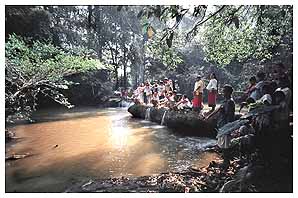
A tantalising resource: Villagers in Lower Klity village can nolonger drink or use the water in the stream. They say it is contaminated and has caused the death of their livestock. -- SMITH SUTIBUT |
Ducks dropped dead. So have cattle in Lower Klity village after drinking water from a stream which is contaminated by toxic waste from a lead mine. The spoiled water is a source of great misery for Karen villagers there.
The morning mist lifts to reveal a field of orange and white flowers. Young Karen girls in traditional white overalls walk along a narrow winding path, giggling. The air is ripe with the scent of orange blossoms. On the surface, the Lower Klity village is a romantic's dreamland. Tucked in a small valley on the west rim of Thungyai Naresuan Wildlife Sanctuary in Kanchanaburi province, the village is picturesque, with mountains in the background and Huai Klity stream flowing by like a line of ribbon. The Karen inhabitants are peaceful and generous. Most grow rice and chillies or raise livestock to support themselves on a subsistence basis.
The problem in this seemingly worry-free village is that no one touches or gets near the water in the stream unless absolutely necessary.
"The water is poisoned," one villager said. "I felt dizzy crossing the stream one time," a young woman echoed. The water is muddy. It oozes a fetid smell and sickens whoever drinks or comes into contact with it, one after another villager voiced their concern.
What happened to the Huai Klity stream? The village was once blessed with a good water supply which lasted throughout the long, hot summer when others dried up. What an irony that they now have to watch it flow by, unable to utilise even a single drop. In this sense, the villagers of Lower Klity might not be much different from the ancient mariners who lamented, "Water, water everywhere, and not a drop to drink."
"The stream was once clear as crystal. I could see all the pebbles on the stream floor. As a child, I bathed, drank and swam in this stream," said 43-year-old villager Kitti Nasuankitti. With a clear stream running through their backyard, who would bother to look for an alternative water supply? Like Kitti, other residents of Lower Klity village depend solely on the stream for daily use and consumption.
"We never collected rainwater here. We don't even know how to do it. We do not have a pipe for rain to flow through. We only had a cistern to store the stream water," said Kitti.
Not any more. One terrible day several years ago, the old faithful Huai Klity stream turned red. Reddish and turbid it is still. Rust-coloured scum floats around, coating underwater debris and boulders near stagnant pools. A foul smell, somewhat like damp iron, wafts throughout the village.
A few kilometres upstream in Thongphaphum district, releases its waste water directly into Huai Klity stream. Rock debris and chemicals used in mineral separation are all in the water. Klity mine has been in operation for well over 20 years. Ten years ago, it started discharging waste water into Huai Klity stream during the rainy season.
Since the mine is owned by an influential figure, former Democrat MP Kongsak Kleeb-bua, the villagers kept quiet about their suffering. But the situation has worsened considerably during the past two years. According to Lower Klity villagers, the mine now lets its waste water flow into the stream almost every day.
"I saw it with my own eyes," Yasue Nasuansuwan, chairman of the village committee, confirmed. "The factory's waste water pond is only 10 metres from Huai Klity stream.
When the pond is filled, which happens frequently during the rainy season, the waste is released into the stream." In 1989, the now-defunct National Environmental Board (NEB) found that water near the factory contained 200 to 7,000 times more lead than the safety level.
According to Lead, a publication of the Coordinating Committee for Primary Health Care of Thai NGOs, the water from Huai Klity stream flows into the Kwae Yai River which is stored behind the Sri Nakharin Dam. A survey by the NEB revealed that the amount of lead in the water flowing from the reservoir was still four times over the safety level.
The sudden deterioration of Huai Klity stream was a shock to people who live by it. Fish now float on the surface belly up. Shellfish and shrimp, which used to be in abundance, have almost disappeared completely.
"There were so many fish in the past that we would start boiling rice before setting out to fish. Before the rice was done, we would have enough fish for a meal. Now we could sit all day and not hook even one fish," Mr Yasue said.
Worse than the loss of free food is the death of village animals. More than 50 cattle which drank from the stream or ate grass growing near the water's edge got sick and died. Last year, a whole flock of ducks dropped dead after entering the stream.
"First the cattle became thin. Then they could not eat or drink. Very soon after that, they died. It all happened so quickly we couldn't do anything to save their lives. When we cut the carcasses open, we noticed that their stomachs were toughened and dry, with many lime-like lumps inside," Mr Yasue said.
Humans have also been affected by the toxic water. Many cases of severe headache and diarrhea among people who consumed the water or inhaled its fumes have been reported.
Villagers in Lower Klity now pipe water for their consumption over the mountain from a natural spring. But the supply is not enough to sustain the whole village.
"The water supply is on and off. The pipe is very long and quite thin. It breaks easily and frequently when things such as tree boughs falls on it. Moreover, the limited supply tenses up the normally amiable atmosphere. Neighbours compete for the scarce water. They watch one another with wary eyes. With less water flowing in, more disputes are likely to erupt," Mr Yasue commented.
The scarcity of water has meant that some villagers continue using the water from the stream to bathe or water their gardens. "We may get used to the rotten water and develop some immunity," one villager quipped half-heartedly.
The poisoned water also affects the Klity waterfall downstream. Once a hidden gem of nature much sought after by travellers, the waterfall is now virtually deserted. Instead of foaming white, the fall sends out mud-coloured, smelly splashes. Visitors who took a dip there complained of itching, villagers said. According to Mr Yasue, the villagers have discussed the problem with the factory manager many times.
Every time, the manager promised to correct the situation. "The factory would stop releasing its waste for a week or so. During that time, our old, clear stream would seem to come back. One or two weeks after that, the bad water returned," said teacher Boonchu Choopitakphaopong. With the problem becoming increasingly unbearable, residents of Lower Klity village lodged a formal complaint with the Pollution Control Department on Wednesday.
PCD director general Sirithan Pairoj-Boriboon promised to send a team to check the quality of water, sediment and aquatic life in Huai Klity stream next week. He will try to bring specialists from the Department of Health, Mineral Resources and Industrial Works to check on the villager's health and the factory's waste water facility, too.
"Lead is a dangerous substance. Normally, factories that deal with heavy metals must have at least three ponds for water treatment, plus a secured landfill for leftover toxic substances," Mr Sirithan said. After his team collect the samples from Huai Klity stream, it will take about a week or two before the lab results come out, he added.
For Mr Yasue, the petition to the PCB is the villagers' last resort. "We desperately need our stream back," he said. "To be honest, we are scared to complain. We are only poor people. We don't want to run up against anybody. It was never our intention to stop the factory from operating. They can continue doing their work. We only ask that they take care of our water resource."
| |
© 2000-2001 by Karen Studies and Development Centre. Report technical problems to [email protected] . This document was build on: 22/06/2001 . Best view in IE4x or higher,800x600 pix.Font Medium.
|
