

CORPORATE DEFINITION
-Corporate Mission-
� � � "Since the company was founded in 1903, Ford has been moving the world, with 270 million vehicles built (Ford 1999 Annual Report)." Since the company�s founder, Henry Ford, introduced the Model T produced by a moving assembly line that completely revolutionized the way of manufacturing automobiles, the company has been providing millions of people all across the world with numerous varieties of automobiles. It has passed almost a century since its foundation, and the company truly became one of the best-known companies not only in the US, but also in the world. Currently, the company is the world�s largest producer of trucks, and the second-largest producer of cars and trucks, marketed under Ford, Mercury, Lincoln, Jaguar, Aston Martin, Volvo and Mazda (Ford 1999 10-K).
� � � Ford announced its worldwide comprehensive reengineering program, called Ford 2000, in 1995 to achieve the industry leadership in the 21st century. Accordingly, the company�s corporate mission has been shifting to deliver superior shareholder returns and to become the world�s leading consumer company that provides automotive products and services (Ford 1999 Annual Report). Instead of being merely a traditional automotive manufacture, the company is pursuing to be more consumer-oriented company that provides both products and services intensively to meet and exceed customer expectation to satisfy as well as delight customers. In order to achieve superior returns to shareholders, it cannot be achieved without focusing on customers, therefore, increasing focus on customers is the basis of everything what the company does.
� � � Besides a careful focus on consumers and shareholders, two other primary missions are to be responsible for society and keep educating and motivating all employees who work for Ford to be entrepreneurial and passionate. With respect to social responsibility, the company thrives to produce environmental friendly automobiles by lowering gas emissions and reducing waste. The company became faster than any other competitors to be certified its plants around the world under ISO 14001, the global environment management standard (Ford 1999 Annual Report). By taking into account the growing demand of environmentally clean automobiles, Ford�s continuous effort to be responsible for the society supports both consumer value and shareholder value.
� � � Since the history of Ford can be expressed as innovation and entrepreneurial spirit, the company emphasizes thoroughly on education to all people to create enthusiastic aspiration. Furthermore, the company also wants to let the people know how important it is to feel and behave more like owners, with a deep appreciation of what it means to be a shareholder (Ford 1999 Annual Report). The company robustly thinks the future growth cannot be accomplished without solid determination along with strong aspiration from employees. To motivate all employees, there are several educational programs that all employees can participate in and the company�s CEO, Jac Nasser, sends email newsletter called "Let's Chat" to 145,000 employees in the company to consistently try to transmit the big picture of where the company is heading and what the company�s current situation is.
-Organizational Structure-
� � � To effectively manage and run an organization, Ford management looks at the business both in total and as a portfolio of two business sectors, which are Automotive sector and Financial Services sector. Each sector is divided into two operating segments that Automotive sector consists of Automotive and Visteon Automotive Systems and Financial Services sector consists of Ford Motor Credit Company and The Hertz Corporation.
� � � The Automotive segment is essentially the core business for the company that is primarily in charge of design, manufacture, sale and service of cars and trucks. The segment markets its automobile by offering seven major brands that are Ford, Mercury, Lincoln, Volvo, Jaguar, Aston Martin and Mazda, in which the company has 33.4 percent equity interests. The segment operates in 38 countries with 105 plants and 231,200 employees in more than 200 markets (Ford 1999 10-K).
� � � The second segment in Automotive sector, Visteon Automotive Systems, is the second largest automotive supplier in the world, producing integrated systems and components to automotive manufacturers and other automotive suppliers. Most of Visteon�s business is with Ford Motor, accounting for approximately 91 percent of its whole business (Ford 1999 10-K). Visteon operates in 21 countries with 73,600 employees, fully utilizing its 49 plants and 37 sales, engineering and technical offices (Ford 1999 Annual Report). Currently, Visteon segment is being prepared for separation from the company, which is further discussed in the Business Strategy section in this paper.
� � � Ford Motor Credit Company is an indirect wholly subsidiary of the company. Ford Credit is the world�s largest automotive financing company and operating in 290 locations in 36 countries with 15,6000 employees. Ford Credit and its subsidiaries provide wholesale financing and capital loans to Ford retail dealerships and associated non-Ford dealerships, which are most owned privately (Ford 1999 Annual Report).
� � � Finally, The Hertz Corporation is the world�s largest car, truck and equipment rental and leasing company. Hertz and its affiliates and independent licensees operate in 6,100 locations in more than 140 countries worldwide with 24,800 employees. In April 1997, Hertz (NYSE: HRZ) completed an initial public offering of common stock representing a 19.1 percent economic interest in Hertz (Ford 1999 10-K).
-Business Strategy-
� � � Since Ford operates in a portfolio of four combined business segments, the company sets its own profitability and growth targets for each business segment. Then, each one breaks down its business into meaningful pieces to grow and improve. In the Chief Executive Officer�s Message from 1999 Annual Report, Mr. Nasser says, "We�re also pursuing synergies across the four businesses to accelerate growth, sharpen our competitive advantage and improve asset efficiency. We�re also maintaining the flexibility to add to, or delete from, the portfolio over time, with a focus on superior shareholder value (Ford 1999 Annual Report)."
� � � Ford has been pursuing to acquire global competitive advantage, especially by acquisition and alliance with other automotive manufactures as well as automotive-related corporations, in the severely competitive automobile industry worldwide. The company added luxury cars in its lineup by acquiring Aston Martin in 1987, Jaguar in 1989 and Volvo in 1999. The newest acquisition was announced on March this year that Ford agreed to buy Land Rover unit from Bayercshe Motoren Werke AG (BMW) for nearly $3.0 billion, enhancing its luxury portfolio further (Simison A1). By adding this new premium brand in Ford�s lineup, the company aims to penetrate the luxury car market by stretching the brand variety, while other competitors add bigger SUVs and smaller cars to their luxury lineups. "You could always choose to go with one brand and stretch it. We�d rather use different brands." As newly hired Group Vice President, Wolfgang Reitzle told Business Week last fall, the company�s strategy is to offer wide variety of different cars under different brand name (Kerwin 58). Although the company�s strength is truck automobiles, which accounts for 60.3 percent of all automobiles produced in 1998, the company is focusing on luxury automobiles intensely.
� � � Ford�s acquisition has been extended to services sectors where the company sees its future growth by not being affected by cyclical environment such as recession and high oil prices that significantly affect the automobile sales. The following Table 1 shows ten acquisitions that Ford conducted, on which the company spent more than $8.0 billion in 1999.
|
� |
� |
� |
� |
� |
� |
� |
|
� |
Acquisition
Company |
� |
Price |
� |
Business |
� |
|
� |
� |
� |
� |
� |
� |
� |
|
� |
MSN
Carpoint |
� |
n/a |
� |
Internet
buying service (US) |
� |
|
� |
KwikFit |
� |
$1,600
m |
� |
Light maintenance & repair (Europe) |
� |
|
� |
Copher
Bross Auto Parts |
� |
n/a |
� |
Vehicle
recycling (US) |
� |
|
� |
PIVCO |
� |
n/a |
� |
Th!nk
electric car (Europe) |
� |
|
� |
APCO |
� |
$180
m |
� |
Extended
warranties (US) |
� |
|
� |
Young
Drivers |
� |
n/a |
� |
Driver's
education (US & Canada) |
� |
|
� |
Stewart
Grand Prix |
� |
$160
m |
� |
Racing |
� |
|
� |
Volvo |
� |
$6,450
|
� |
Swedish
auto maker |
� |
|
� |
IHA |
� |
$35-$40
m |
� |
Online
insurance (US) |
� |
|
� |
Carclub.com |
� |
<$50
m |
� |
Internet
vehicle information & buying service (US) |
� |
|
� |
� |
� |
� |
� |
� |
� |
� � � Ford�s acquisition criteria are clear that provides synergies with the core automotive business to be able to sell more vehicles, brings Ford closer to its customers to be able to get better information and improve understanding of customer requirements, and reduces cyclical risk by increasing its service operations (Bruynesteyn 30).
� � � Another strategy to gain competitive advantage is to revolutionize Ford�s distribution system by actively consolidating dealer groups and participating in online services related to vehicle selling and ownership. The company assembled metropolitan dealer groups by consolidating several Ford dealers in five major US cities to develop best practices that can be shared with the rest of the dealer body and improve inventory control levels and costs associated with operations. Dealer consolidation is being taken under way in Europe and it is expected to expand this strategy into the UK. As of now, in terms of the use of the Internet, the company is experimenting to acquire some feasible ways to reach directly to customers, since the company believes 70 percent of consumers will use the Internet in their vehicle purchase process within 4 to 5 years. Ford has not completely developed the best way to reach customers through the Internet, however, the company is working on it to precisely seize the sizable chance toward the next new century.
� � � As mentioned above in the Organizational Structure section, Ford has become ready to spin off its $19 billion Visteon business unit. This strategic decision is aimed to bring benefits for both Ford and Visteon itself by being more competitive in the market place as in the case of Delphi Automotive Systems Corp., which spun off from General Motors in 1999. More specifically, the biggest benefit for Ford would be the ability to get the best technology at the best prices by purchasing other than Visteon and reduction in its fixed costs of running Visteon�s facilities worldwide. On the other hand, Visteon would be better off by being able to increase its business outside from Ford, given the current reluctant behavior of rival carmakers to buy from Visteon taking the relationship with Ford into account that the information might be shared with Ford (Muller 60). Ultimately, all strategies being employed by Ford are based on the strong customer focus as clearly stated in corporate mission, and superior shareholder value driven by customer satisfaction.
-Senior Management Team-
� � � Former Chairman of the Board and CEO, Alex Trontman, was named on November 1, 1993 and he initiated Ford 2000 program throughout the company. During his five-year leadership at Ford, the company�s EVA rose from a negative $3.9 billion to a positive $3.1 billion (Ford 1999 Annual Report). After his resignation, Ford has undergone a major restructuring of its management team since late 1998 and the new chairman Bill Ford and new CEO Jacques Nasser immediately ushered out seven vice president level executives and have brought in fresh faces. By bringing new faces from outside the company and outside the industry, Ford tries to bring a new perspective in the group (Bruynesteyn 43). The following Table 2 shows the management board member as of October 1999 and Table 3 shows new management faces hired outside from Ford recently.
|
� |
� |
� |
� |
� |
� |
� |
� |
� |
|
� |
Name |
� |
Position |
� |
Name |
� |
Position |
� |
|
� |
� |
� |
� |
� |
� |
� |
� |
� |
|
� |
Jacques
A. Nasser |
� |
CEO |
� |
Robert
L. Rewey |
� |
Marketing,
Sales, & Services |
� |
|
� |
W.
Wayne Booker |
� |
Vice
Chairman, CFO (Interim) |
� |
Henry
D.G. Wallace |
� |
Ford
Asia Pacific |
� |
|
� |
Peter
J. Pestillo |
� |
Vice
Chairman & Chief Staff |
� |
Donald
Winkler |
� |
Ford
Credit |
� |
|
� |
Carlos
E. Mazzorin |
� |
Purchasing
and Ford Mexico |
� |
James
Donaldson |
� |
Global
Business Development |
� |
|
� |
James
J. Padilla |
� |
Manufacturing |
� |
Nick
Scheele |
� |
Ford
Europe |
� |
|
� |
Richard
Parry-Jones |
� |
Product
Development & Quality |
� |
I.
Martin Inglis |
� |
Ford
South American |
� |
|
� |
J.
Yost |
� |
Process
Leadership |
� |
W.
Reitzle |
� |
Premier
Automotive Group |
� |
|
� |
� |
� |
� |
� |
� |
� |
� |
� |
|
� |
� |
� |
� |
� |
� |
� |
|
� |
Name |
� |
Position |
� |
Previous
Company, Position |
� |
|
� |
� |
� |
� |
� |
� |
� |
|
� |
Mei
Wei Cheng |
� |
VP,
President Ford China |
� |
President,
GE Appliance Hong Kong |
� |
|
� |
Earl
Hesterberg |
� |
VP,
Marketing, Ford Europe |
� |
President
& CEO, Gulf States Toyota |
� |
|
� |
Brian
Kelly |
� |
VP
& COO, Ford Investment Ent. |
� |
VP
& GM of Sales & Dist., GE Appliance |
� |
|
� |
James
Schroer |
� |
VP,
Global Marketing |
� |
EVP
of Sales, RJR Nabisco |
� |
|
� |
Wolfgang
Reitzle |
� |
Group
VP, Premier Auto. Group |
� |
Management
Board Member, Mktg., Devel. & Distrib'n, BMW |
� |
|
� |
Luise
Goeser |
� |
VP,
Quality |
� |
VP,
Refrigeration Product Team, Whirlpool |
� |
|
� |
Chris
Theodore |
� |
VP,
Lg. & Lux. Car Veh. Cntr. |
� |
Senior
VP, Platform Engineering, DaimlerChrysler |
� |
|
� |
Shamel
Rushwin |
� |
VP,
Adv. Manuf. Engineering |
� |
VP,
International Manuf. & Minivan Ass'y, DaimlerChrysler |
� |
|
� |
J.C.
Mays |
� |
VP,
Design |
� |
VP
Design, SHR Perceptual Management |
� |
|
� |
Craig
Muhlhauser |
� |
VP,
Pres. - Visteon Auto. Systems |
� |
Senior
VP, Sales & Service, United Technologies |
� |
|
� |
Donald
Winkler |
� |
Chairman
& CEO, Ford Motor Credit |
� |
Chairman
& CEO, Finance One a subsidiary of Bank One |
� |
|
� |
� |
� |
� |
� |
� |
� |
� � � Ford is broadening its management team both vertically (from Ford) and horizontally (outside from Ford) in order to find innovative ways to do more business with variety of perspectives that come from different background. As Table 3 shows, Ford hired some new management whose background is totally different from automobile industry, such as General Electric, Whirlpool and Finance One, while bringing some management from same automobile industry, such as BMW and DaimlerChrysler. In total, ten of the top 53 officers of the company have come recently from outside Ford. The changes are an attempt to reconfigure the company to focus on being consumer-oriented company through products and services rather than being traditional automobile company (Bruynesteyn 43).
CORPORATE SCOPE
� � � The only concern associated with the new management team is the departure of the former CFO, Mr. John Devine, whose position is currently held by Mr. W. Wayne Booker as interim CFO. Before Mr. Devine took his office as a CFO at Ford, the company�s investor relations department had been doing very poor job and the reputation was awful in the Wall Street. However, under the strong leadership of Mr. Devine, Ford had changed significantly in a positive direction and has gained credibility and reliability from the Wall Street. What Mr. Devine did was to bring all the company�s business and financial information together in the right context for investors and showed how business news, financial information, sales results and profits fit into the company�s overall strategy (Banham). Ford definitely needs to seek out a new CFO, who has solid determination and leadership that is as strong as that of Mr. Devine.
-Products-
� � � Ford classifies cars by small, middle, large and luxury segments and trucks by compact pickup, compact bus/van/utility, full-size pickup, full-seize bus/van/utility and medium/heavy [4] segments. The large and luxury car segments and the compact bus/van/utility, full-size pickup and full-size bus/van/utility truck segments include the industries most profitable vehicle lines. As stated before, Ford markets its full line of automobiles under seven brands: Ford, Mercury, Lincoln, Jaguar, Aston Martin, Volvo and Mazda (Ford 1999 10-K). The following Table 4 shows some of automobiles Ford currently markets from each segment.
|
� |
� |
� |
� |
� |
� |
� |
� |
� |
� |
� |
|
� |
Cars |
� |
||||||||
|
� |
� |
� |
� |
� |
� |
� |
� |
� |
� |
� |
|
� |
Segment |
� |
Auto
name |
� |
Brand |
� |
Price
Range |
� |
||
|
� |
� |
� |
� |
� |
� |
� |
� |
� |
� |
� |
|
� |
Small |
� |
Escort/ZX2 |
� |
Ford |
� |
$11,855 |
- |
$11,975 |
� |
|
� |
� |
� |
Focus |
� |
Ford |
� |
$11,960 |
- |
$15,380 |
� |
|
� |
� |
� |
� |
� |
� |
� |
� |
� |
� |
� |
|
� |
� |
� |
Contour |
� |
Ford |
� |
$16,940 |
- |
$22,810 |
� |
|
� |
Middle |
� |
Taurus |
� |
Ford |
� |
$17,790 |
- |
$22,345 |
� |
|
� |
� |
� |
Sable |
� |
Mercury |
� |
$17,790 |
- |
$22,345 |
� |
|
� |
� |
� |
� |
� |
� |
� |
� |
� |
� |
� |
|
� |
Large |
� |
Crown
Victoria |
� |
Ford |
� |
$22,100 |
- |
$25,135 |
� |
|
� |
� |
� |
Grand
Marquis |
� |
Mercury |
� |
$22,100 |
- |
$25,135 |
� |
|
� |
� |
� |
� |
� |
� |
� |
� |
� |
� |
� |
|
� |
� |
� |
S-Type |
� |
Jaguar |
� |
$42,500 |
- |
$48,000 |
� |
|
� |
� |
� |
XK8 |
� |
Jaguar |
� |
$66,200 |
- |
$81,800 |
� |
|
� |
Luxury |
� |
Continental |
� |
Lincoln |
� |
$38,880 |
� |
||
|
� |
� |
� |
70
Series |
� |
Volvo |
� |
$27,500 |
- |
$46,500 |
� |
|
� |
� |
� |
S80 |
� |
Volvo |
� |
$36,000 |
- |
$40,500 |
� |
|
� |
� |
� |
� |
� |
� |
� |
� |
� |
� |
� |
|
� |
Trucks |
� |
||||||||
|
� |
� |
� |
� |
� |
� |
� |
� |
� |
� |
� |
|
� |
Segment |
� |
Auto
name |
� |
Brand |
� |
Price
Range |
� |
||
|
� |
� |
� |
� |
� |
� |
� |
� |
� |
� |
� |
|
� |
Compact
pickup |
� |
Ranger |
� |
Ford |
� |
$11,480 |
- |
$23,740 |
� |
|
� |
� |
� |
B-Series |
� |
Mazda |
� |
$11,480 |
- |
$23,740 |
� |
|
� |
� |
� |
� |
� |
� |
� |
� |
� |
� |
� |
|
� |
� |
� |
Explorer |
� |
Ford |
� |
$21,675 |
- |
$34,470 |
� |
|
� |
Compact bus/van/utility |
� |
Mountaineer |
� |
Mercury |
� |
$21,675 |
- |
$34,470 |
� |
|
� |
� |
� |
Villager |
� |
Mercury |
� |
$22,259 |
- |
$27,115 |
� |
|
� |
� |
� |
MPV |
� |
Mazda |
� |
$19,995 |
- |
$25,550 |
� |
|
� |
� |
� |
� |
� |
� |
� |
� |
� |
� |
� |
|
� |
Full-size
pickup |
� |
F-150 |
� |
Ford |
� |
$15,380 |
- |
$31,125 |
� |
|
� |
� |
� |
� |
� |
� |
� |
� |
� |
� |
� |
|
� |
� |
� |
Excursion |
� |
Ford |
� |
$33,560 |
- |
$40,405 |
� |
|
� |
Full-size
bus/van/utility |
� |
Expedition |
� |
Ford |
� |
$29,750 |
- |
$46,210 |
� |
|
� |
� |
� |
Navigator |
� |
Lincoln |
� |
$29,750 |
- |
$46,210 |
� |
|
� |
� |
� |
� |
� |
� |
� |
� |
� |
� |
� |
� � � Ford offers completely full line of automobiles to the market by efficiently utilizing its seven brands, which are characterized and marketed differently. Especially, Ford has strength in the production of trucks that the company, in fact, is the market leader in the US truck market, being followed by General Motors and DaimlerChrysler. As a matter of fact, 60.3 percent of Ford�s vehicle sales came from the truck segment in 1998 and the percentage has been gradually increasing since 1995, when the truck sales had 53.3 percent of total sales (Ford 1999 10-K). Since consumers�Epreferences have been changing from traditional cars to multiple-use cars such as SUV (Sports Utility Vehicle) or RV (Recreational Vehicle) type in the market, Ford has been shifting its production to satisfy consumers' needs of these cars. In addition, as the past acquisition strategy shows, Ford is concentrating on the luxury car market, where the competition is severely harsh but the market is very lucrative at the same time.
-Markets and Market Share-
� � � Although Ford operates globally across the world with global product development capability and distribution network, the US is, by far, the largest market, accounting for 73 percent of total revenues in 1998. Of the rest 27 percent revenue, 20 percent came from Europe, 4 percent came from South America, and 3 percent came from other than those markets respectively. As the revenue distribution shows, Europe is the largest and the most important market behind the US market. Within this Europe market, Great Britain and Germany deserve most consideration from the fact that those two countries have huge economic power, hence, a sizable number of customers (Ford 1999 10-K).
� � � Accelerated by NAFTA, Mexico and Canada also are important markets for Ford. In 1998, industry sales of new cars and trucks in Mexico were 665,000 units, up 34 percent from 1997 level. In Canada, industry volume in 1998 was 1.4 million units, which equaled to 1997 level. Other than Mexico market in South America, Brazil and Argentina are principal markets, even though these countries have been volatile in terms of the economic environment. In the Asia Pacific region, Australia, Taiwan and Japan are primary markets for Ford. Industry volume reached 808,000, 474,000 and 5.9 million units in each country respectively in 1998. Japanese manufacturers have built solid position in the region, however, Ford is positioning itself to participate actively in these markets in recognition of their long-term growth opportunities (Ford 1999 10-K).
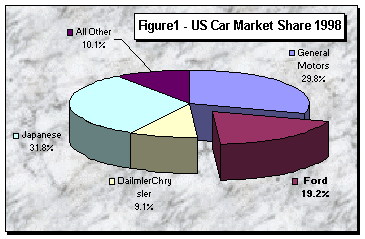
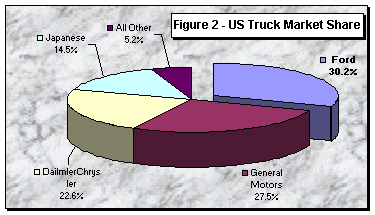
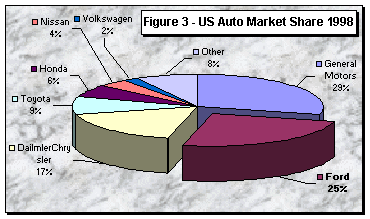
� � � As Figure 1[6] shows, Ford has 19.2 percent in the US car market share in 1998, which was positioned far behind the market leader, General Motors of 29.8 percent but far beyond DaimlerChrysler of 9.1 percent. As stated before, however, Ford has strength in truck production, keeping its market leader position as the following Figure 2[7] shows. The company�s F-Series in pickup truck segment and Expedition in full-size SUV segment were ranked as best-selling vehicles in 1998 in each segment (Market Share Reporter 230). In the US combined car and truck market, Ford�s market share was 25 percent in 1998 as Figure 3[8] below shows, which was positioned right behind General Motors�s 29 percent market share.
� � � In other markets, Ford does not have market power as strong as in the US, since the local automobile manufactures have established strong initiative and market position.
In Europe, for example, actual number reported in 1999 10-K SEC filing shows that Ford�s combined car and truck market share was 10.3 percent out of industry volume of 16.1 million units. Furthermore, Ford achieved market share of 16.6 percent, 19 percent, 13.1 percent, 16.4 percent, 15.9 percent, 15.4 percent and less than 1 percent in Mexico, Canada, Brazil, Argentine, Australia, Taiwan, and Japan respectively (Ford 1999 10-K).
-Major Customer Groups-
� � � Ford sells cars, trucks, automotive components and systems throughout the world and the company sold 6.8 million vehicles globally in 1998. Customers can be mainly divided into two groups, which are commercial accounts and individuals. Major commercial accounts include the company�s automobile leasing division, Hertz, and its business units, Hertz Equipment Rental Corporation, Hertz Local Edition, Hertz Car Sales, Hertz Car Leasing, Hertz Claim Management, Hertz Technologies. In addition, Hewlett-Packard, General Electric, Merck, Budget Rent-A-Car are included in major commercial accounts (Ford 1999 Annual Report).
� � � In order to satisfy millions of individual in the world, Ford offers full line of automobiles from SUV type vehicles for relatively young target market to luxury type vehicles for upper-class target market. As mentioned before, Ford is currently trying to get much closer to individual customers by using the growing technology enhanced by the unlimited capability of the Internet. As of now, Ford is in the stage where the company is collecting some relevant data on how consumers use the Internet when they plan to prechase automobiles. In a few years, the data collected by the company will be one of the significant tools to know consumer behaviors on the Internet and will be effectively used to penetrate further in the individual market.
CORPORATE ENVIRONMENT
-Economic Environment-
� � � Automobile industry is essentially a highly competitive and cyclical business that has a wide variety of product offerings. Whether or not Ford will be able to accomplish its corporate goal depends on several factors, including economic conditions both in the US and in the world, fuel price, and government regulation. Since the major revenue source for Ford is derived from the US market, the economic condition in the US has significant influence on Ford�s performance. The US economy is now experiencing its record-long period of prosperity with low inflation rate, primarily enhanced by high productivity accelerated by advanced technology. The so-called New Economy theory suggests that permanent gains in productivity allow the US to grow at a 3.5 percent to 4 percent clip, and even higher, without leading to inflation (Blaskstone and Parry).
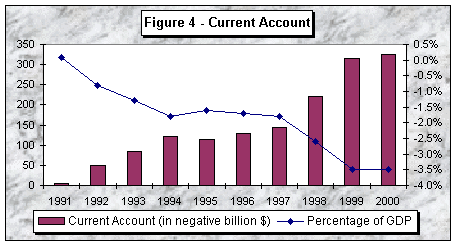
� � � Federal Reserve Bank of New York President William McDonough, however, expressed concerns about strains developing in the US economy, saying, "It seems to me that the accompanying low levels of inflation, together with relatively high rates of resource utilization, suggest that something more than normal cyclical forces is at work." He is particularly concerned about the growing current account deficit, which reached record levels at around 4 percent of gross domestic product last year (Blaskstone and Parry). The following Figure 4[9] shows the past ten year current account balance of the US based on the data announced by IMF in its recent World Economic Outlook. As the figure shows, negative current account balance has increased gradually since 1991, which currently accounting for 3.5 percent of the GDP.
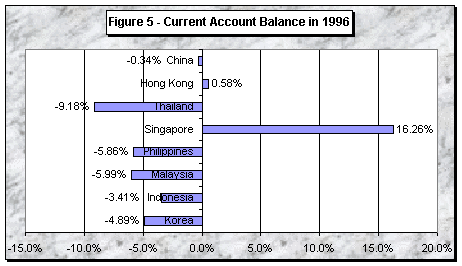
� � � As seen from the empirical example of Asian currency crisis, current account imbalance is one of the key macroeconomic indicators that lead to a significant economic contraction in some way, depending on the country�s strength of its fundamental economy. In the case of Asian currency crisis, most countries affected adversely by crisis had negative current account balance prior to 1997, which the governments were not able to sustain by the strong pressure on their currencies. Eventually, the large amount of current deficit led an accumulation of foreign debt that became unsustainable and led to a currency crisis (Roubini). The following Figure 5[10] shows current account balance of major Asian countries in 1996. Coming back to Mr. McDonough�s statement, he also said, "Current account imbalances eventually require macroeconomic adjustment - adjustment that is smoother and more orderly the earlier and more coordinated the policy response (Blaskstone and Parry).", implying there might be a slowdown in the US economy in the near future. The implication of this slowdown in the US economy will be a decline in Ford�s automobile sales in some extent because cars and trucks are durable items that people can wait to replace.
� � � In terms of the fuel prices, fuel prices have fallen to a level that they are no longer an issue with consumers, with good fuel economy landing well outside the top-ten list of buyers' desired vehicle attributes. Taken as a percentage of disposable personal income, fuel expenditure is barely over 2 percent, versus more than 6 percent in 1980 and 1981 level. There is likely some threshold over which driving and buying habits would change, probably in the $1.60 to $1.80 per gallon range for gasoline (Bruynesteyn 23). However, according to the decision of the meeting held recently by OPEC, the production of oil is likely to increase to the point where the oil price per gallon will not exceed the above price range, implying fuel prices will have less influence for Ford at least in a short term.
� � � One of the influential factors for Ford as well as all automobile manufacturers is the government regulation regarding with the environment such as gas emission level and recycling. The US government sets standards for fuel economy and emissions, while the European government is close to enacting a new law on recycling and is studying new emissions regulations (Bruynesteyn 27). Key emissions from automobiles are carbon dioxide (CO2) and oxide of nitrogen (NOX), which deteriorate the ozone layer permanently. US emissions standards proposed for 2004 can probably be met by the manufacturers, but at a cost of several hundred dollars per vehicle. Having cut the cost amounted to $2.2 billion, Ford claims a lead in already cost-effectively meeting the proposed 2004 regulations for its truck fleet (Bruynesteyn 28).
� � � A new law requiring vehicles sellers to take back vehicles for recycling at the end of their useful lives is supported by manufacturers for vehicles sold after 2001 but opposed for the existing vehicles, since these older vehicles have not been designed for recycling. The manufacturers would have to pay about $180 per vehicle to dismantle and scrap them, which would be liable for Ford to pay about $1.5 billion taking its market share into account (Bruynesteyn 28). Ford�s performance will be substantially affected by a significant amount of these costly regulations for greater vehicle safety and for improved fuel economy, given the growing concern for the environment (Ford 1999 10-K).
-Competitors-
� � � In the global automobile industry, strong automobile manufacturers have been looking for a partner to establish strong alliance to gain more competitive advantage or trying to merger to gain more economies of scales, full line of products, and another new market. In the year of 1998, the announcement on the mega-merger between Daimler-Benz and one of the Big Three, Chrysler, brought a huge impact not only to the automobile industry but also to the world. In light of the recent trend in strategic alliance and merger movement by manufacturers, the industry map has changed dramatically to the one people could not expect a several years ago.
� � � The reason behind this trend is that there is a rapid growth in automobile demand from emerging countries, while the advanced countries' markets are sort of saturated. There has been a severe battle among manufacturers to acquire market share in those emerging countries such as China and India. In order to procure automobile components efficiently and to streamline the production foothold, there is an absolute need to pursue the advantage of economies of scales. Furthermore, there is also a need for technology development in terms of environmentally clean engine, new automobiles, recycling and information system, which all incur huge costs by the manufacturer if it decided to build up solely. These factors are the primary reasons why automobile manufacturers pursue to establish alliance and merger with other manufacturers (Nihonkeizai-Shinbusha 140-141).
� � � Accordingly, the alliance and merger trend have caused the industry to be more consolidated and the number of competitors has declined but each has become stronger with more market presence. Since the primary target for Ford is the US market, major competitors are General Motors and DaimlerChrysler, which have the market leader position and the third position in the US market respectively. Other strong competitors are primarily Japanese automobile manufacturers, such as Toyota, Honda, and Nissan. In actuality, while US manufacturers have been loosing their market shares gradually, these Japanese manufacturers constantly have been gaining market shares and solid positions in the US market with their high quality automobiles. Toyota�s Camry and Honda�s Accord are, in fact, two best-selling cars in the US car market, and both companies have extended their product mix much wider to further penetrate in the US market. As another competitors for Ford in the US market, European manufacturers such as Volkswagen and BMW are major competitors.
� � � The automotive industry outside of the US market consists of many producers, with no single dominant producer. Certain manufacturers, however, account for the major percentage of total sales within particular countries, especially their countries of origin (Ford 1999 10-K). European manufacturers have superior advantage in Europe market to other countries�Emanufacturers and Japanese manufacturers have dominant position in Japanese market and superior advantage in Asian market as a whole.
-Rational for Peer Group Selection-
� � � General Motors, DaimlerChrysler, and Toyota were included in Ford�s peer groups from the fact that these three companies are most strong competitors for Ford both domestically and internationally. Moreover, the US, Germany and Japan are the top three countries that produce automobiles in the world, and each company represents the top automobile manufacturer in respective country.
� � � The following analysis is based on the data retrieved from the CompuStat database to compare Ford with three other peer groups: General Motors, DaimlerChrysler, and Toyota. Here, all of the data is not exactly the same as the data that we can see in 10-K SEC filing or annual report published by each company. This is because CompuStat treats and interprets data differently from the way each company does and publishes in 10-K SEC filing and annual report. More specifically, CompuStat database adjusts the data to completely reflect all changes in accounting method and accounting regulation occurred most recently. In fact, most number in balance sheet and income statement is far different from the number that each company announced in its 10-K SEC filing and annual report.
� � � In the case of Ford, for example, the total assets figure in 1998 is $210,635 millions in CompuStat and $237,545 millions in 10-K SEC filing, resulting in almost $27 billion difference. If we look at the net income figure in 1998, we can see CompuStat shows $15,920 millions and 10-K SEC filing shows $22,071 millions, which has a difference of almost $6 billions. Furthermore, in the case of composition average of peer groups, net income figure was calculated to be even negative number for the examined time period of 1994 through 1998. Even though the figure is considerably different from the figure in 10-K SEC filing and other publicly available data, the following analysis is primarily based on the data retrieved from CompuStat.
LIQUISITY
� � � The current ratio of Ford in 1998 was calculated to be 1.63, which is much higher than the peer group average of 1.25. Cash and equivalents figure in the balance sheet of Ford in 1998 shows a significant amount of $24,956 millions, while the peer group average has $15,421 millions. This excessive liquidity position implies Ford is not fully utilizing its current assets to generate further income, however, the excess amount of cash compared to peer groups can be explained by Ford�s future production lineup, acquisition plans and the expected future slowdown in the economy, which might cause even a recession.
� � � Ford is slated to bring out four brand new models in 2000, which are Escape (small SUV), Sport Trac (midsize SUV with a pickup), SuperCrew (large SUV with a pickup) and retro-styled Thunderbird (Bruynesteyn 4). In order to ensure the smooth rollout of these new models, Ford needs to have relatively high liquidity position. As Ford has been actively participating in merger activity, Ford keeps its high liquidity position not to loose the chance when it is available as in the case of Volvo and Land Rover. Finally, by holding materially greater liquidity than peer groups, Ford will ensure that its chances are the best among its peers of surviving a recession with its product programs intact (Bruynesteyn 23).
ACTIVITY
 � � � The inventory turnover of the peer group average in 1998 is calculated to be 12.70, which is approximately a half of Ford�s figure of 25.53, indicating that Ford has greater liquidity in its inventory. This high figure can be explained by the company�s continuous efforts toward consolidation of dealer groups, which was discussed in Business Strategy part in this paper. By consolidating dealer groups, Ford dealers are able to share information on the current demand of the market to offer the best automobile at the best time to consumers, which will enable dealers to improve inventory control.
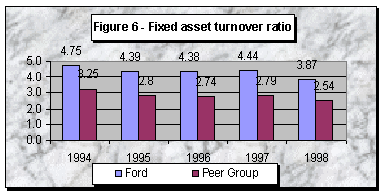
� � � Another financial ratio we can look to evaluate company�s activity is fixed asset turnover ratio. The following Figure 6[11] shows fixed asset turnover ratio for the examined time period of 1994 through to 1998 for both Ford and peer groups. Although the ratio has been declining since 1994 for both Ford and peer groups, Ford has consistently higher value than peer groups as the figure shows. Ford is radically altering its manufacturing model to reduce asset intensity and lower costs. The idea is to replace existing conventional assembly facilities with smaller and more modern plants that would consolidate component sets or modules into new vehicles with fewer people than needed today (Bruynesteyn 6). We can say Ford has been utilizing its fixed asset effectively to generate sales for the past 5 years, and Ford�s effort to streamline its plants and facilities will allow further effective use of its fixed asset.
DEBT
� � � A firm with a low debt-to-equity ratio usually has greater flexibility to borrow in the future. The higher this ratio the more sensitive it is to economic shifts in the overall economy. Ford�s debt-to-equity ratio for the year 1998 is 7.62 (762%) while the peer group average is 3.38 (338%), which is much lower than Ford�s value. Even though automobile industry is capital intensive, Ford has more than two times of its peer group average, implying more exposure to the economic environment. When we see debt-to-total assets ratio, Ford�s value is calculated to be 0.88 (88.40%), while peer group average has 0.77 (77.19%), further confirming its exposure to the economic environment and implying possibility of long-run insolvency. Yet, since Ford holds more cash than peer groups, this cash will mitigate the risk caused by the change in economic environment in some extent as mentioned before.
� � � The peer group average of the times interest ratio is 1.06 whereas Ford�s value is calculated to be 1.32. This indicates that Ford will have little difficulty in meeting obligation of a loan and also indicates that Ford is in a very good position to take on further loans. However, this high figure of the times interest ratio does not justify both debt-to-equity and debt-to-total assets ratio mentioned earlier. Certainly, Ford is able to meet its short-term loan obligation as the times interest ratio shows, though, the high liabilities compared to peer group average will be a substantial burden in the long-term. Thereby we can say that Ford is in a good position in the short-term and managing its debt well.
PRODUCTIVITY AND PERFORMANCE
 � � � In order to assess the productivity, sales revenue per employee and profit per employee can be used as a good measure. Since the data retrieved from CompuStat turned out to have negative net income for the peer group average during the entire examined time period and for Ford in both 1995 and 1996, all number and ratio related to net income, such as profit per employee, ROA, and ROE, was calculated to be negative. This might not reflect the true value for the peer group average as we can see positive net income in each company�s income statement shown in Exhibit 1-D. Therefore, the following analysis is based on the comparison between Ford and each company respectively.
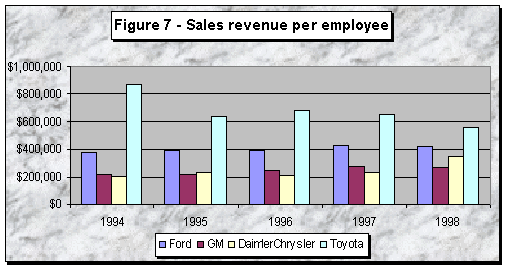
� � � Comparing the sales revenue per year for both Ford and each peer company, we can see Ford has been able to raise its productivity since 1994 except a slight decline in 1998 from $422,177 to $418,385 as the following Figure 7[12] shows. Toyota has obviously a declining trend that the number decreased from $873,251 in 1994 to $556,312 in 1998, which is almost 36 percent decrease. This is perfectly explained by the number of employees that Toyota increased approximately 46 percent of its employees from 1994 to 1998. Therefore, Toyota actually became more productive. On the other hand, General Motors has been decreasing its employees with only a little increase in its sales revenue per employee, while DaimlerChrysler has become more productive by the mega-merger in 1998 as the Figure 7 shows.
� � � The following Table 5 and 6 show each company�s ROE and ROA for the examined time period of 1994 through 1998.
|
� |
� |
� |
� |
� |
� |
� |
|
� |
ROE |
� |
||||
|
� |
� |
� |
� |
� |
� |
� |
|
� |
� |
Ford |
GM |
DaimlerChrysler |
Toyota |
� |
|
� |
� |
� |
� |
� |
� |
� |
|
� |
1994 |
0.19% |
1.79% |
4.46% |
3.76% |
� |
|
� |
1995 |
-0.10% |
4.83% |
-44.23% |
2.71% |
� |
|
� |
1996 |
-8.44% |
-9.84% |
4.18% |
4.93% |
� |
|
� |
1997 |
2.66% |
-3.34% |
18.37% |
6.90% |
� |
|
� |
1998 |
63.70% |
-22.75% |
22.75% |
7.56% |
� |
|
� |
� |
� |
� |
� |
� |
� |
|
� |
� |
� |
� |
� |
� |
� |
|
� |
ROA |
� |
||||
|
� |
� |
� |
� |
� |
� |
� |
|
� |
� |
Ford |
GM |
DaimlerChrysler |
Toyota |
� |
|
� |
� |
� |
� |
� |
� |
� |
|
� |
1994 |
-0.02% |
0.17% |
1.05% |
1.97% |
� |
|
� |
1995 |
-1.18% |
0.71% |
-6.65% |
1.36% |
� |
|
� |
1996 |
-0.97% |
-1.46% |
1.11% |
2.40% |
� |
|
� |
1997 |
0.33% |
-0.37% |
5.23% |
3.20% |
� |
|
� |
1998 |
7.51% |
-1.84% |
5.34% |
3.42% |
� |
|
� |
� |
� |
� |
� |
� |
� |
� � � In the year of 1998, Ford recorded a gain of $15,955 million in the first quarter as a result of a spin-off of The Associates accounting for $15,006 million in special items in the income statement, which resulted in a boost in both ROE and ROA. This is, of course, one-time gain so that these values do not reflect as an ordinary business year. If we subtract the special items from the income statement and recalculate the value, ROE is calculated to be 4.2 percent and ROA is calculated to 0.38 percent. We can see from both Tables that Toyota has the best performance with a constant growth to generate profit by effectively utilizing its asset and equity. Furthermore, the strong distinction can be seen in Toyota�s capital structure that 45 percent of assets is owned by shareholders while 55 percent is owned by debt holders, resulting in a much lower interest expense.
� � � In contrast, shareholders in Ford, General Motors and DaimlerChrysler own 9 percent, 8 percent and 25 percent of asset respectively. The intensive ownership by debt holders appears in a big difference between ROE and ROA. Even though those companies are able to show high value of ROE with less profit, there is a great possibility of suffering from a change in economic environment in a long-term. Therefore, those companies especially General Motors and Ford might need to have a fundamental change in their capital structures in the future.
� � � In order to evaluate executives' compensation and their performance in terms of the corporate governance as well as their dedication to shareholders, we need to know who is on the board and what is his/her background first. The following Table 7 shows Ford�s board of directors as of March 1, 1999 (the number in parenthesis shows the age).
|
� |
� |
� |
� |
� |
� |
� |
|
� |
Michael
D. Dingman (67) 2,4,5 |
� |
Irvine
O. Hockaday, Jr. (62) 1,5 |
� |
Homer
A. Neal (56) 1,3,5 |
� |
|
� |
President
and CEO of |
� |
President
and CEO of |
� |
Professor
of Physics at |
� |
|
� |
Shipston
Group Ltd |
� |
Hallmark
Cards, Inc. |
� |
The
University of Michigan |
� |
|
� |
Director
since 1987 |
� |
Director
since 1987 |
� |
Director
since 1997 |
� |
|
� |
� |
� |
� |
� |
� |
� |
|
� |
William
Clay Ford, Jr. (41) 3,4,5 |
� |
Marie-Josee
Kravis (49) 4,5 |
� |
Carl
E. Reichardt (67) 2,4,5 |
� |
|
� |
Chairman
of the Board of Directors |
� |
Senior
Fellow of |
� |
Retired
Chairman and CEO of |
� |
|
� |
of
Ford Motor |
� |
Hudson
Institute Inc. |
� |
Wells
Fargo & Company |
� |
|
� |
Director
since 1988 |
� |
Director
since 1995 |
� |
Director
since 1986 |
� |
|
� |
� |
� |
� |
� |
� |
� |
|
� |
William
Clay Ford (74) 4,5 |
� |
Ellen
R. Marram (52) 1,3,5 |
� |
John
L. Thornton (45) 1,5 |
� |
|
� |
Retired
Chairman of the |
� |
Former
President and CEO of |
� |
President
and Co-COO of |
� |
|
� |
Finance
Committee of Ford Motor |
� |
Tropicana
Beverage |
� |
Goldman
Sachs Group, L.P. |
� |
|
� |
Director
since 1948 |
� |
Director
since 1988 |
� |
Director
since 1996 |
� |
|
� |
� |
� |
� |
� |
� |
� |
|
� |
Edsel
B. Ford II (50) 4,5 |
� |
Jacques
A. Nasser (51) 4,5 |
� |
1~Audit |
� |
|
� |
Retired
VP of Ford and |
� |
President
and CEO of |
� |
2~Compensation
and Option |
� |
|
� |
Retired
President and CEO of |
� |
Ford
Motor |
� |
3~Environment
and Public Policy |
� |
|
� |
Ford
Credit |
� |
Director
since 1998 |
� |
4~
Finance |
� |
|
� |
Director
since 1988 |
� |
� |
� |
5~Organization
Review and Nominating |
� |
|
� |
� |
� |
� |
� |
� |
� |
� � � Four directors out of eleven are inside directors and three of them are blood relatives of the founder, Henry Ford. Current Chairman of Board Directors, Mr. William Clay Ford, Jr. is great-grandson of Henry Ford. In terms of the number of inside directors, Ford does not meet the Business Week criteria, which suggest no more than two or three inside directors is appropriate. Furthermore, since three of them have blood relationship with Henry Ford and from the fact that the Ford family owns about 34 percent of the company�s voting stock, one might think the company would not pay a close attention to its shareholders ("Ford Motor Company"). As mentioned earlier in Corporate Mission, however, Ford keenly emphasizes on the superior shareholder returns, meaning Ford does care about its shareholders, including the biggest shareholder of Ford family.
� � � Ford�s Board of Directors has some other issue with respect to Business Week criteria of a good board. One of them is that all inside directors are members of Nominating Committee, while Business Week criteria suggest Nominating, Audit and Compensation Committee should be composed entirely of independent directors. In fact, Mr. William Clay Ford, Jr. is the Chairman of that Committee. Another issue is that there is a director who is over 70 years old and there is no limit on the number of other boards on which its directors can serve. There are three directors who serve as a director in more than four other companies (Ford 1999 Proxy Statement).
� � � As shown in Exhibit 4-B, executive compensation is designed to link to the director�s goal with his/her interests as stockholders and company performance. If we look at the comparison figure in Exhibit 4-B, Ford�s stock price has been giving great return to shareholders, however, compensation given to executive is much higher than the return to shareholders in some years (1993, 1996 and 1998). However, it is true that the company�s stock has been performing well, providing shareholders with great return. These factors show that overall, Ford�s Board is less than average board and executive compensation is average and paid in an appropriate manner.
� � � In order to forecast the year 1999 income statement and balance sheet, the forecast growth rate of 6.17 percent is applied, which is the average of past 5 year sales growth rate taken from 10-K SEC filing. Here, the forecast is based on the percentage to sales method, though, a couple things are worth to mention.
� � � After running all calculations to obtain the first external funds needed/available, the result came out to have $2,483 million of external funds available. Since Ford has high debt-to-equity ratio, we can assume the company pays off using this external funds available to be less expose to the change in economic environment and be less leveraged. The following Table 8 shows how the funds are allocated in each debt item.
|
� |
� |
� |
� |
� |
� |
� |
� |
� |
� |
� |
|
� |
Item (in
million $) |
� |
Amount |
� |
Percentage |
� |
Allocation |
� |
||
|
� |
� |
� |
� |
� |
� |
� |
� |
� |
� |
� |
|
� |
Long-term
debt due in 1 year |
� |
� |
� |
$10,428 |
� |
6.93% |
� |
$172 |
� |
|
� |
Notes
Payable |
� |
� |
� |
$57,549 |
� |
38.22% |
� |
$949 |
� |
|
� |
Accounts
payable |
� |
� |
� |
$17,739 |
� |
11.78% |
� |
$293 |
� |
|
� |
Long-term
debt |
� |
� |
� |
$64,858 |
� |
43.07% |
� |
$1,070 |
� |
|
� |
� |
� |
� |
� |
� |
� |
� |
� |
� |
� |
|
� |
Total |
� |
$150,574 |
� |
100.00% |
� |
$2,483 |
� |
||
|
� |
� |
� |
� |
� |
� |
� |
� |
� |
� |
� |
� � � After the adjustment in allocation of external funds available, Ford resulted to have $462 millions as external funds available and positive net income of $2,309 millions with $28 millions of contribution to retained earnings. By paying off some debts utilizing the available funds, Ford will be able to decrease its interest expense of $146 millions and increase its proportion of assets held by shareholders.
� � � Overall, the forecasted year of 1999 looks much healthier and makes Ford stronger than 1998 as ratios in Exhibit 8 shows. Although nearly all of the ratios of liquidity, activity, productivity, debt and market value ratio have higher value than 1998, the performance ratios will decline substantially. One of the main reasons associated with this is, as mentioned earlier, Ford accounted for a one-time gain of $15,955 as a result of spin-off of The Associates, having resulted in boosting the net income tremendously. Even if we take out of the effect of this one-time gain from the income statement in 1998, we can actually see a growth in 1999. Dividend growth, which has negative 57.36 percent, is one of the examples. Nevertheless, the number changes to positive 6.17 percent, which is the forecasted growth rate, if we take out the $3.2 billion of the special cash distribution.
� � � The gross margin is same in forecasted year of 1999 from the fact than we assumed there is no change in cost structure in 1999, which could be changed, depending on recent Ford�s effort of cutting down the cost. In fact, Michael R. Bruynesteyn of Prudential Securities says that gross margin is likely to increase due to cost savings and increased unit revenues, with offsets from continued high incentives (Bruynesteyn 51). Ford achieved $5.0 billion in cost reductions in the fiscal year of 1997 and 1998 and the company has good intentions to further reduce cost, which might change the gross margin dramatically in the future (Ford 1999 Annual Report).
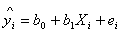
� � � Setting Ford�s monthly stock return as a dependent variable for the time period of January 1994 to December 1998 and S&P�s monthly index as an independent variable for the correspondent time period, we can obtain the following simple linear regression equation.
 |
--- |  |
� � � The comprehensive result is shown in Exhibit 9-A and following is the key interpretation of the result.
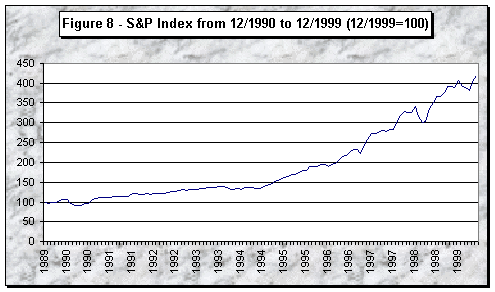 � � � By applying CAPM to obtain Ford�s required rate of return, it is calculated to be 14.25 percent (See Exhibit 9-A). This rate is calculated by using 10 year Treasury bond yields of 4.65 percent as of December 1998 and expected return of market portfolio of 14.72 percent. The expected return of market portfolio is calculated by observing the historical S&P index for the time period of December 1990 to December 1999. The following Figure 8[16] shows the ten-year period movement of S&P index, setting the December 1990 index equals to 100.

� � � In calculating the intrinsic value of Ford common stock, the Nonconstant Growth Dividend Discount Model was applied. As mention earlier, Ford has a strong production outline in 2000, planning to bring out four brand new models in the market. Moreover, Ford is creating new truck subsegments in 2000 with the SuperCrew and Sport Trac models, which will enhance Ford�s diverse product mix and help create positive image of the company among dealer shops as well as consumers (Bruynesteyn 4). Therefore, we can assume Ford can appreciate additional 2 percent growth rate to the historical growth rate of 6.17 percent in year 2000. By using 14.25 percent as Ford�s required rate of return calculated in Exhibit 9-A, the intrinsic value of Ford�s common stock was calculated to be $22.97 (See the calculation in Exhibit 9-B), which is far below the market value of $58.69 a share as of December 31, 1998. Accordingly, the intrinsic value of Ford�s stock leads to a recommendation of "Strong Sell."
� � � Here, two things deserve mentioning with respect to the use of DDM model to obtain intrinsic value and CAPM, which derived Ford�s required rate of return. First of all, DDM model assumes DPS and EPS grow at the same growth rate, which is not true in the case of Ford as the following Table 9 shows.
|
� |
� |
� |
� |
� |
� |
� |
� |
� |
� |
� |
� |
� |
� |
� |
|
� |
� |
� |
1993 |
� |
1994 |
� |
1995 |
� |
1996 |
� |
1997 |
� |
1998 |
� |
|
� |
� |
� |
� |
� |
� |
� |
� |
� |
� |
� |
� |
� |
� |
� |
|
� |
Revenue
(million) |
� |
$108,521 |
� |
$128,439 |
� |
$137,137 |
� |
$146,991 |
� |
$153,627 |
� |
$144,416 |
� |
|
� |
Annual
Growth |
� |
N/A |
� |
18.35% |
� |
6.77% |
� |
7.19% |
� |
4.51% |
� |
-6.00% |
� |
|
� |
� |
� |
� |
� |
� |
� |
� |
� |
� |
� |
� |
� |
� |
� |
|
� |
Net
Income (million) |
� |
$2,259 |
� |
$5,308 |
� |
$4,139 |
� |
$4,446 |
� |
$6,920 |
� |
$22,071 |
� |
|
� |
Annual
Growth |
� |
N/A |
� |
134.97% |
� |
-22.02% |
� |
7.42% |
� |
55.65% |
� |
218.95% |
� |
|
� |
� |
� |
� |
� |
� |
� |
� |
� |
� |
� |
� |
� |
� |
� |
|
� |
EPS |
� |
2.27 |
� |
4.97 |
� |
3.58 |
� |
3.73 |
� |
5.75 |
� |
18.17 |
� |
|
� |
Annual
Growth |
� |
N/A |
� |
118.94% |
� |
-27.97% |
� |
4.19% |
� |
54.16% |
� |
216.00% |
� |
|
� |
� |
� |
� |
� |
� |
� |
� |
� |
� |
� |
� |
� |
� |
� |
|
� |
Dividend
Paid |
� |
0.8 |
� |
0.91 |
� |
1.23 |
� |
1.47 |
� |
1.645 |
� |
1.72 |
� |
|
� |
Annual
Growth |
� |
N/A |
� |
13.75% |
� |
35.16% |
� |
19.51% |
� |
11.90% |
� |
4.56% |
� |
|
� |
� |
� |
� |
� |
� |
� |
� |
� |
� |
� |
� |
� |
� |
� |
� � � Another thing to mention is that fluctuation in the demand and supply could bring a huge impact on the aggregate value of the market that would lead to a change in calculations in some extent. Furthermore, DDM model and CAPM are primarily based on Efficient Market Hypothesis, which implies that it is unlikely to consistently earn superior rate of return and beat the market by analyzing related-information on the stock in conventional ways. We can see, however, the market is not always efficient by looking at some investors who have consistently exceeded market performance.
� � � As an alternative to the DDM model, we can also use P/E multiple model to obtain Ford�s intrinsic value. The forecast EPS based on the data from CompuStat gives us $2.00 (See Exhibit 8) and the industry EPS is 12.9 according to the data retrieved from Dow Jones Interactive database, therefore, Ford�s intrinsic value is calculated to be $25.80, which is still far below the market value. If we use EPS of $5.78 forecasted by Rod Lache and Anthony Sterling of Deutsche Bank, the intrinsic value is calculated to be $74.56, which leads to a recommendation of "Strong Buy." This was primarily derived from the difference in the balance sheet and income statement data to forecast the expected EPS. At the end of this risk analysis, it is needless to say that the intrinsic value should be taken as the best guess, considering the rapid change in the global business environment where Ford is extensively involved and the uncertainty in the market situation.
Banham, Russ. "Ford�s Drive For Credibility." 1998.
CFO Magazine. Online. Available: http://www.cfonet.com/html/Articles/CFO/1998/98Deford.html.
March 13 2000.
Blackstone, Brian, and John Parry. "Fed�s McDonough
Concerned About In US Economy." 2000. The Wall Street Journal Interactive
Edition. Online. April 9 2000.
Bruynesteyn, Michael R. "Ford Motor Company Report,
November 16, 1999." Prudential Securities. (1999): 56pp. Online. NC LIVE
/ Research Bank Web. February 22 2000.
Dow Jones Interactive. "Ford Motor Co." Dow Jones
Interactive. (2000): 8pp. Online. NC LIVE / Dow Jones Interactive.
February 22 2000.
"Ford Motor Company." Hoover�s Company Profiles. 2000. Online.
NC LIVE / EBSCO. January 24 2000.
Kerwin, Kathleen. "At Ford, The More Brands, The
Merrier." Business Week. 3 April 2000: 58
Lache, Rod, and Anthony Sterling. "The Auto
Quarterly, May, 7 1999." Deutsche Bank Securities. (1999): 48pp. Online.
NC LIVE / Research Bank Web. February 22 2000.
Muller, Joann. "Maybe What�s Good For GM Is Good For
Ford." Business Week. 24 April 2000:60
Nihonkeizai-Shinbunsha. The
Future of the Turmoil in Asia: Hundred pieces of knowledge of the World Economy.
Tokyo: Nihonkeizai-Shinbunsha, 1998
Roubini, Nouriel. "An
Introduction to Open Economy Macroeconomics, Currency Crises and the Asian
Crisis." Online Available: http://www.stern.nyu.edu/~nroubini/NOTES/intromacro.html.
Shiller, Robert J. "Home
Page of Robert J. Shiller." Online. Available: http://aida.econ.yale.edu/~shiller/data/ie_data.xls.
March 22 2000.
Simison, Robert L. "Widening Losses Force BMW to
Sell Rover; Ford Nabs the Big Prize." The Wall Street Journal. 17 March
2000: A1 and A8.
"2000 Auto Rating Guide." 2000. Consumer Guide
Magazine. May 2000: 72-88, 105-108, 119-120, 123-124, 134-135, and 183-185.
�
Business Week ("The Best & Worst Boards." November 25, 1996.) for EXECUTIVE COMPENSATION EVALUATION
Federal Reserve Bank for Long-term (10 year) Treasury bond yield
Online. Available: http://www.frb.gov/release/H15/data/m/tcm10y.txt.
FinancialWeb.com for closing stock price of 1998
Online. Available: http://www.financialweb.com/market/.
International Monetary Fund ("IMF World Economic Outlook April 2000" for US current account balance
Online. Available: http://www.imf.org/external/pubs/ft/weo/2000/01/index.htm.
Market Share Reporter 2000 for US market share.
Yahoo Market Guide for P/E of industry
Online. Available: http://www.imf.org/external/pubs/ft/weo/2000/01/index.htm.
�
Ford 1999 Annual Report
Ford 1999 10-K SEC filing
Ford 1999 Proxy Statement
[1] Source: Bruynesteyn, Michael R. "Ford Motor Company Report." 1999. Prudential Securities.
[2] Source: Bruynesteyn, Michael R. "Ford Motor Company Report." 1999. Prudential Securities.
[3] Source: Bruynesteyn, Michael R. "Ford Motor Company Report." 1999. Prudential Securities.
[4] Ford ceased production of heavy trucks in North America in December 1997. The company sold to Freightliner Corporation, Australia. The transfer was completed in 1998 (Ford 1999 10-K).
[5] Source: "2000 Auto Rating Guide." 2000. Consumer Guide Magazine. p72-88, 105-108, 119-120, 123-124, 134-135, 183-185
[6] Source: Ford 1999 10-K
[7] Source: Ford 1999 10-K
[8] Source: Market Share Reporter. p.229
[9] Source: "World Economic Outlook." International Monetary Fund.
[10] Source: Roubini, Nouriel. "An Introduction to Open Economy Macroeconomies, Currency Crisis and the Asian Crisis."
[11] Source: CompuStat database (from Exhibit 4-A)
[12] Source: CompuStat (calculated using Exhibit 1-D for each peer group and Exhibit 4-A for Ford)
[13] Source: CompuStat (calculated using Exhibit 1-D for each peer group and Exhibit 4-A for Ford) for both Table 5 and 6
[14] Source: Ford 1999 10-K and Ford 1999 Annual Report
[15] Source: CompuStat
[16] Source: Data taken from the website of Dr. Robert J. Shiller, professor of economics at Yale University, and plotted by using Microsoft Excel.
[17] Source: Ford 1999 10-K