|
Introduction
����������� In the past decade, East and Southeast Asian countries have shown an incredible outward-oriented economic growth, mainly accelerated by a strong level of savings, substantial investments and capital flows from developed countries, and relatively stable macroeconomic factors. The region has been one of the few promising areas that would be able to continue to grow at an amazing rate. This optimistic perspective and expectation, however, have been totally changed due to the financial crisis, which occurred in July 1997 triggered by a sudden plunge of the Thai baht.
����������� The significant plunge of the Thai baht spread enormously a negative impact among adjacent countries, causing their currencies to plunge. The financial crisis led people to think as if the incredible economic growth was miracle and collapsed entirely. Thailand, Indonesia, and Korea were the three countries that were most heavily affected by the financial crisis and these countries accepted financial bailout plans supported by the IMF. In addition, Malaysia, Philippines, Singapore, Hong Kong, and Taiwan were the major countries that had negative impacts in a lesser extent.
����������� Certainly, there are some fundamental economic as well as political problems that led to the turmoil, though, the strength and potential still exist extensively through tightly connected local economies. This implies that after a certain period of recession depending on the country, the region will keep developing in the long run if the issues surrounding the crisis are solved in a systematic and efficient matter.
Background of Asian Currency Crisis
-Current Account Balance-
����������� Despite the successful economic performances in the region, there were several distinct factors that were presented before the crisis and contributed to the collapse of their currencies. With well-managed government fiscal position in most countries, growing account imbalances had emerged in the 90s, financed by shot-term capital inflows outside from the Asian countries (See the Macroeconomics Indicators). The sizable external current account deficits were the result of extraordinarily high investment from the private sector, since the saving rates were significantly higher than the global standard and the fiscal position was in a healthy shape ("IMF World Economic Outlook December 1997" 1997).
����������� Whether a large current account deficit is sustainable or not primarily depends on four macroeconomic factors, which are the country�s growth rate, the composition of the current account deficit, the degree of openness of the economy and the size of the current account deficit. Prior to the currency crisis in Asia, the real GDP growth rates were relatively high ranging from 5.03 to 8.58 percent, spreading optimistic expectations of the future growth. However, most of the foreign funds were composed of short-term capital that was invested in the wrong sector of the economy such as non-traded goods, real estate, and speculative property investment. The excessive investments had created an asset price bubble, which resulted in collapse later in the stock markets, land and real estate sectors. In terms of the openness of the economy, Asian countries have been open to the world to catch up with the developed countries and the openness of the economy was one of the reasons that the region has achieved a tremendous economic growth. On the other hand, the current account deficits were large relative to GDP that amounted to exceed negative 4 percent in some countries. Eventually, the large amount of current deficits led to an accumulation of foreign debt that became unsustainable and led to a currency crisis (Roubini).
����������� With respect to productivity enhanced by the foreign investment, there was a controversial argument brought up by Paul Krugman, an economist at MIT. He claimed that the rapid expansion of output in East and Southeast Asia was driven by increase in inputs of capital and labor, rather than productivity gains based on technological advance. By using the example of the Soviet Empire, he argues that the input driven growth of the economy will eventually fade out, due to the limitation of the input, which can be explained by the diminishing rate of return (Krugman. 1994). In some extent the provocative argument confirms the situation of the Asian region, since the excessive investment was directed to dubious projects that would decrease their productivity. However, without the combination of productivity and technological gains, their successful economic performance that has been shown in the past two to three decades could not have been accomplished. The openness of their economies brought highly skilled labor, advanced technology and an active flow of information from the globe that connected the local economies to the others spilling their prosperity to adjacent areas. Therefore, unlike the Soviet Empire, productivity and technological gains were presented throughout their development.
-Government Policy
����������� The overzealous governments' pursuit of economic growth led to provide incentives toward corporations that excessively invested in non-profitable sectors and domestic banks to obtain funds from abroad to finance questionable projects by the firms (Corsetti, Pesenti, and Roubini. 1998). Here, some critical failures form the government can be observed. Instead of building up competitive financial markets that provide domestic companies with a variety of options to gain capital, they primarily focused on banks as an intermediary of finance. The closely interrelated relations among governments, banks and corporations lacked transparency and accountability, hence risk management, as these countries started to move out from the initial stage of their rapid growth. The asset price bubble, guarantee of government bailout to weak banks and corrupt relationship among banks, firms and government resemble the situation of the bubble economy in Japan that burst in the early stage of last decade. As seen from the empirical example of Japan, when the babble starts to pop, banks suddenly incur a heavy burden of non-performing loans. In the case of the Asian currency crisis, the credits were mostly dominated by foreign currencies, thereby accelerating the magnitude of the bad debt (Corsetti, Pesenti, and Roubini. 1998).
����������� Another critical governments' policy that exacerbated the currency crisis was the delay of monetary tightening and increase of interest rate, which were not employed in the early stage of the crisis. Because the governments were concerned about the credit squeeze and corporate and banking bankruptcies due to the monetary tightening and slowdown in economic activities due to the increase of interest rate, they decided to prevent further financial problems by taking a loose monetary policy. However, the loose monetary policy neither prevented nor mitigated the depreciation in the value of currencies at all. The government could have slowed down the capital outflow and the currency fall, if they had seized the essence of the financial problem and reacted to the right direction at the right time. When the governments gave up to consistently hold the loose monetary policy and were forced to tighten monetary and credit conditions, the situation was more deteriorated in a negative direction. Ironically, by the time the governments changed to the tight monetary policy, the degree of depreciation had come to the point where real external liabilities were more than a serious problem and the tight monetary policy further exacerbated the financial problems (Roubini).
-Exchange Rate System-
����������� As emerging countries try to establish more stable economy by building infrastructure, expanding industries and developing trades, inflation or runaway prices become the major obstacle. This circumstance will be accelerated by the excess demand of goods, which outweigh the overall supply. In order to control the money supply and sustain stable prices of goods, those emerging countries tend to peg their currencies to one that is stable, even if it might cause their currencies to be overvalued in the long term (Peress. 1999). In most of the South and Southeast Asian countries, currencies were linked or pegged to the US dollar in some way. Another reason why Asian countries linked their currencies to the US dollar was to stabilize their currencies to facilitate the capital inflows from foreign countries, since foreign countries were extremely concerned about the exchange rate risk by the severe fluctuation of currencies (Nihonkeizai-Shinbunsya. 112-136). Unfortunately, the exchange rate regime chosen by Asian countries turned out to be one of the reasons that worsened the currency crisis. The following Table 1 shows each country�s exchange rate regime prior to July 1997.
| Exchange Rate System Prior to July 1997 | |||||||||||||||||
|
|
||||||||||||||||
����������� In the year of 1995, after the US dollar depreciated in the value relative to Japanese yen and hit the lowest point where a dollar equaled to 80 yen, US dollars started to appreciate against both Japanese yen and European currencies. As a result of this appreciation, Asian currencies pegged to the US dollar also appreciated very rapidly as the US dollar experienced its appreciation. Since the region was highly interlinked to the Japanese economy in terns of trade as well as direct investment, most Asian countries were highly sensitive to the dollar-yen relationship. Consequently, the appreciation of the US dollar brought a significant loss of competitiveness for Asian countries, which worsened the trade balance and made the current account balance less sustainable (Roubini).
����������� Furthermore, as another negative impact brought by the exchange rate policy was that the policy attracted and encouraged large capital flows from foreign countries, though, it prevented central banks from rising interest rates that led to overheat the economies. Most of the Asian countries had experienced relatively low inflation rates, however, inflation rates were usually above those of the OECD countries. A distortion emerged according to Purchasing Power Parity theory, which suggests that interest rate should be higher by the difference of the inflation rates between two countries. By not being able to raise the interest rate, Asian countries experienced appreciation in their currencies, which merely worsened the current account balance. Finally, it is worthwhile to mention that most of the foreign borrowings were unhedged, due to the pegged currencies to the US dollar and guarantee of government bailout to banks that worsened the aftermath of the crisis (Corsetti, Pesenti, and Roubini. 1998).
Currency Contagion
-Domino Effect-
����������� As the exchange rates Figure 1 below shows, each currency had headed downward since the plunge of Thai baht, however, there was a significant time lag in the pace of the currency crisis that spread from one country to the other.
Figure 1 Source: PACIFIC Exchange Rate Service
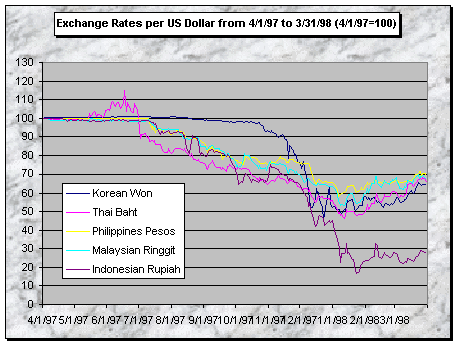 ����������� Apparent example is the movement of Korean won that sustained its value against the US dollar until the middle of October 1997 while other currencies dramatically had been plunging. Once the currencies in Thailand, the Philippines, Malaysia, and Indonesia started to plunge in their values, the impact to the Korean won was unveiled to be the appreciation in its effective value relative to adjacent currencies and significant loss of competitiveness for the Korean exporters. Since many countries in Asia compete against each other in similar products in world and regional markets, currency depreciation in one country brought a considerable pressure of depreciation for other currencies that had not come under attack and depreciated yet. The fall of Thai baht in early July led to the fall in Malaysian ringgit, the Philippines pesos and Indonesian rupiah by July and August, which in tern spread to Singapore dollar and Hong Kong dollar. Korean won could not sustain its value from the pressure from the fall of the six currencies, and it finally plunged in November and December (Roubini).
-Recession in Japan-
����������� The spiral phenomenon of the currency plunge was further strengthened by several factors. One of the factors was the prolonged recession in the Japanese economy. Japan was, by far, the most committed country to the Asian countries in terms of capital investments and trades, therefore, the Japanese recession could only exacerbate the currency crisis. The burst of the economic bubble that occurred in the early stage of 90s uncovered Japanese incompetent political, bureaucratic and financial system, which put Japanese economy in the worst recession ever. Banks, which had already been in a fragile condition, incurred a heavy burden of non-performing loans due to the burst of the economic bubble and these banks suffered from the currency crisis since many Asian corporations went to bankruptcy in which many Japanese corporations invested that was either directly or indirectly supported by Japanese banks (Roubini). In this sense, the Mexican crisis in the late 1994, where the US played a significant role to rebuild the economy, differs from the Asian crisis. The further deepening recession in Japan, that had only deteriorated the crisis, indicated no capability to take a similar role like the US.
The Role of IMF
-Response to the Crisis-
����������� The following Table 2 shows the commitments of the international community and disbursements of the IMF in response to the currency crisis.
| Commitments of the International Community (billion US $) | |||||||||||||||||||||||||||||||||||||||||||||||||||||||||||
|
|
|
|
|
|
||||||||||||||||||||||||||||||||||||||||||||||||||||||
����������� A huge amount of bailout funds were set up to reform and stimulate the worst three countries, Indonesia, Korea and Thailand, affected by the crisis. Two primary roles of the IMF have been to rebuild the fragile financial systems and to resolve the governance issue, which both contributed to worsen the crisis. In terms of the financial system, IMF mainly has emphasized four issues, which are the closure of unviable financial institutions, the recapitalization of undercapitalized institutions, close supervision of weak institutions and increased potential for foreign participation in domestic financial systems. On the other hand, in terms of the governance issue, IMF has been dedicated to four issues, which are improving the efficiency of markets, breaking the close links between business and governments, ensuring the integration of the national economy with international financial markets and enhancing the transparency of the information. ("The IMF�s Response to the Asian Crisis" 1999).
-Resistance Against the IMF-
����������� There has been a controversy of the way in which IMF has been supporting the affected countries, especially in Korean and Indonesia. On the negative side, the tight monetary policy and high interest rate with a cut in government spending slowed the economic growth and brought the long-term recession. It is true that a lot of corporations including some major banks went bankrupt due to the excessively tight monetary policy combined with the high interest rate, directed by the IMF programs. In Korea, there was an anti-IMF demonstration movement by the people, demonstrating around the city with placards written "I�M Fired." In the case of Indonesia, not only the people in Indonesia but also the people around the world were shocked when they saw President Suharto sign to the IMF bailout program while IMF officer Camdessue was looking at it with his arms crossed. Once the IMF program started, some politicians in Indonesia complained that IMF was not aggressively helpful as the funds from the IMF were less than expected (Nihonkeizai-Shinbunsya. 112-136). Although, some of the programs directed by the IMF might be extremely severe, the depreciation spiral could have progressed more profoundly if those countries had not accepted the bailout program. As the exchange rate figure shows (See Appendix), the currency depreciation has hit the bottom in each affected country.
Implication
 ����������� Since the economic structure, political stability and social concerns differ among these South and Southeast Asian countries, the impact and implication considerably differ to each country. Nevertheless, the slowdown in their economic expansion in every country has been seen in the past, due to highly interlinked economic structure.
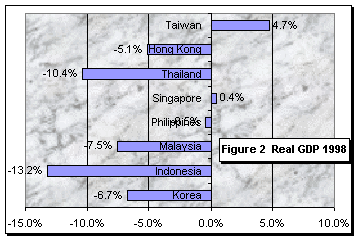
As the Figure 2 (Source: "IMF World Economic Outlook April 2000") shows, most of the countries affected by the currency crisis experienced disastrous year with a substantial contraction in their economies, recording negative GDP except Taiwan and Singapore.
����������� Since the economic structure, political stability and social concerns differ among these South and Southeast Asian countries, the impact and implication considerably differ to each country. Nevertheless, the slowdown in their economic expansion in every country has been seen in the past, due to highly interlinked economic structure.
As the Figure 2 (Source: "IMF World Economic Outlook April 2000") shows, most of the countries affected by the currency crisis experienced disastrous year with a substantial contraction in their economies, recording negative GDP except Taiwan and Singapore.
����������� Considering the healthier countries in the region, Hong Kong, Singapore and Taiwan, they all indicate flexibility to the market response. They have shown a well-regulated financial sector, positive current and relatively stable political system with less corruption. These countries were expected to recover from the crisis faster than the rest of the countries in the region. Yet, companies that were primarily based on exports with the region and imports went through difficulties by the crisis. Especially, Hong Kong companies suffered severely, recording negative 5.1 percent real GDP, which was much lower than expected.
����������� On the other end of the spectrum, Indonesia, South Korea, Malaysia and Thailand, where fragile institutions, government corruption, social distress, political uncertainty and less educated human capital were shown, experienced a significant contraction in their economies. The tight monetary policy and increase in interest rates hampered the previous rapid increase in output, domestic spending and flow of investments. In addition, the impact of the asset price bubble to their financial institutions choked their economic growth. Despite the severe contraction in the economy, Thailand has shown a proactive commitment to reform its fundamental economic weaknesses. The government closed 56 fragile financial institutions and committed to establish a robust financial system by opening the finance industry to foreigners ("The IMF�s Response to the Asian Crisis" 1999).
����������� The worst two countries, Indonesia and South Korea, have encountered much larger extent of negative impact from the crisis to their economies. As these two countries showed negative real GDP growth, both experienced extremely severe contraction in their economies. In Indonesia, President Suharto�s and his relatives�Egreedy desire to dominate its economic as well as the political arena has proved inefficiency to deal with the crisis and revitalize its economy. Even after President Suharto�s resignation, political uncertainty still remains and continues to cause many riots in the chaotic environment. One of the reasons that Indonesia has been performing very poorly dealing with the crisis is that Indonesian-Chinese people, who dominate around 70 to 80 percent of the major listed companies in Indonesia, are reluctant to invest or gone to other countries. This has been causing a serious problem by not stimulating the domestic demand as well as the imports and exports (Nihonkeizai-Shinbun. 112-136). South Korea, where the economy is most controlled and distorted through the domination of chaebol, directed by the government forces, has shown a highly inflexible system to cope with the turmoil. Before the crisis erupted in the country, the top 30 chaebol at the end of the 1996 had already indicated a debt-equity ratio of 333%, whereas similar figures in the US firms were close to 100% (Corsetti, Pesenti, and Roubini. 1998).
Conclusion
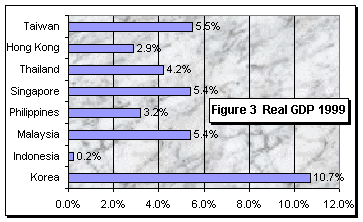 ����������� The rot has spread throughout South and Southeast Asian economies and most countries in the region experienced harsh economic contractions in the year of 1998. However, the strong commitment to rebuild the robust financial system in accordance with global standards is attracting foreign investment again in the region. A great progress resulted in high GDP growth in 1999 in each country as the Figure 3 (Source: "IMF World Economic Outlook April 2000") shows. Moreover, currencies significantly have gained their strength compared to the year 1997, when the currency crisis exploded (See Appendix). In fact, the countries affected adversely by the currency crisis still have strength in their local networks that reach beyond the other side of the world. Furthermore, the recent development in the field of information technology combined with the enhanced educational program by the governments will allow the region to regain its competitiveness in the world market. The market confidence will be settled and the region will be able to provide abundant opportunities to exploit and potential growth to both domestic and global economy for the next few decades.
List of References
Corsetti, Giancarlo, Paolo Pesenti, and
Nouriel Roubini. "What caused the Asian currency and financial crisis?" 1998.
Online. Available: http://www.stern.nyu.edu/~nroubini/asia/AsiaHomepage.html.
March 2 2000.
"IMF World Economic Outlook
December 1997." 1997. International Monetary Fund. Online. Available: http://www.imf.org/external/pubs/ft/weo/weo1297/index/htm.
February 28 2000.
Krugman, Paul. "The Myth of Asia�s Miracle." 1994.
Online. Available: http://web.mit.edu/krugman/www/myth.html.
March 3 2000.
Nihonkeizai-Shinbunsha. The
Future of the Turmoil in Asia: Hundred pieces of knowledge of the World Economy.
Tokyo: Nihonkeizai-Shinbunsha, 1998
Peress, Cheryl. "The
Devaluation Drama." 1999. Moneysearch.com. Online. Available: http://www.moneysearch.com/guestwriters/worldlyinvestor/sambacrash1.html.
February 2 2000.
Roubini, Nouriel. "An
Introduction to Open Economy Macroeconomics, Currency Crises and the Asian
Crisis." Online Available: http://www.stern.nyu.edu/~nroubini/NOTES/intromacro.html.
March 2 2000.
"The IMF�s Response to the
Asian Crisis." 1999. International Monetary Fund. Online. Available: http://www.imf.org/External/np/exr/facts/asia.HTM.
March 16 2000.