| Page 5 |
| Wolfman Jack quickly became a household name and was no longer associated with just the radio. Soon, anyone with a TV set knew who he was. In 1973 he began a eight and half year stint as host of NBC-TV's The Midnight Special, a 90 minute program of recorded performances from various pop entertainers. And, he made over 80 guest appearances on various sit-coms, cop-shows, sci-fi, and super-hero programs. There was even a Saturday morning Wolfman Jack cartoon series. As Charlie Brown would say, "Arrrgh!" Various tributes to the Wolfman entered the pop charts including The Guess Who's, "CLAP FOR THE WOLFMAN" which featured voice-overs by the hairy one himself. |
| There was very little pre-promotion for American Graffiti. However, for a preview screening on May 15, 1973 Universal Studios executive, Ned Tanen called Wolfman and asked him to pack the house at The Writer's Guild Theatre in Beverley Hills. Wolfman got on the air at KDAY and helped them draw a big crowd of young people. Most of the cast attended the screening, and apparently the crowd loved the movie. When Graffiti was officially released in theatres on August 1, 1973, Wolfman spent time and some of his own money helping publicize the film by making promotional appearances and setting up giveaways for albums, posters, and other items. As we know, American Graffiti went on to become one of the most profitable films in Hollywood history. George Lucas was grateful to those that helped make the film a success and showed his gratitude by sharing the wealth. After the film made $20 million in profits Lucas and co-producer, Gary Kurtz generously began sharing a small percentage of the film�s profits with its stars including Wolfman. For the first few years after Graffiti was released Wolfman would get royalty checks for about $175,000 every six months. |
| Awww, we gonna rock 'n' roll ourselves ta death, baby! |
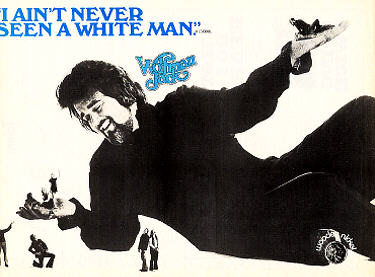
| About the same time he was sending out his syndicated programs, Wolfman released several record albums. He assembled a team of professional studio musicians and as lead "singer," Wolfman croaked his way through various styles of music both old (STAGGER LEE, BLUEBERRY HILL, etc), and new ("I AIN'T NEVER SEEN A WHITE MAN). As a novelty, the songs were fun to listen to, but it convinced the record buying public that Wolfman was a much better disc jockey than singer. |
| Advertisement for Wolfman's 1972 single release, "I AIN'T NEVER SEEN A WHITEMAN." One listen to the song and it's clear: He ain't never seen a vocal coach neither! |
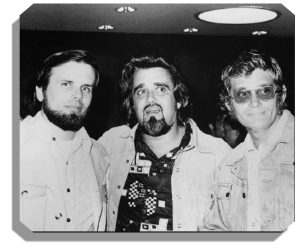
| Co-producer, Gary Kurtz, Wolfman, & Bo Hopkins at an American Graffiti premier. ca.1973. |
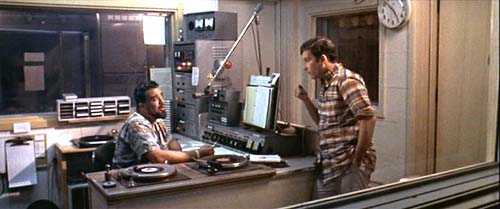
| There's no question he was extremely busy. In the same year he filmed his appearnce in Graffiti he had joined KDAY and he began a syndicated radio program. However, Wolfman didn't record new shows for the syndicated market but simply re-edited old ones. Just as in Graffiti he had a whole refrigerator full of melting popcicles, Wolfman, in real life, had a whole warehouse full of dissolving radio shows on reel-to reel tapes. These old XERB recordings were recut to fit anytown in the United States, at anytime. Wolfman hired 18 year-old Lonnie Napier to review tapes of old shows and edit out any comments that specifically stated a time and place. Napier explains, "I was taking all the time elements out. Nothing could say 'night time,' nothing could say 'Los Angeles.' 'I'm down here on Willshire Blvd., It's cold-it's hot!' It all had to be real generic," he explained. Wolfman's syndicated program was first picked up in Honolulu, then Tulsa, Oklahoma. He received an excellent opportunity when Armed Forces Radio added the syndicated show to its playlist. And, with his appearance in Graffiti, Wolfman's status was elevated from cult hero to international superstar. This caused his pre-recorded shows to spread like wildfire across the nation. |
 |
 |
 |
 |
 |
 |
 |