| Page 2 |
| GRAFFITI Style |
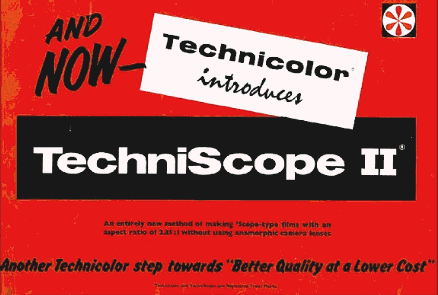
| As in Lucas� first feature film THX-1138, Graffiti was shot in the 35mm TECHNISCOPE format. Many Italian films made in the 60s used this format. For instance, Italian Spaghetti-Western filmmaker, Sergio Leone had used the Techniscope format for his wonderfully nihilistic and violent 'Dollars Trilogy:' - A Fistful of Dollars (1964), For a Few Dollars More (1965), and The Good, Bad and the Ugly (1966). Lucas preferred the Techniscope process for the filming of Graffiti for several reasons: The process provided the most economical use of the camera negative. Not only was it cheaper but also one could film for twice as long without having to reload. The use of smaller equipment gave the film crew the most mobility in catching the cruising atmosphere. In addition, more speed in the lenses made it possible to shoot at lower light levels. Since most of Graffiti takes place at night this made it optimal. The Techniscope frame was half the height of the standard 35mm anamorphic, and when the film was at the optical printing stage the frame was stretched vertically to twice the height. This gave the film a grainy, de-saturated look when it was projected on the big screen. It has the appearance of being shot with a smaller 16-mm camera much in the same way documentaries and amateur films are only with a wide-screen scope. |
| To light big, night exteriors took skill and experience that the film crew, unfortunately, did not have. At first, the film was too dark, Lucas remembers, and he wanted the colors to be similar to those of the mid-60s teenage party movies, like Beach Blanket Bingo, Pajama Party, etc. �That�s what I wanted for the film, and that was one of the problems I was having early in the film,� Lucas says. After a few nights of filming, Lucas contacted Haskell Wexler in Los Angeles and asked if he would come on-location to help out. The Academy Award winning , cinematographer, Wexler (who'd been working on feature films since the mid-fifties), agreed to lend his expertise and fly up to Petaluma every night for five weeks and act as visual consultant and lead cameraman. "I was scheduled to do a lot of commercials, so I flew up to San Francisco every night and worked 'till daylight then came back to Los Angeles," Wexler recalls. "It was incredible fun, but there was no money. I was so spaced out from not having any sleep at one point I said to George, 'Point me in the right direction and I�ll shoot.' " |
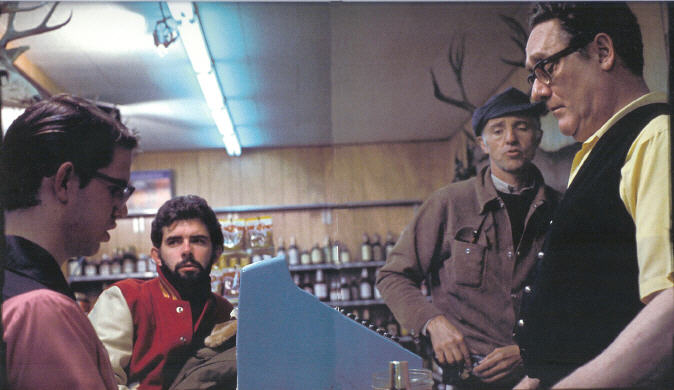
| (l-r) Charlie Martin Smith, George Lucas, Haskell Wexler, & Walter Niven. |
 |
 |
 |
 |
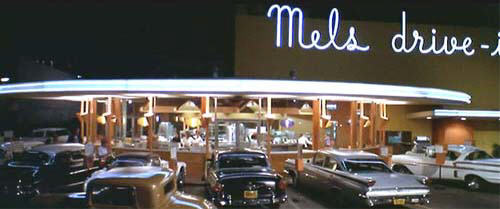
| Haskell's influence can be seen throughout the film. Lucas remembers, "Wexler came up with the idea of making Mels drive-in look like a jukebox. He really added a lot of quality to the whole thing, that I hadn't really thought of." |
 |
 |