
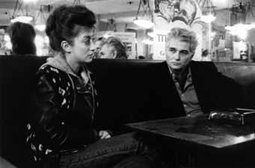

It draws strongly on influences from Jacques Rivette (Especially Celine and Julie go Boating) and Jean Luc Godard.
The film's intellectual centre is French theorist Jacques Derrida whose ideas about ghosts being memories of a past never present underline much of what happens on screen.
Writer-director Ken McMullen also draws upon anthropological myth studies, most notably the cargo cults, and explores the possibility that ghosts have been able to use electricity and electronics to expand their presence in the modern world -Ken Wlaschin,Los Angeles Times.
Through the experiences of two women in Paris and London, Ghost Dance offers a stunning analysis of the complexity of our conceptions of ghosts, memory and the past. It is an adventure film strongly influenced by the work of Jacques Rivette and Jean Luc Godard but with a unique intellectual and artistic discourse of it's own and it is this that tempts the ghosts to appear, for Ghost Dance is permeated with all kinds of phantomatic presence. The film focuses on philosopher Jacques Derrida who considers ghosts to be the memory of something which has never been present. This theory is explored in the film.
Dinard 1996
Rough Translation of the review in "Frankfurte Allgemeine Zeitung" 17 December 83
GHOSTS DON'T REALLY HAVE A VERY HIGH STANDING IN OUR CIVILISATION; reason has banished them to the edge of our world. As childish imaginings, as archaic relic of a backward culture, as leftover superstitions of our own history, they continue a tenuous existence, although they were once powers respected with reverential reserve. That is of course not the whole truth. in his brilliant first film GHOST DANCE Ken McMullen has placed the land of ghosts in the modern, and not at the edges but right in the centre. The cities of London and Paris are the territories over which he traces the cracks through which the fragmented archaic infiltrates into a rationale-ordered world.
This fascinatingly puzzling film, that is comprised of suggestive pictures and the poetic essayism of it's text, does not arise from dim speculation. With the coarse monsters and strong shivers of the horror film, this film has nothing in common. Modern thought in relation to language and history-philosophy and ethnology, was the film's Godfather, as protagonist, the philosopher Jacques Derrida-himself co-operates in the film. Myth and ritual are it's keywords, they merge in our midst in many metamorphoses. They allow themselves to be easily discovered by the alienated look of the observation that owes itself to he investigation of "primitive" cultures. History. and memory, language and the erotic, and even modern technology, are their realm. "Cinema is the art of conjuring up ghosts" says Derrida at one point: that is more than a witty remark he touches on there, from a perspective that one must call phenomenological, the bodilessness of the visible and audible, which distinguishes the film. Similarly without body, even ghostly, are the phenomena which bring forth the modern technology of communication; and perhaps it is really so, that we are at first able to find our way about the world of the electronic revolution by means of a new science of ghosts.
This delightful,
highly complex film resists, again and again, understanding; it demands a
patient, careful "Reading", which is barred to one in the haste of cinematic
pictures. This might indeed be quite appropriate to it's theme; but better
one holds tight to that which is slipping away.
The film by Ken McMullen GHOST DANCE one would with pleasure submit
oneself to again.
Cinema=ART+ DECONSTRUCTION
(or British filmmaker Ken McMullen in Regina)By Jeannie Mah (Splice)Extract
Since I last saw Ghost Dance and Zina ten years ago, Ken McMullen has been one of my favourite directors (up there with Antonioni, Godard, Paradjanov), so Ken's visit to Regina in late September thrilled me. With my heart on my sleeve, I offer a few moments from the week long event.
Ken McMullen is an artist who became a filmmaker, and his films are both cinematic and painterly. He works intuitively and visually, yet his well researched films are grounded in philosophy, history, psychoanalysis and literature. "Tarkovsky referred to film as sculpting in time. it's painting in time, for me.' He encourages his students to study paintings to learn about composition and lighting. "Go sit in front of a Rembrandt for two hours; it takes about that long to see what is there." Ken spoke of his affinity with other painters who became filmmakers, such as Derek Jarman who was at the Slade, and was the subject of a portrait film, called There we are John. Ken has also worked with performance artists Joseph Beuys and Stuart Brisley, and others who use the body as the fundamental form of expression. The synthesis of historical and contemporary art with cinema produce films that are pictorially stunning and intellectually challenging.
Ken McMullen is the master of the long take, and an excellent example of this is 1867, a film based on the Manet painting The Execution of the Emperor Maximillian. the eighteen months in which Manet painted the four versions of the painting is portrayed in an 11 minute take which uses the whole of a 1000 foot reel of film. Ken deconstructs time and space within a Bazinian Realism which reaches beyond the present, so that tightly choreographed camera movements work to speak of social history and cultural memory. He refers to the long take as a negotiation of technical and dramatic realities. "The long take is something I am very drawn to, like material that I am playing with. It is organic; it is quite intriguing, it can imply time. The slowness of the take draws on anxiety. It plays with the off-screen, and the camera movement allow mystery, so a conclusion is reached through a whole series of contradictions."
While introducing Ghost Dance Ken recounted how philosopher Jacques Derrida agreed to appear in a fictional film as Jacques Derrida, but neither were sure what would materialise. The collaboration included Pascal Ogier, who arrived at the question to ask Derrida, "Do you believe in ghosts?" This question elicited from Derrida one of his few pronouncements on cinema. Cinema plus psychoanalyse *gale le science des fantômes. Vive les fantômes! This improvised interview gained greater poignancy as unconscious communication of Pascal's own mortality, for after Ghost Dance she would win best actress at Venice for Rohmer's Full Moon over Paris, and then she would die. This scene continues to haunt Derrida and McMullen to this day, and Derrida has said that Ghost Dance has returned in Spectres of Marx. Hurrah for Ghosts!
"Cinema plus psychoanalysis is the science of ghosts." says Derrida. Cinema and psychoanalysis began one hundred years ago, and Ken enjoys playing with the notion that , possibly, both could have been born the same day.