Odyssey to Mongolia
September
2002 to February 2003
By Kenneth Siow, March
2003 ã
I haven't
updated you with what's been happening for a while. Writing has always been
pleasurable but I had to stop for a while, because of my hectic schedule last few months. In a way, the past 7 months was a little bit like a
dream! When I first took the volunteer assignment up I knew it
would only last for half a year and that would come and go quickly.
Nevertheless I have the philosophy that we all lived once, and only young once.
So any opportunity to break away from our shell, to conquer new grounds -
should never be underestimated. As Maslow the social psychologist puts it, we are creatures with an instinctive craving for fulfilment, where Self-actualisation remains the highest and most humanly-satisfying need
Man has.
The journey to Mongolia
started off with a mad rush in trying to vacate and clear my own flat in
Nottinghill London. At that point in time my thoughts were to just leave
everything behind, in search of a new frontier - as I have grown somewhat weary
of my job role in London. Somehow the idea of plunging myself into the unknown
seemed pretty attractive - "Would I be living in a Mongolian tent, speaking
Mongolia and living like the locals?" The stories of anthropologist caught
in the jungles of South America or Papua New Guinea, living amongst the locals
and dressed like them, caught my imagination. I too, wanted to be Indiana Jones
– even if the fantasy only last for a short 6 months.

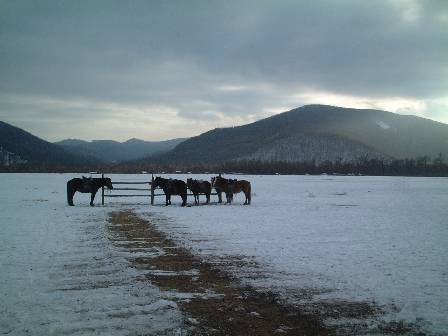
Mongolian
Plains
I soon found myself on
the notorious Aeroflot aircraft where numerous reports of horrendous services,
poor attitude from stewardess, and the danger of the aircraft falling apart :-)
had been circulated amongst travellers since the earliest days. Not so, I
found, at least from London to Moscow. But quickly the journey from Moscow to
Ulaanbaatar turns to be one of those classic examples that I pointed out. It
had felt like some 1950 aircraft, where annoying noises reminds you that you've
better tightened your seatbelt at all cost more than anything. Our small
aircraft landed in Mongolia early in the Morning, where I found myself for the
first time in a year, back in the Asia continent but in a completely unfamiliar
environment.
The city of Ulaanbaatar
(UB) resembled more like a European city than an Asian one. After being
controlled politically and economically by the former Soviet Union, Mongolians
has somewhat developed a distinctive culture of their own compared to say,
their cousins and brothers from Russian Buyartia or Inner Mongolia China. It
had felt like a Europe in Asia/Asia in Europe kind of feeling. The road from
the airport to the town centre was filled Korean and Japanese cars. The picture
I developed in my mind earlier - a primitive, stone-age culture - turn out to
be completely untrue. Hyundais and Hondas, Toyotas four wheels drive to the
classic Russian cross country military-looking Jeep, lined the streets
everywhere. Nevertheless, I was told that life goes back to how it was 500
years ago when you get out of the city into the countryside. How true, I was
soon to find out.
The first week in
Mongolia turned out to be quite pleasant although unsettling. I was, however,
very much psychologically prepared to rough it out. Somehow my 30 plus
countries of travel together with my former military training had to be put
into the test, I felt, in the most appropriate manner. Met up with fellow
volunteers from Britain and elsewhere, and started going for language lessons.
I was soon speaking basic Mongolian in about 10 days, and was able to go to the
market to buy my groceries. Not bad, I thought.
Mongolians are completely
different from the Chinese, contrary to some popular beliefs - apart from their
looks, of course. As a matter of fact there is a somewhat strong anti-chinese
sentiments especially towards Mainland China. Since the earliest of time the
relationship between Chinese and Mongolians has always been a strenuous one -
artificially good at times for economic reasons, and outright war at most other
times. Numerous Chinese historical described the Mongol hordes as barbarians
from the North, which constantly harassed the Chinese empire. Whether through
diplomacy, bribery or politically motivated marriages, the Chinese had never
underestimated the threat posed by the nomadic tribes from the North. Emperor
Qinshihuang the first emperor of China had to build on earlier constructions of
the great wall - and subsequent dynasties especially the Ming added to its
construction after the downfall of the Yuan Dynasty that were ruled by the
families of Chinggis Khaan. Today, the Mongolian spoke of their Great National
Hero, the great Khaan who had conquered the Chinese and brought most of the
civilised world into submission in the 11th century. An icon used everywhere,
it has become the most popular symbol of Nationalism and national revival after
70 years of communist control by the Soviets. Alongside with the portraits of
Chinggis Khaan often lie the picture of the Dalai Lama, the spiritual leader of
Tibetan Buddhism, epitomising the influence of Tibetan culture, religion and
influence over Mongolia.
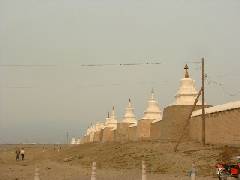
Ancient Monastery built
in the 15th Century.
Also the site where Chenggis
Khaan built his first capital of Mongolia in the 11th century.
The state of Mongolia,
founded by Chinggis Khaan, was independent until the 17th century where it came
under the control of the Manchus, who ruled China proper till the earlier 20th
century with the establishment of the Republic. Till today there remains a deep
distrust of the Chinese because of the fear of cultural, economic and political
domination. When China was declared a republic by Sun Yat-sen in 1911, a period
of turmoil ensued right until the establishment of the People's Republic of
China in 1949. Mongolia declared its independence of Mongolia from Chinese rule
in during the times of political turmoil within China proper - with the help
and the political might of the newly-formed Soviet Union, which had promised
protection, financial and economic support. China, thrown into chaos at that
time, were too politically fragmented by various warlords to stop the
independence movement. The Nationalist government, soon after it unified most
of the country in the 1920s, had to fight the communist movement and soon
after, the Sino-Japanese started. Henceforth Mongolia's independence, while
challenged by the Chinese government at that time, were able to develop into a
more mature phase, eventually becoming Soviet Union's unofficial 16th satellite
state. Chairman Mao zedong, which had formed an alliance with the Communist
Party of Soviet Union, promised not to pursue the issue of Mongolian
Independence after the establishment of the People's Republic in 1949 as Stalin
had become the closest ally of Mao at that time.
Nevertheless, the
Nationalist Government, who retreated to the Taiwan Island, till this day,
refused to recognise the 1911 independence of Mongolia. Till this day the
Republic of China, Taiwan - produces Maps that includes Mongolia, China proper
and Taiwan as part of the territorial boundaries of the Republic of China
(Zhonghuamingguo) - much to the dismay of the Mongolians.
After the fall of
Communism in the Soviet Union in 1989, Mongolia declared itself independent and
became a democracy. Years of dependency of the Soviet Big brother had to stop
and Mongolia became a market-driven economy. What this means however is that
large subsidies that used to come from USSR were no longer available. Social
benefits were removed. Health and educational services now came at a cost,
something that not everyone could afford. State own industries were closed and
countless found themselves out of jobs. During the transitional years of the
90s, Mongolia saw a huge widening of income levels, a rise of prostitution and
crimes, an increase in social problems including Alcoholism, Family abuse, and
a rise in Sexually Transmitted Disease and unwanted pregnancy due to a lack of
knowledge in the prevention of STDs and family planning. Some families were
forced to go into Animal Husbandry again, but the harsh winter zuud (the winter
disaster that kill hundred of thousands of animals) and dry summer drought in
recent years brought living conditions to an even harsher level.
An unequal ratio of
male-female education level is noteworthy. It was reported that out of 10
students in the Universities, 7 were females and only 3 are males. This unequal
ratio could be direct consequences of males wanting to inherit and work in
fields and women who wanted to work as white collars after graduation. It took
me a while to understand this - for a moment, I had made a gross generalisation
that "Man are lazy, woman are hardworking" - a popular misconception
amongst foreigners.
The father of a friend of
mine, a Mongolian teacher who taught Russian and English, lamented that the
Socialist times in which he grew up in, was the best times of his life. A free
education, government sponsored trips to Moscow - Capital of the "Great
Motherland" - free housing. Sure, maybe life wasn't as exciting as now -
where various bars and restaurants serving various cuisines lined the streets
of Ulaanbaatar. But life was easier, and as a matter of fact, kinder. Yet years
of Russian influence have also brought vices such as the huge consumption of
Vodka and an attitude of reliance towards social benefits. In fact, a third of
the Gross Domestic products come from Foreign Aid. Stark figure.
I went through an
orientation course, which saw me picking up basic Mongolian language. Soon I
was in the market buying food and bargaining! Taking the taxis became a norm -
It cost cheaper taking taxis everyday for a month than to take the train and
underground in London for a week. I soon met my fellow VSO volunteers, most of
them friendly and supportive of one another. Soon we were introduced to the
International volunteers community - the United Nations Volunteers, the Peace
Corps from America, JICA (Japanese International co-operation agency) from
Japan, Koica (Korean Aid Agency)...and various others. Life became a little bit
more interesting as I began to know more friends.
The following few months
were tough. Tough not because living conditions were so bad beyond belief, but
it was rather the culture shock that followed. I am blatant about the fact that
I have no liking for the Mongolian daily diet of Mongolian Milk Salted Tea, the
same old Mutton Dumplings that they seemed to enjoy everyday, or even the so
called " Fermented Horse Milk" which was described by Marco Polo in
the 12th century as similar to white wine. My taste bud wasn't made for the
Mongols, I decided from day one. It was fortunate that I could find a couple of
western and chinese restaurants in the capital city - but once you get out to the
countryside you are given the choice of either eating what the local eat or you
simply starve to death. Yes, there are no other options.
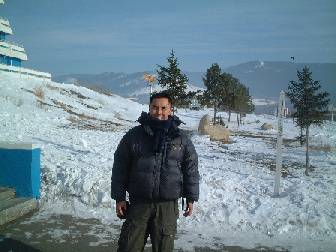
Countryside
A lot of people asked me
what I was doing there. Basically, I went in the capacity of a Management
Adviser for a Non-Government Organisation (NGO) - working in conjunction often
with agencies such as the Scouts Association of Mongolia as well as UNICEF,
UNFPA and the WHO (All UN agencies). The NGO focuses on Youth related issues -
and improving the outlook of Adolescents Girls and Boys in Mongolia. As I have
pointed out above, the problems young people faces are acute. In one UN
studies, it was found that Mongolia has one of the youngest population on earth
- with a statistic of nearly 70% of the poppulation below the age of 35, and out
of that figure nearly half are in their teens.
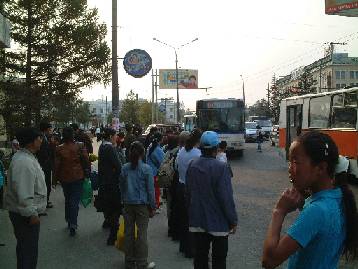
Ulaanbaatar
– Bus Stop
For me to
document everything about Mongolia will be difficult. What I like to share, is
that the experience in Mongolia has opened my understanding towards Nomadic
culture in remote parts of the earth, in understanding a little bit more of
life under Soviet-Style Socialism, of what it means to live and grow up in a
very poor country. For many of my Mongolian friends, they have never seen a
proper department store as we know it. They have not sat and flown in an
aircraft, and have never seen the ocean. Many of them worry about their
next-day living, live in small and undesirable conditions (From my
perspective). But there is a resilience to survive, to thrive and to succeed in
many of them. I applaud them – especially those who have a determined attitude
in life to succeed, as opposed to reliance on others. Many of them, by no fault
of theirs, ended up having a lower-than-healthy esteem simply for the lack of a
socially and morally healthy environment. I do not think I have become a lot
more intelligent over the last 6 months in Mongolia, but what I have acquired,
and thankfully so, is a strong empathy towards people in the developing world –
and not to take for granted the many luxuries and comforts that we so often
enjoy. We often forget that capitalism and market forces may mean luxury and
comfort for some, but often times, exploitation and a tough life for others.
On the Trans-Mongolian Train
I have also made 2 side
trips to the People’s Republic of China. The winter had become unbearably cold
in Ulaanbaatar that I felt it necessary to go south in search for “greener
pastures” (i.e. better food, weather and to catch up with some friends). Being
on the Trans-Mongolian train- a non-stop, 30hours journey (except for a couple
of hours at the customs) was such an interesting event. I met interesting people
on both trips – In total I must have spent 120 hours on the train travelling
both ways! On one instance I was detained by Chinese Border guards, who
suspected me to be an illegal Chinese immigrant (!) trying to leave China -
using a fake passport. It was an interesting experience. They had thought I
manipulated with my passport – which was old and a little damaged. Furthermore
I had spoken to them in Mandarin which to them was strange – as a matter of
fact many Chinese guards, living near the border regions of Inner
Mongolia/Mongolia, had little idea that there are many ethnic Chinese
descendants in Singapore, and who are bilingual in both English and Mandarin.
Side Note:
In Beijing (Early Nov 2002 and Late Dec 2002)
Development
in Beijing has become so fast that the city is beyond recognition since the
last time I was there 2 years ago. Skyscrapers everywhere, traffic and
posh cars line the street, people in well-dressed clothes -branded, posh and
fashion conscious - especially in the central business districts. My feelings
of being "overwhelmed" by the pace of economic development
hadn't quite gone away. The clubs were fantastic and colourful,
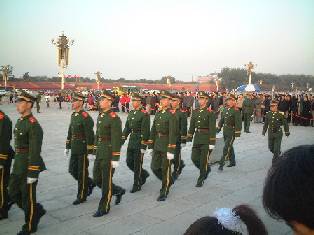
and security presence fills the streets everywhere. I also
saw an armed contingent of the People's liberation Army lowering the flag,
a disciplined and impressive display of orderliness and military prowess.
Tiananmen square was clean like a washing board during the preparation of the
16th Communist Party Congress - they had spent days cleaning and
even removing any traces of chewing gums stuck on the ground. The red communist
flags were flying everywhere on top of buildings.... not to mentioned the
numerous trees planted - an attempt to stop the sand from the Gobi from
polluting the city. All these, in preparation of the Olympic games. Every
second something is going on. Every minute something was being built and
something being torn down as well. Everywhere people were changing - the city
was changing.
An
hours' drive from Beijing city and one still find desolate poverty in the
countryside. The income disparity between the costal cities are as high as 10
to 20 times. What one could spend a night in a bar in Beijing could be the
salary one makes in a month in the countryside or in the inner cities!
This is China, very exciting, but also very unsettling. Already millions who are out of job everywhere as state owned enterprise closed, small-scale riots were happening in various parts of China, but notably in the Northeast traditionally known to be centres of manufacturing and heavy industries. Today's it's known as a "rust belt" - the rust looks set to eat further into the country as inefficient state-owned enterprises gave way to Market forces.
In Shanghai (Dec 2002)
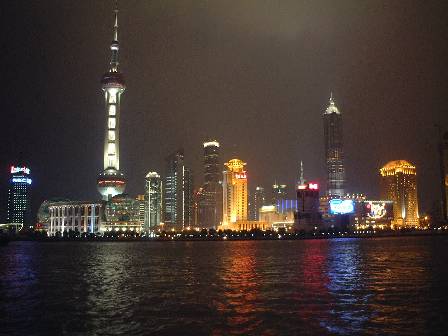
I was in
Shanghai on Christmas Eve 2002. It was absolutely surprising – I already had
certain images of Shanghai being an extremely Modern city in my mind but had
never envisioned it to be so impressive. The picture above is one of Putong –
the new development area. I was told, that barely 6 years ago Putong was a flat
area, a sleepy fishing village of sort. But today Putong holds the tallest
building in China (The Jingmao Plaza), the Oriental Pearl Tower, and many other
important, futuristic buildings. I also had the opportunity to visit the
clubbing scenes in Shanghai – including the “97” and the “Guangdi” – the latter
opened by David Wu the MTV Host along with his partners. It was a delight –
after all I had been living in Mongolia for a couple of Months and were looking
for some excitement. I wasn’t disappointed but have to admit, after spending a
week in Shanghai, I cannot but feel that it is losing some of the “Chinese
Soul” which Beijing and many other inner cities have. Shanghainese are proud of
their city and in fact there is a sense of anti-foreigner sentiments (Foreigner
being non-Shanghainese-Chinese) amongst the elite. (There is even a nickname
for the “Countryside people” in the Shanghainese language) Yet, anything deemed
Western or Japanese were considered fashionable, desirable, and “embraceable”.
That was, at least, in my opinion. Amongst the many things I did I also visited
a new developed area called the “Xintiandi” – a place to be developed into the
“Soho of Shanghai” kind of concept. The prices there were even dearer than that
in London – yet the bars, restaurants were all jam-packed with people. Shanghai
to me has become something not quite like the China I know – It is modern,
fast-paced and exciting, but like Singapore and Hongkong, it’s resembles more
like a concrete jungle. Nevertheless, it was a delight to be there.
Leaving Mongolia
It was an emotional event when I left Mongolia. I had embarked on a field trip to the countryside a week before my departure and upon coming back to the city I was down with a terribly flu. Hence when I was fully up and ready to meet people I only had a few days left – including packing time and sorting out all my paper work. (E.g. you can’t just leave Mongolia as and when you like it – you have to “de-register” from the Home office and get an “Exit Visa”…a whole bunch of bureaucracy!) . Saying farewell to people whom I have got to know, or getting to know a lot better – it wasn’t that easy when the thought that you may never see them for the rest of your life rings through your head when you gave them your final hugs. Indeed, I have made many wonderful, delightful friendships, and have met the most sincere and genuine of people. Often times it is the people who make the place. I am already missing all my friends…. With this in mind I promise myself that I must return, someday.
As I look out of my window seat on Air China, heading towards Beijing, I could see the city of Ulaanbaatar from 2000meters up in the air. It was a small city, but one that had captured the imagination of many. My 6 months in Mongolia came and went like a twinkling of an eye – but its impact on my life will last forever, and hopefully, in a positive way, extend into the lives of who cross my paths one day...