Regional High Monk in S.E.Asia - Luang Phor Kasem Khemako
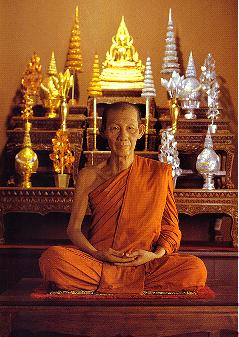
Luang Phor Kasem was born on Wednesday, 28th November BE2455 in Jangwat Lampang. He was the descendants of Lampang's King
from Lanna Period. He became a novice monk in BE2468 after the dead his uncle, the abbot of Wat Bunyeun. In BE2470, he went to
Bangkok, Wat Setuwan to study Pali language. He returned to Lampang and further his Pali studies in Wat Seelom and Wat Bunyawaht.
In BE2475, he passed his Pali examination with good results and came in first in class at Wat Setuwan. He was ordained as a monk at
Wat Bunyeun at the age of 21 years old in BE2576. His preceptor was Tahn Jow Koon Tammajindah. His ordained name's was
Khemako Pikkhu.
After he entered monkhood, Luang Phor Kasem went to Jangwat Chiangrai to further his Pali studies. He met Luang
Phor Krubah Gaen, a very famous monk in North Thailand who was a Tudong monk (forest monk), very good in sammahdti. Luang
Phor Kasem became a disciple of Pra Krubah Gaen and went Tudong with his teacher in forests and cementries. When the abbot of Wat
Bunyeun passed away, Pra Dtomkum became the new abbot. After some time, Pra Dtomkum left the temple and the post of abbot at
Wat Bunyeun because of boredom. The villagers invited Luang Phor Kasem to return to Lampang to be the new abbot of Wat Bunyeun.
Luang Phor Kasem continued his learning in dhamma and sammahdti practise even when he was the abbot. The more he trained, the
more realised that life is uncertain. His duties as the abbot, kept him rather busy and finally in BE2492, he left Wat Bunyeun, and went to
stay at Sasahn Sahlahwangthan (a cementry at another place in Lampang). Luang Phor Kasem was determined to practise the highest
sammahdti at the cementry. He would sit in front of the burial place and watch the burning of corpse. Whether in hot sun or raining,
Luang Phor would just sit quietly and watched the corpse being burned to ashes.
Luang Phor Kasem ever sat in sammahdti for as long as 3 months, without shether under hot sun or heavy rain. Even his robes were wet
by the rain and then dried by the sun or during cold season, when the cold wind blows, Luang Phor Kasem would just sit quietly and not
complain of cold or hunger. He had let go of everything and steadfast in his practise of dhamma and sammahdti. Once, he ever go without
food for 49 days.
Since BE2514, Luang Phor Kasem only bathed once a year, but there is no stench or foul odour from his body, even as his sweat was
pouring under the hot sun. More surprisingly, without shether and mosquito net, Luang Phor Kasem never suffered a bite from mosquito
at the cementry.
Luang Phor Kasem carried nothing with him. His only possession was an alms bowl, his robe which he was wearing and a piece of human
bone for him to practise sammahdti. He did not have any footwear also. Luang Phor Kasem ever mentioned that he is a forest monk and
does not required any possession. He was contented with a piece of robe covering his body. Whatever things that the layman gave to him,
Luang Phor Kasem would give away to other monks.
Luang Phor Kasem never used a pillow to sleep, because to him, a pillow is a luxury. Luang Phor Kasem would sleep with his body in full
protrate position and would sleep at the same spot where he sat in sammahdti the whole day. He was very determined to find the truth of
life. He asked for nothing in life though he was of royal blood and could enjoy all the luxuries in life.
Luang Phor Kasem passed away in BE2539 at the age of 84. His body is encased in a glass coffin at Susahn Dtailak, dried up but
undecayed. Hundreds and thousands of devotees still pay respect to this great monk till today.
Luang Phor Kasem Khemako as we Thais call him resided at Trailak, Lampang province, has been known
to be a highly devout and well disciplined member of Buddhist Order, whose faith and practice have been
respected by people from all walks of life. He is directly related to the aristocratic Na-Lampang family. His
father was Prince Noinu of Na-Lampang and his mother is Princess Buajon, niece of Prince Boonvat
Wongmanit, the last ruler of Lampang. Luang Phor Kasem entered the monkhood in 1920 for the first time
just for seven days and his devout faith remained with him. A couple of year later he was re-ordained as a
novice at Wat Boonyun, Lampang.
In 1931, the young novice passed ecclesiastical exam. He took interest in Khmer language, dialects and
Pali, the Latin of Buddhism, so he could study the religion more fully. He was then under the mentorship
of Phrakru Pichaimongkol, abbot of Wat Pichaimongkol, and practiced meditation indifferent cemeteries
to the extent that he could develop his understanding and realization of the world and the path towards
peace and compassion. In 1932, Luang Phor Kasem was ordained as a monk and has been known by his
religious name as "Khemako" meaning person of happy and well contented in Dharma. Four years later, he
passed another high level of ecclesiastical exam where he learnt Buddhist language more thoroughly. With
firm belief in the law of evanescence and impermanence, whether it is praise, honor, glory, blame or
whatsoever, he practiced meditation to be delivered from the worldly concerns. The abbot of the
monastery passed away. The monks and the people unanimously voted that he should be the abbot. He
finally accepted it as a good successor of Buddhist teachings. Though he preferred to be delivered from
worldly preoccupations.
In 1951, he decided to resign from being an abbot but was held back by senior monks. Eventually he left
away quietly leaving the following message:
"Everything I taught is fine. But please don't accompany me since I have renounced the worldly pleasures.
Being an abbot may be compared to being chief of the household who is responsible for several things
though not appropriate for me. I would go towards peace and serenity and I shall never return."
Luang Phor Kasem had practiced meditation in several cemeteries until finally he decided to settle down at
Trailak in Lampang. His conduct and practice have drawn attention from several disciples. Phra
Bhavanavisuthajarn of Wat Trimit commented: "Luang Phor Kasem has always been highly devout. Even
his ecclesiastical robe has not been changed indiscriminately nor his bowl which accepts food without
considering that he should simply part of it in order to survive and not be carried away by its taste and
flavor. His shelter is simple and good enough to avoid strong sunburn and mosquitoes. Even medication is
dealt with in the sense that he can separate mind from body, another path of deliverance from worldly
suffering and woes."
"Another aspect is when Luang Phor Kasem finds paper scattered here and there he would collect and
hang it on trees. When asked why he did it that way he answered that alphabets and letters may lead
people to Arahatship, the highest stage of deliverance." "So we should not contempt the paper which could
be used to teach Dharma. His teaching is compared to Buddhist riddles which do not give direct answers
not solutions. One requires mind and wisdom to reinterpret the meaning in order to discover a more
profound path."
Phra Bhavanavisuthajarn also observed:
"The Dharma-hood as realized by monks is not known by outsides except by the monks themselves,
otherwise it should be devoid of meaning once it is explained as having reached the high stage of
development. However, it may be classified according to four levels; namely, Sodaban or person has
attained enlightenment; Sakitaka, person of great enlightenment; Anakami, person who has renounced
worldly pleasures and Arahat or person who has completely realized the four noble truths as discovered by
Lord Buddha. Once he mentioned that Buddhadassa is the monk who has renounced worldly pleasures. It,
therefore, is known far and wide that he realized that Buddhadassa is an Anakami. He himself, therefore,
should be at least an Anakamo."
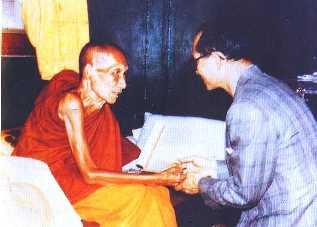 Once Their Majesties the King and Queen visited him and graciously supported and patronized him as well.
Luang Phor Kasem has been a source of faith and a great follower of Buddha's teachings, whose conduct
has been incomparable and well respected by people all over the country.
Once Their Majesties the King and Queen visited him and graciously supported and patronized him as well.
Luang Phor Kasem has been a source of faith and a great follower of Buddha's teachings, whose conduct
has been incomparable and well respected by people all over the country.
