TV Guide: November 3, 1984
Hey, Mates, This Game Makes U.S.
Football Seem Prissy Aussie
football appears at odd hours on TV and offers its cult followers outrageously
rowdy, slam-bang entertainment By William
Marsano
Australia,
a large, empty country located - and known as - Down Under, has given us movies,
TV fare, assorted pop singers and even a soap-opera star. Sooner or later,
one imagines, the Aussies would want something in exchange. Well, they
do. They want America's football fans. By
way of a lure, they are offering something called Australian Rules Football, aka
footy, which can be seen, so to speak, on ESPN, the cable sports network.
Footy is developing what ESPN programming vice-president Steve Bornstein calls
"a small but determined cult of fans." That
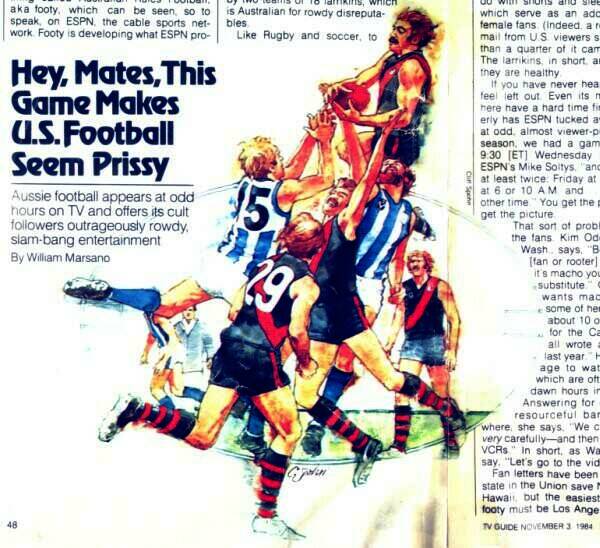
is because footy is a full-tilt, flat-out blend of athletic skill and
good-natured violence once described as "sort of like a demolition derby,
but without the cars." It is played with a watermelon-shaped ball on
a watermelon-shaped field roughly 180 yards long by 150 yards wide by two teams
of 18 larrikans, which is Australian for rowdy disreputables. Like
Rugby and soccer, to which it is related, footy requires superbly conditioned
athletes. Each game consists of four 25-minute quarters, with brief breaks
in between, during which a team, according to the ruling Victorian Football
League, "may be addressed [read: yelled at] by its coach or receive medical
treatment." The larrikans use no fancy equipment and wear no body
armor. They make do with shorts and sleeveless jumpers, which serve as an
added attraction to female fans. (Indeed, a recent analysis of mail from
U.S. viewers showed that more than a quarter of it came from women.) The
larrikans, in short, are as hunkish as they are healthy. If
you have never heard of footy, don't feel left out. Even its most ardent
fans here have a hard time finding it, so cleverly has ESPN tucked away its
telecasts at odd, almost view-proof hours. "Last season, we had a
game each week at 9:30 [ET] Wednesday mornings," says ESPN's Mike Soltys,
"and it was repeated at least twice: Friday at 1 P.M., Saturday at 6 or 10
A.M. and ... possibly some other time." You get the picture: you don't
get the picture. That
sort of problem doesn't stop the fans. Kim Odell, of Edmonds, Wash., says,
"Being a barracker [fan or rooter] isn't easy, but if it's macho you want,
there's no substitute." Odell apparently wants macho, and so do some
of her friends. "There's about 10 of us who barrack for the Carlton
Blues. We all wrote a poem to them last year." How do they
manage to watch the games, which are often on in the pre-dawn hours in her time
zone? Answering for determined and resourceful barrackers everywhere, she
says, "We check the listings very carefully - and then we switch on
our VCRs." In short, as Warner Wolf would say, "Let's go to the
videotape!" Fan
letters have been logged for every state in the Union save North Dakota and
Hawaii, but the easiest place to watch footy must be Los Angeles, where Olivia
Newton-John and her friend Pat Farrer run a little outpost of Australia called
Koala Blue (website). This boutique-cum-milk-bar "always has footy tapes on
hand," according to Farrer. "When Americans see them, they do a
double take - but then they end up glued to the set." The shop fell
into the tapes naturally. "Olivia and I were just talking one day,
and the subject came up. It was so obvious, we decided to go ahead and do
it." The
object of these obsessions is sometimes bewildering but always appealing.
It moves and it keeps moving. There are, for example, only two substitute
players, and if a team has more than two players hurt, it plays short-handed -
and that's that. Every player plays the whole game. There are no
timeouts and clock-stopping stalls while the punting unit, field-goal unit,
short-yardage offense, special teams, prevent defense and other such nonsense
troop onto the field. Americans
are sometimes confused by the rules. One viewer summed it up this way:
"There are rules?" Yes - two sets. The official
rules are as elaborate and torturous as those of any other sport, and maybe more
so. The author of one official footy guidebook hints a little desparately
that some of them are almost unintelligible. The other set of rules is the
one in practice on the playing field. In fact, it is just one rule: play
on! It
means exactly that. The object is to play the game, not to hold conclaves
of refs at midfield or trot out obscure regulations and technical
violations. In footy, as in war, the man on the spot is assumed to know
more than some legal eagle in a windowless office back at headquarters. If
playing is more important than a penalty in the opinion of the umpire - and it
usually is - the cry goes up, play on! Action
in footy is more or less continuous. There are no scrimmages. There
are no huddles to dawdle back to (anyway, if an umpire suspects a team of
delaying the game, he can simply lengthen the game). Running plays are
discouraged - the runner must touch the ball to the ground every few yards, so
it is more effective to move the ball by hand-passing (punch-ball style) or by
booming uncannily accurate kicks that are unleashed on the dead run.
Anybody can go for the ball. There is no foolishness about incomplete
passes or ineligible receivers downfield, "mite," which is Australian
for mate. Such is the eagerness to get the ball that a player will use
his cleats to climb up a teammate's back (or an opponent's, for that matter) to
get it. And if he is tackled, does the game stop while two guys in zebra
shirts blow their little whistles and measure with their little chain? Do
Aussies eat quiche? No to both questions, laddie. The tackler is
awarded possession on the spot, and the two teams play on! Injuries,
which are not infrequent, slow things down some, but not much. Devotees of
the American game (who may, by now, be feeling just a twinge of disloyalty) are
familiar with this routine: Referee:
Tweet! Announcer: "Oh no! Ookums has a hip
pointer! He's down on the field!" Color man: "I don't
know, Al - it could be a scraped knee, and play will be stopped while the team
physician confers with the Surgeon General by satellite." Minutes,
and several commercials, go by. Then, announcer: "It is a
hip-pointer. You can see him holding his hip. But he's all right,
and he's getting a big hand as he leaves the field under his own steam!" Big
deal. Footy teams are well into the second quarter by that time, because
in footy no player leaves the field who can leave the field. He
stays on unless he has to be carried off, preferably on a stretcher.
Sometimes not even then: it may be deemed sufficient to simply drag the body a
few yards away from the action and, while the teams play on, deliver medical aid
or a speedy burial on the spot. Inspired by such tender mercies, players
who regain consciousness have been known to fight off doctors and charge back
into the fray. So
far, so good. The perspective student realizes that despite many obvious
differences, footy is played with the same kind of spirit that was found in
American football in the dear, dead days before artificial turf, domed stadiums
and the outpourings of coachly mumbo-jumbo that only a color commentator would
pretend to understand. But things do get tricky when it comes to scoring. At
either end of the field are two pairs of goal posts, with no crossbars: a
short outer pair and a tall inner pair. To score, a ball must be kicked
through the uprights and be untouched in transit. Going through the tall
posts nets six points; socking it to the outer or "behind" posts nets
a single point, also called a behind. Scores are tallied by counting goals
and behinds separately and together. Thus, when the Collingwood
Magpies or the Essendon Bombers or the Geelong Cats or the Sydney Swans (Swans?)
or the Melbourne Demons play, you gets scores like this: "20.15 (135) to
19.21 (135)." Translation: 20 six-point goals plus 15 one-point
behinds equal 135 points total. The same arithmetic for the other team
yields the same result for a 135-all tie. Weird, but at least it
eliminates the tedium of the point after touchdown. And for the record,
Aussies hate ties. The above-mentioned Magpies, for example, have
settled for ties only 18 times in 1712 games, going back to 1892. Another
slight complication for American viewers is the language barrier. The
announcers who report the games are, of course, Australians, which means they
speak a variety of English that sometimes loses radio contact with the mother
tongue. In fact, they often lapse into the impenetrable dialect called
"Strine." To get an idea of what it sounds like, all you have to
know is that "Strine" is how an Australian says
"Australian." Another hint is the remark of a British wit who
said that "Hell is a place where all the radio announcers are
Australian." Footy
players, contrary to the practice on this side of the Pacific, are not paid like
Arabian princelings. A direct salary comparison is impractical, but
suffice it to say that most players hold down full-time jobs in addition to
footy. That doesn't prevent them from being a colorful lot, blessed with
evocative names. Let us now introduce you to the likes of Gary and Alan
Sidebottom; Paul Van Der Haar, the Flying Dutchman; Bruce Doull, the Flying
Doormat; Rene Kink, the hairdresser who looks like the Hulk; Paul
"Sockeye" Salmon; Jacko "I Am Not an Aeroplane" Jackson;
and, best of all, Lethal Leigh Matthews. Lethal Leigh sports a second
nickname - Barney Rubble. Last season, running at high speed with a chance
to score, he smashed straight in the goal post. He played on, of course -
the replay shows that he practically ricocheted back into action - and it wasn't
until later he realized that the goal post had broken in two. Is
footy a superior game to football as we know it? That's a moot point, but
Americans who sacrifice their sleep or program their VCRs to ESPN's telecasts
have come to believe that it is superior as entertainment. Footy is played
with abandon, not eye-on-the-clock caution; "shirt-fronts" and
"king hits" are more rule than the exception. (The former bit of
footy jargon is described by an expert as "a means of stiffening your
opponent," as with extra starch. The latter, a less legal tackle, is
"a profoundly large hit, preferably unseen by the referee.") Watch
out NFL, USFL, NCAA - footy might be gaining on you. The Victorian
Football League (VFL) is talking about playing some regular-season games here in
1986. The West Coast, Kim Odell explains, is "Pacific Rim territory -
there's a sizable Aussie contingent here." Say
this for the Aussies: they are as fair as they are ferocious. Just to show
that it's a two-way street with the larrikans Down Under, they are willing to
give some our lads a chance. A fellow from the Melbourne Demons is right
now on the Coast scouting American college talent that might like to play in
Australia. The possibilities are endless. Provided,
of course, that the American players are tough enough.
Return 

|