Harald Szeemann
| Home Page | The Artists Of The 49th Venice Biennial 2001 | Poetic Bunker |
| 110 poets "chosen with care" by Karenina.it for the Biennial | Karenina.it |
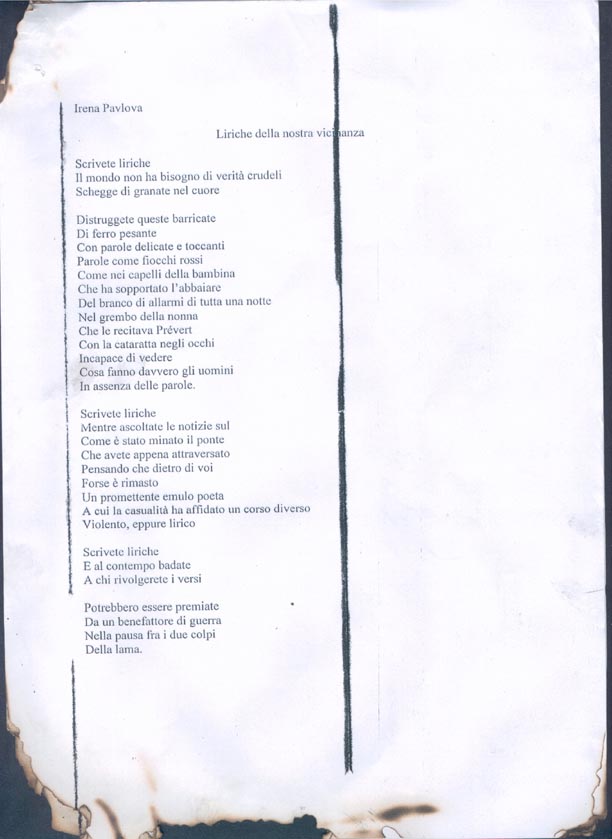
Irena Pavlova |
||
Plateau of Humankind
by Harald Szeemann
The 49th International Exhibition of Art opens its doors on June 10th.
No set theme was applied in choosing the artists; indeed, it is their work which decides the dimension of the event. So, after dAPERTutto we come to a plateau of Humankind. The term "plateau" evokes various associations: it could describe uplands; it might suggest a base and foundation; it is also a raised platform. The Biennale of Visual Arts, therefore, hopes to serve as a raised platform offering a view over mankind. In the 1950s an exhibition entitled "The Family of Man" travelled around the world; and at the beginning of this new millennium our title hopes to suggest a link with that show. However, at present the chances of all individuals actually forming one single family do not look particularly hopeful, in spite of the faith professed in globalisation and the fact that numerous walls are being – or have been – thrown down. Every day we see religious and ethnic differences – or even the bald desire for political supremacy – give rise to new conflicts that can lead to war. And in the reaction of artists now one can see a clear difference to that of ten years ago: there is no longer the intense affirmation of one’s own identity, but rather an appeal to what is eternal within humankind – an appeal that is only valid if it draws on what is local and "rooted". At this point, the century-old struggle between the abstract and the figurative seems finally to have become a part of history. The awareness of space and time (and of how space can become time) is now part of a shared heritage, so much so that some committed artists have actually been able to free themselves from the power of autonomy and independence, and shift their work in the direction of desires, behaviour and ways of seeing that are shared by all human beings as such – a process which can be understated or turbulent; can be seen in terms of aesthetics or as a way of unmasking the truth. This year’s Exhibition aims for precisely this concrete experience of freedom. It opens with a key work by Joseph Beuys, The End of the Twentieth Century. It was Beuys above all who was the indefatigable spokesman for the concept of liberty, giving it plastic expression as a field of energy: Capital = Creativity. He hoped that with the end of the old and beginning of the new century our warmth would be enough to generate life in what was inorganic. This is the message conveyed by these lumps of tufa, which lie on the ground looking it up at us with staring round eyes, like so many prehistoric fish that are waiting to be set free. Alongside Beuys, various other artists of the twentieth century are given the chance to offer a concentrated account of their exceptional contribution to art. There is Cy Twombly, whose generous gestures restore myth to the modern world; Richard Serra, the creator of a new concept of the monumental; Niele Toroni, the champion of painting as trace. Then come a number of those contemporary artists who have focused on the human figure – for example, Ron Mueck – and various others artists who are included in the, still provisional, list of exhibiting artists (the work of each illustrated by slides).
Davinio Art Electronics / Electronic Art & Writings Archives / Videotheque |
||
This page hosted by
/get your own Free Home Page