
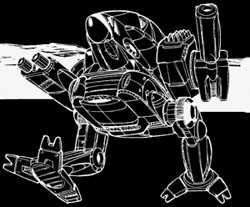
Today�s subject of scrutiny is the fast Black Lanner. Aptly named after a now native bird of prey on Ironhold, this is Clan Jade Falcon�s premier medium Omnimech. Its first appearance dates back to a mere listing amongst the Falcons� Keshik during their deployment in Tukayyid � in the ancient (both in terms of universe time since that battle and its printing at the start of the 90s) Jade Falcon Source Book.
At that time, no data was given to this design and as such it presented a minor mystery until the release of TRO:3058, where it was introduced together with the other 3 Falcon Omnis that also saw their debut on Tukayyid (though the Fire Falcon�s and the Turkina�s debuts have since been placed more accurately in the mid/late 50s). To this day it remains in exclusive production with Clan Jade Falcon, not only being manufactured on our Clan capital Ironhold, but also on the Occupation Zone capital Sudeten. Only our greatest arch-enemies, the Steel Vipers and the Ice Hellions have clashed with us often enough to claim isorla on such a scale as to field their own Black Lanner units.
[Most readers will surely remember the most visible and menacing illustration of the Black Lanner � on the cover of Field Manual: Crusader Clans. This particular machine was a rare single example of Blood Spirit isorla, piloted by a Star Colonel or Galaxy Commander at a time before the introduction of the Crimson Langur. I would greatly appreciate anyone who has a picture of a miniature that features that non-canon interpretation of a large cockpit to post this photo, please!]

Within Clan Jade Falcon, the Black Lanner is used as a striker or as a support unit for fast, light stars. In this function it is always fielded with the Fire Falcon and the Fire Moth [cementing the fact that the Moth is in fact in use with Clan Jade Falcon]. Obviously, weighing in at 55 tons, it is much heavier than any other light or other �mech used in the reconnaissance role (even the Ice Ferret is 10 tons lighter), but its speed fully justifies its role. It moves along at an astonishing 7/11 that is further increased by the utilisation of MASC. This speed is equal to that of the second fastest Clan Omnimech � the Phantom � over short distances and only leaves the Fire Moth with a higher theoretical top speed.
Of course, this unusual speed for such a heavy �mech (the tonnage of 55 is the highest that still theoretically allows a movement of 7/11) already forebodes gross inefficiency. The massive 385 XL reactor and accompanying MASC take up 24 tons, or almost 44% of the total mass, leaving a mere 21 tons for armour, weaponry and heat dissipation systems. These are split into 8 tons for ferro-fibrous armour and 13 tons pod space.
The 8 tons of ferro-fibrous armour did mean that it was the best protected fast �mech (7/11+) until the advent of the Crimson Langur, and fully in the norm of the IS �mechs at the time of the invasion. The classic trio of 55-tonners all originally mounted 152 pts of armour, the Black Lanner mounted 154, which will turn into 153 with the new TW implementation of rounding down FF armour fractions. However, the Black Lanner fails to achieve what I call smart armour allocation (as defined in Excursion 2 of my Mist Lynx article). The legs may be this design�s biggest asset, nevertheless I would have preferred greatly a slightly weaker leg armour (20 instead of 22 pts) and a slightly stronger arm armour (15 instead of 13 points). As it is, the arms will now suffer internal damage not only from ERPPCs and the like, but also from dual medium laser hits. The torsos and legs are fine, but the weak arm armour is almost a critical weakness, as most configurations field a high proportion of equipment in arm mounts.
At this point I will start to include a comparison to two other Omnimechs in the discussion: the Storm Crow and the Crimson Langur, both incidentally covered as parts of one article by Iron Mongoose. The former shares the weight class, yet sets standards for not only all medium �mechs, but for all efficient �mech construction, period. The latter arrived on the scene of the home Clans one and a half decades after the Black Lanner and is noticeable for following the same design philosophy while arguably correcting the Lanner�s gravest faults.
The Storm Crow carries more armour (an advantage of 30 points equal almost two tons) and a full 10 tons more equipment, while still being fast. Conversely, the Black Lanner gives that up to gain a very noticeable speed boost. There is actual validity to changing from a 6/9 to a 7/11+ profile, as opposed to a 5/8 to 6/9 jump (which the Linebacker illustrates quite succinctly). As long as the faster �mech does not cripple its capabilities, it may remain a valuable force. We shall soon see that the Black Lanner�s design actually mimics Storm Crow variants in some configurations of its own, which should prove � depending on the success of said configurations � that a comparison between the Black Lanner and "the best medium mech money can buy" is in fact warranted.
The Crimson Langur, in itself a favourite of many mechwarriors, is as fast (though without MASC), carries more equipment (15 compared to the Lanner�s 13 tons) and more armour (an advantage of 15 points, or basically a ton), all while forgoing the usage of ferro-fibrous armour. This design demands a comparison and really is a great example of greater power on a smaller chassis due to engine efficiency (the 101 example being the Timberwolf vs the Gargoyle). Nevertheless, the Crimson Langur does add jump jets in half of its configurations, meaning it does drop quite a bit of mission equipment and opts for the path of the Grendel � that of the super-heavy scout.
It is now, after illustrating the shortcomings of the Black Lanner in both intrinsic and extrinsic terms, that the configurations can complete the picture and possibly turn the evaluation around. [There really are some parallels to the Mist Lynx article, quiaff?]
Primary Configuration � LRM10 (12), SRM 6 (15), ERLL, 2 ERML, ECM. I cannot start to describe my admiration for this configuration. The package compressed into the 13 available tons is incredible. With the absence of an active probe or TAG, there is no pretence that the ECM is used for recon work � this is a fast striker that is equipped to combat C3 units. This should not be the heaviest �mech of its star, it should be the lightest �mech of a fast assault unit. It even feels like a heavy �mech � the arm mounted laser weaponry and the respectable missile launchers mounted in the cavernous torsos are reminiscent of the Mad Dog or Timberwolf to a great extent. Of course, with only its base 10 DHS, bracket firing is a must, but the ERLL and LRM10 are sufficient to cover the �mech while closing, at which stage the ERLL is swapped for the remaining weaponry (the LRMs can still be utilised until the ammo is depleted), resulting in an absolute heat balance. This �mech can sport a good punch, is equipped to do so at all ranges, has a useful electronic package and feels right. Excellent!
Configuration A � ERPPC, 2 MPL, ECM, Probe, TAG. This variant seemed the most impressive, at first. It packs some of the best weapons of the game and fields the whole electronic package of a scout. Yet an acute lack of flexibility (with only three weapons) and actual punch (compared to other configuration) as well as difficult heat management (three weapons make for a wish to fire them all, yet a mere three weapons leaves very little room for actual cycling of fire patterns) leave this performing much less well than on paper. Nevertheless, the guns are still great, the package is there, it will certainly be able to fulfil several roles in a very reliable fashion and is as such still a very viable configuration.
Configuration B � 2 LRM20 (18). I would rate this configuration as the biggest failure of the Black Lanner series. Originally, it seemed like a great idea: the firepower of an Archer on a chassis that is potentially faster than a Locust. However, as a fire-support unit it only really works in its intended role � as the heaviest design of a light unit, where it would only likely face the enemy�s own light elements. It simply lacks endurance for anything else. Despite the huge amount of punishment it can dish out, this will only last for a maximum of 9 turns, meaning that this is a design that will likely be left without firepower before being in any danger of suffering critical damage. [I learnt this lesson when taking the Lanner out for its first test drive, against a Stormcrow D. After a couple of turns during which the new design did surprisingly well for itself, the fight was suddenly over while both designs were still comfortably on their feet. Some may argue that this configurations in fact best serves its intended role, nevertheless it is the only one where I would dare to suggest an improvement to our Clan's technicians: replace the launchers with 2 LRM15, artIV and 4 tons of ammo � this way, it causes the same effective damage, has a vastly increased endurance and is actually symmetrically balanced.] The Stormcrow D carries much more ammo and the Crimson Langur A carries not only 2 large launchers with more ammo but also a large energy weapon to back the weaponry up.
Configuration C � 6 ERML, SSRM6 (15), 3 DHS. Here I want to quote something directly from the Storm Crow B: "With a sensational six pocket large lasers (ER mediums), it can tear an older mech apart with great aplomb, though it can only use five of the lasers with out heat problems, thanks to its insufficient 13 double sinks." As was discussed in that article and also proven by the Nova (which can only fire 7-8 ERML and stay efficient), this would fully suffice for a �mech this size. This is fortunate, as the Black Lanner cannot back the ML up with the biggest AC � but still packs the largest SSRM launcher. Considering that it also mirrors the Storm Crow B in terms of packing 3 additional DHS, this means that the Black Lanner C can pump out comparable damage, just not in such concentrated form. Make no mistake, this variant is absolutely fearsome and packs a punch that totally belies its miniscule pod space. Being able to dictate the combat range in almost every case, this is a very, very dangerous �mech.
Configuration D � 2 MPL, 2 ERSL, 4 MG (100), 2 SRM6 (30), Flamer, Probe. This is the token configuration that takes into consideration the possibility of having to engage in traditional scouting conflicts. The mix of lasers, MG and SRMs (with more than one ton of ammo) certainly means that neither infantry or vehicles have much of a chance of survival and the active probe certainly facilitates reconnaissance. Against �mechs this is not much good, with a truly appalling range and no concentrated punch. Generally, lighter �mechs should fulfil this role, not only in concerted efforts with the Black Lanner, but generally on all battlefields.
Configuration E � ATM12 (15), 3 ERML. Generally, this is very solid. Compared to the Nova E, this only lacks some medium lasers, but gains a great amount of speed. The huge ATM launcher is worthy of note, the total damage is solid and heat is manageable. However, there is the matter of the similar C configurations which reduces any and all appeal of this configuration markedly.
Configuration H � HLL, 2 MPL, ECM, 4 DHS. This configuration is a simple refit of configuration A � a common theme amongst almost half the H configurations. The straight swaps can result in any of three results: an actual and successful change of profile (eg Summoner D to H), a failure (eg Storm Crow Prime to H) or a success. This is one of the latter, as it illustrates a valid use of heavy lasers: to enable high levels of firepower on designs with extremely limited pod space. For once, the swap of an ERPPC to a HLL really does culminate in an improvement of sorts. The reduced weight (doubled by the dropping of the electronic equipment that is useful in a pure scout role) results in enough saved weight to add enough heat sinks for the Black Lanner to fire all its three weapons and run while remaining exactly neutral on the heat scale. This transforms the Black Lanner from a sniper/heavy scout to a mid-range brawler that carries the capability to disrupt C3 networks as a pure bonus.
I only have the old bidding values [really BV 1.0 - it even fits as an acronym!] available, but these can hopefully give an outlook: Configuration C is still very viable at 1900, A and E both clock in at around 1800. But the real deal is once again the primary variant, which comes in at only slightly more than 1650 � absolutely sensational, considering the total package. I duly hope that BV 2.0 has not completely changed this facet of the configuration�s appeal.
All up, a review of the design shows a machine that is suited to many roles. Amongst these is certainly its intended role but also a much more aggressive one. The comparison to two other similar medium �mechs hopefully showed the following: The Black Lanner is actually much more viable in a straight up combat role than the Crimson Langur, despite the latter�s clearly superior base chassis. This has to do with the configurations; the Black Lanner A somewhat resembles the Crimson Langur Prime, the Lanner B attempts something similar to the Langur A. Those are the Lanner�s weak configuration but arguably the Langur�s strong ones. The comparison to the Storm Crow showed a plethora of weaknesses but also some areas where the discrepancy of performance was surprisingly minor. The overall attitude of the design is best summarised by the fantastic(ally versatile) primary configuration: Jack of All, Master of None. But a very fast one!
return to The Holo-Tank
return to LosTech Cache