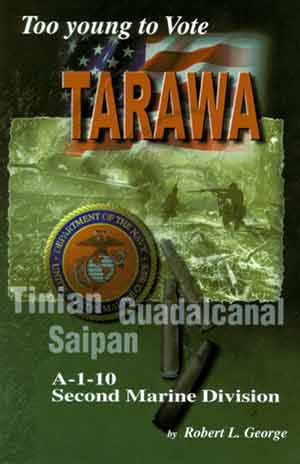
by Robert L. George
A-1-10
This tale of a machinegunner from A Company, 1st Battalion, 10th Marines has a familiar ring to it for the generation coming of age in the Great American Depression. For Robert George from Tahlequah, Oklahoma, there were few luxuries while growing up. His father, a farmer, had lost everything after the stock market crash and they lived in one of the areas of the United States hit hardest by the faltering economy. Enlistment in the Marine Corps meant for Robert an opportunity and maybe the only opportunity to escape this hardship. During the summer of 1941, one day short of his seventeenth birthday, he joined the Marine Corps. Robert writes that despite the rigors of bootcamp and Marine life, "...it was some of the best years of our lives. As kids hardened in the Great Depression, we never had it so good." Approximately five months later the Japanese attacked Pearl Harbor and the challange of war had come.
Guadalcanal was the first fight for the 10th Marines and Robert George. His description of this island shows there were many more enemies than the Japanese:
"We would live miserably and some would die miserably in muddy foxholes. If we could find a dry place to lay our head and let our feet hang in water all night long, we had a good place to sleep. Our battlegrounds were dark jungles, full of malaria infected mosquitoes, bugs, lice, lizards, snakes, crocodiles, and even wild pigs. ...it was a jungle hellhole. Everything was rotten and decaying."By early 1943 the fight for Guadalcanal was nearly over and the 10th Marines had been replaced by the "Pogey Bait" 6th Marines. Shortly before they were relieved Robert recalled that they only discovered they were winning when an Army outfit moved in next to them on the front lines. They were amazed when a portable kitchen was rolled out they started to fry bacon and eggs. The Marines had nothing but cold C rations and whatever they could get out of moldy dumps for months. A couple days later when the Marines moved out most of the Army supplies moved with the Marines.
The next stop for Robert was New Zealand where the entire 2nd Division formed up for the first time in the war. Here intensive training took place but like almost all the Marines there Robert found the people extremely friendly and grateful the 2nd Division was there. Of course one of the highlights of New Zealand was the endless supply of milk and ice gream which was unavailable on Guadalcanal. Another memorable episode was the legendary, "Battle for Wellington." Here the reason for the design of Marine belt buckles was made absolutely clear.
Tarawa was the second major engagement of the 2nd Division and the bloodiest. From Robert's account it is plainly evident that those first two days of fighting were numerous small battles and private wars all over the invasion beaches. Groups of Marines were returning fire, destroying bunkers, and helping wounded buddies up and down the beach. Of course many Marines were killed in these efforts. He points out that on Tarawa, "...one set of eyes could see much more. The island was so small and flat, with very few coconut trees left standing.... Because of this, I witnessed many more heroes and tragedies on Red Beaches 1, 2, and 3 but that would fill another book." One event he witnessed was the private was led by "Hawk" and his Scout and Sniper platoon. Lt. Hawkins, known as "Hawk", was posthumously awarded the Medal of Honor for his actions. Like a madman Hawk destoryed bunker after bunker even though he had been seriously wounded. Another small battle he saw was between the mascot duck "Siwash" and a Japanese chicken. Siwash was bloodied but unbowed and received a Purple Heart for his deeds.
The final invasions Robert participated in were Siapan and Tinian. By the summer of 1944 few men were left in A company that had shipped out for Guadalcanal in 1942. The rest were replacements picked up mainly after Tarawa. Even though he was still a teenager Robert was a combat veteran. He survived two Banzai attacks consisting of hundreds of Japanese and over 30 tanks.
The pinacle of this book is also found in the Saipan chapter. The 105th Army Regiment was positioned between the 2nd Marine Division and the 4th Marine Divsion after these two Marine divisions had gained much ground after days of desperate fighting. The Japanese had found the position of the regiment between the Marines and proceeded to attack. Much of the 10th Marine artillerymen, who were supporting the army, were engulfed by the attack. While the army regiment retreated in disorder the Marines held their ground firing their guns point-blank at the Japanese. Another small group of Marines litterally formed a circled behind piles of debris and held up the Japanes attack untill help arrived the next day. This event led to the dissmissal of army General Ralph Smith by Marine General Holland Smith and created much animosoty between the Army and Marine Corps. Understandingly Robert has harsh words for the "whitewashers" and "Army excusers" since this mistake cost 45 Marines their lives.
From Guadalcannal to Tarawa, through Saipan, and over to Tinian Bob shows us how it actually was with the frontline combat Marines in the South Pacific. 150 pgs.
$16.95 plus $5.54 (tax and S.&H.)
To Order Call: 1-800-954-9161
For more information email Bob at [email protected]
or order the book on his website.
An evergrowing list of books, articles, and papers can be found in the
"Tarawa on the Web" Bibliography section.
Email - [email protected]
copyright 2002 Wheaton, Illinois
Created 30 January 2002

Return to Index
