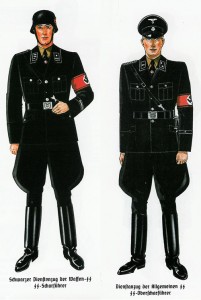
 Hugo Boss. In the 1930s, Hugo Boss started making Nazi
uniforms. The
reason: Hugo Boss himself had joined the Nazi party, and got a contract
to make
the Hitler Youth, storm trooper and SS uniforms.
Hugo Boss. In the 1930s, Hugo Boss started making Nazi
uniforms. The
reason: Hugo Boss himself had joined the Nazi party, and got a contract
to make
the Hitler Youth, storm trooper and SS uniforms.Corporatism,
Liberalism and Corporatacracy
Whereas positivism was a secular and even antireligious philosophy, corporatism in its early incarnations was born of Catholic political thought;
In
1881, Pope
Leo XIII commissioned
theologians and social thinkers
to study corporatism
and provide a definition for it.
In 1884 in Freiburg, the commission
declared that corporatism was
a "system of social organization that has at its base the
grouping of men according
to
the community of their natural interests and
social functions, and as
true and proper organs of the state they
direct and coordinate labor
and capital in matters
of common
interest".[4]
http://en.wikipedia.org/wiki/Corporatism
while Marxism stressed class conflict and struggle,
corporatism emphasized
the organic harmony of labor and capital
under state direction; while liberalism
emphasized individual rights
and responsibilities, corporatism
focused on
group or communal rights. In contrast to the
totalitarian state that
emerged out of Marxism with no subsystem autonomy, and to the inorganic
one-person-one-vote and individual representation of liberalism,
corporatism institutionalized
representation by distinct groups
or “corporations”—hence the name “corporatism”—business,
labor, the
Church, armed forces, farmers, etc. Portugal in earlier times may have
been the
“purest” corporatist system extant; in recent decades Austria has
gotten the
prize as the world’s most corporatist system.
(Wiarda, Howard J., editor, Grand Theories and Ideologies in the Social Sciences, N.Y., N.Y.: PALGRAVE MACMILLAN, 2010, p. 5)
**********************************************************************
Liberal
corporatism
Liberal corporatism refers to
the application
of economic corporatism by
liberal political
parties and organizations, that recognizes
the bargaining interests of multiple groups
within society, such
as in the business, labour, and agricultural sectors and licenses them
to
engage in bargaining over economic
policy
with the state.[1]
Liberal corporatism is often
in conflict from proponents
of liberal pluralism that opposes
the granting
of power to organized
interest groups.[1] English liberal philosopher
John
Stuart Mill supported
corporatist-like economic associations
as needing to predominate
in society to create
equality for labourers
and give them a voice
in management through democratic
economic rights.[2] Unlike
a number of other forms
of corporatism, liberal
corporatism does not
reject capitalism
or individualism, but believes
that
the capitalist firm is
a social institution that requires
its managers to go
beyond
achieving the bottom
line, by recognizing
the needs of their
members.[3] This
liberal corporatist ethic was
similar to Taylorism but
called for democratization
of the capitalism firm.[3]
Liberal corporatists believed that
inclusion of all members
in the election of management would bring
them into
the process of management and in effect "reconcile
ethics and efficiency, freedom and order, liberty
and rationality".[3]
Liberal corporatism was an influential component of the progressivism in the United States that has been referred to as "interest group liberalism".[4] The support by labour leaders' advocacy of liberal corporatism of the U.S. progressives is believed to have been influenced by an attraction to the syndicalism and particularly the anarcho-syndicalism at the time in Europe.[4] In the United States, economic corporatism involving capital-labour cooperation was influential in the New Deal economic program of the United States in the 1930s as well as in Fordism and Keynesianism.[5] Liberal corporatism is commonly supported by proponents in Austria, Denmark, Finland, Norway, and Sweden.[1]
http://en.wikipedia.org/wiki/Liberal_corporatism
**************************************************************************
Fascism's theory of economic corporatism
“Fascism should
rightly
be called Corporatism,
as it is the
merger
of corporate and government
power.”
Fascism's theory of economic corporatism involved management of sectors of the economy by government or privately controlled organizations (corporations). Each trade union or employer corporation would, theoretically, represent its professional concerns, especially by negotiation of labour contracts and the like. This method, it was theorized, could result in harmony amongst social classes.[30]
No individuals or groups (political parties, cultural associations, economic unions, social classes) outside the State (15). Fascism is therefore opposed to Socialism to which unity within the State (which amalgamates classes into a single economic and ethical reality) is unknown, and which sees in history nothing but the class struggle. Fascism is likewise opposed to trade unionism as a class weapon. But when brought within the orbit of the State, Fascism recognizes the real needs which gave rise to socialism and trade unionism, giving them due weight in the guild or corporative system in which divergent interests are coordinated and harmonized in the unity of the State (16).
[...] Everything in the state, nothing against the State, nothing outside the state.
[...] We have constituted a Corporative and Fascist state, the state of national society, a State which concentrates, controls, harmonizes and tempers the interests of all social classes, which are thereby protected in equal measure. Whereas, during the years of demo-liberal regime, labour looked with diffidence upon the state, was, in fact, outside the State and against the state, and considered the state an enemy of every day and every hour, there is not one working Italian today who does not seek a place in his Corporation or federation, who does not wish to be a living atom of that great, immense, living organization which is the national Corporate State of Fascism.
(Mussolini, THE DOCTRINE OF FASCISM, 1932, http://www.worldfuturefund.org/wffmaster/Reading/Germany/mussolini.htm )
Authors have noted, however, that de facto economic corporatism was also used to reduce opposition and reward political loyalty.[31]
http://en.wikipedia.org/wiki/Neo-corporatism
**********************************************************************
Corporatism
in Spain
The Organic Law stipulated the government to be ultimately responsible for all legislation of the country,[22] while defining the Cortes of Spain as a purely advisory body elected by neither direct or universal suffrage. As all ministers were appointed on the grace of Franco as the "Chief" of state and government, he was monopolized as the one source of legislation. The law of national referendums (Ley del Referendum Nacional), passed in 1945 approved for all "fundamental law" to be approved by a popular referendum, in which only the heads of family could vote. Local municipal councils were appointed similarly by heads of family and local corporations through elections, while the government exercised the exclusive right to appoint mayors. It was thus one of the most centralized countries in Europe, and certainly the most centralized in Western Europe following the fall of Portuguese dictator Marcelo Caetano in the Carnation Revolution.
http://en.wikipedia.org/wiki/Francoist_Spain
****************************************************************
National syndicalism (also
Socialist nationalism
or Socialist Fascism)
is an adaptation
of syndicalism to suit
the social agenda of integral
nationalism. National
syndicalism developed in France, and then
spread to Italy, Spain and Portugal.
National syndicalism was intended to win over the anarcho-syndicalist Confederaci�n Nacional del Trabajo (CNT) to a corporatist nationalism. Ledesma's manifesto was discussed in the CNT congress of 1931. However, the National Syndicalist movement effectively emerged as a separate political tendency. Later the same year, Juntas de Ofensiva Nacional-Sindicalista was formed, and subsequently voluntarily fused with Falange Espa�ola. In 1936 Franco forced a further less voluntary merger with traditionalist Carlism, to create a single party on the Nationalist side of the Spanish Civil War. It was one of the ideological bases of Francoist Spain, especially in the early years.
In 1900, Charles Maurras declared in Action Fran�aise's newspaper that anti-democratic socialism is the "pure"[1] and correct form of socialism.
http://en.wikipedia.org/wiki/National_syndicalism
****************************************************************
Transition
to Democracy from Authoritarianism: Southern Europe
Any
discussion of democratic transitions in
Southern Europe must surely begin with the transition from
authoritarian
regimes in Spain,
Portugal, and
Greece during the mid-1970s. In the cases of Spain and
Portugal, the authoritarian
regime in question existed in the form of long- standing dictatorships.
Spain
existed under the authoritarian rule of Francisco Franco (1939−1975)
and
Portugal under Antonio Salazar (1928−1968) and Marcello Caetano
(1968−1974). These
regimes ruled using
the corporatist model, which uses
well-established social and economic organizations, such as the
Catholic
Church or the military-industrial complex, to control the citizenry.
Corporatism was popular with the citizenry until the spread of new
technology
and ideas, such as the development of the stark contrast between the
old
culture (corporatist) and the new culture (liberalism) due
to the
economic growth of the later years of the Franco and Salazar regimes,
gave rise to social change and created calls for liberalism.
Today, both
nations have obviously transitioned to democracy, but the consolidation
of
democracy is another question. Many
in both
nations continue to have nostalgia for the past ways (particularly, the
older
generations) as well as hold many of the nation’s democratic
institutions in
low esteem, suggesting perhaps that democracy has not been completely
consolidated in either nation. Also important to
note is the fact
that both nations’ transition to democracy acted as a catalyst for
other
democratic movements around the world, particularly in Latin America,
during
the 1970s and 1980s.
Portugal
The democratic transition in Portugal began essentially with the death of Salazar and was accelerated during the rule of Caetano, who began the process of liberalizing the government, but many felt that the transition to a more open and democratic society needed to move faster than Caetano was allowing. These desires were only aggravated by economic, political, and social tensions that arose in the early 1970s (i.e., the oil crisis in 1973, and the ongoing African wars in Angola, Mozambique, and Guinea- Bissau during the 1960s and early 1970s). The African wars were particularly damaging to Caetano’s legitimacy, because so many Portuguese soldiers were coming home in body bags, creating discontent within the citizenry as well as the military establishment. This discontent was catalyzed in 1974 during the Portuguese “Revolution of Flowers,” which consisted of a combined effort of military and civil elements that was aimed at overthrowing the Caetano regime. Within two days of the revolution’s initiation, the old regime (i.e., the party system, the corporatist system, and the secret police) fell peacefully. However, the revolution soon spread to the streets, which allowed for the citizenry to revolt against the corporatist structure of society at the grassroots level and paved the way for a possible social revolution, but Portugal pulled back from the radical transition and gradually consolidated a more centrist democracy.
Spain
The democratic transition in Spain was more evolutionary than revolutionary, meaning that it was more of a reform movement (led primarily by civilians) rather than a revolution (led primarily by armed forces). The Portuguese revolution, having occurred before Spain’s, was very influential in the latter’s case. In the case of Spain, the transition was less abrupt than that in Portugal, because Franco had already begun to relinquish power prior to his death, thus preventing the creation of a power vacuum. Under these circumstances, Spain was in a much better position to allow a transition to democracy to occur. Spain was culturally and economically more advanced and closer to the rest of Europe, and thus more open to the spread of economic and social liberalism from Europe. Spain had a monarch that provided for continuity during the transition, and Spain had also already experienced a bloody civil war during the 1930s, while Portugal had not.
Greece
The Greek revolution occurred about three months after the Portuguese revolution. Greece was controlled by a military junta that held power from 1967 until 1974, when it was removed from power. Military elements took control of the Greek government in a coup in 1967, which was the culmination of nearly three decades of division between leftist and rightist elements. These groups developed during the resistance to the Axis occupation of Greece during World War II and the period following the war, which saw a rightist-authoritarian regime come to power under cover of the United States (as part of the Truman Doctrine) and the North Atlantic Treaty Organization (NATO). The military junta claimed that the coup was necessary primarily to prevent communist elements from taking over the Greek government in upcoming elections and that democracy would be restored once political stability had been obtained, which followed suit with the military junta allowing broad freedoms in some areas, including increased tourism, and the permeation of Western music, art, and fi lms. The most critical aspects of the junta’s rule were that it (1) provided political stability that had been missing in Greece since before World War II and that (2) it provided for high rates of economic growth and low rates of unemployment and inflation during its rule. However, the junta eventually began a process of liberalization that began to weaken state limitations on freedom of speech, press, and assembly, which inevitably led to demands for more and more freedoms. This gradual process of liberalization, in conjunction with the Turkish army’s invasion of Cyprus in July 1974 (revealing the miscalculations of the military junta), led to the eventual collapse of the junta and the restoration of democracy.
Transition
to Democracy from Authoritarianism: Latin America
(Wiarda, 199-203)
************************************************************************
Along these lines, it is important to ask tough questions of what exactly Western democracy entails. For example, is a democratic political culture (i.e., a civic culture) a necessary condition for democracy? Must individualism go hand in hand with the promotion of democracy? Could a hybrid of a corporatist political culture and democratic institutions (as we have seen already in the Latin American case) ever be consolidated into a successful democracy? While these questions are likely to remain unanswered for some time, especially when the promotion of democracy is a top foreign policy priority for the United States, it is important that they are asked and potentially addressed by the
Transitions to Democracy approach. Either the American or Western model of democracy is compatible with every nation in every region of the world, or there are simply some places where Western democracy may be inhospitable and thus may require some adaptation. If the latter is the case, then there may be hope for continuing the promotion of democracy as a foreign policy instrument in the future. However, if the former is the case, then the Transitions to Democracy approach will
face serious limitations in its ability to sufficiently explain and analyze democratic transitions around the world without some sort of adaptation to non-Western notions of democracy.
(Wiarda, 209)
******************************************************************************
What is important to note is that the co-optive and corporatist strategies employed by the political elites in Latin America show that the traditional system, perceiving a threat, was able to bend, accommodate, and eventually absorb this threat. Co-optive models are still used in the majority of countries of Latin America, and new groups must still show a capacity to organize as well as abide by the rules dictated by the political elites to be incorporated into the system today.
(Wiarda, 218)
******************************************************************************
It was [...] striking that in the great financial meltdown of 2008, when the Europeans nationalized parts of their banking systems, they also decided—corporatist style—to demand seats on the banks’ governing boards. In contrast, the United States, which does not have a long history of corporatism, nationalized part of the banking system but did not concurrently require representation on the banks’ boards.
(Wiarda, 243)
******************************************************************************
Corporatocracy
Corporatocracy /ˌkɔrpərəˈtɒkrəsi/, is a term used as an economic and political system controlled by corporations or corporate interests.[1] It is a generally pejorative term often used by critics of the current economic situation in a particular country, especially the United States.[2][3] This is different to corporatism, which is the organisation of society into groups with common interests. Corporatocracy as a term tends to be used by liberal and left-leaning critics, but also some economic libertarian critics and other political observers across the political spectrum.
******************************************************************************
Corporatocracy???
[B]y bankrolling the Nazi party,
powerful companies like Krupp (steel and weaponry),
I.G. Farben (chemicals
and pharmaceuticals), and Siemens
(electronics) had undermined the fragile Weimar Republic…
Globalist
(mostly German) Corporations which were around during the Nazi regime –
and
which still have a lot of (political?)
influence today:
�
German insurance
company Allianz…
�
Kodak. During World War
Two, Kodak's German branch used slave laborers from concentration
camps.
Several of their other European branches did heavy business with the
Nazi
government.
� Hugo Boss. In the 1930s, Hugo Boss started making Nazi
uniforms. The
reason: Hugo Boss himself had joined the Nazi party, and got a contract
to make
the Hitler Youth, storm trooper and SS uniforms.
�
Volkswagen. Ferdinand Porsche, the man behind Volkswagen
and Porsche,
met with Hitler in 1934, to discuss the creation of a "people's car."
(That's the English translation of Volkswagen.) During World War Two,
it's
believed that as many as four out of every five workers at Volkswagen's
plants
were slave laborers.
�
Bayer. During the
Holocaust, a German company called IG Farben
manufactured the Zyklon
B gas used in the Nazi gas
chambers. They also funded and helped with Josef Mengele's
"experiments" on concentration camp prisoners. IG Farben
is the company that turned the single largest profit from work with the
Nazis.
After the War, the company was broken up. Bayer was one of its
divisions, and
went on to become its own company.
�
Siemens. Siemens took slave laborers during the
Holocaust and had
them help construct the gas chambers that would kill them and their
families.
Siemens also has the single biggest post-Holocaust moment of
insensitivity of
any of the companies on this list. In 2001, they tried to trademark the
word
"Zyklon" (which means
"cyclone"
in German) to become the name a new line of products... including a
line of gas
ovens.
�
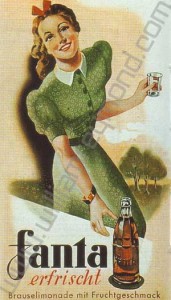 Coca-Cola, specifically Fanta. Coke played both sides during World War Two...
they
supported the American troops but also kept making soda for the Nazis.
Then, in
1941, the German branch of Coke ran out of syrup, and couldn't get any
from
America because of wartime restrictions. So they invented a new drink,
specifically for the Nazis: A fruit-flavored soda called Fanta.
Coca-Cola, specifically Fanta. Coke played both sides during World War Two...
they
supported the American troops but also kept making soda for the Nazis.
Then, in
1941, the German branch of Coke ran out of syrup, and couldn't get any
from
America because of wartime restrictions. So they invented a new drink,
specifically for the Nazis: A fruit-flavored soda called Fanta.
�  Ford. Henry Ford is a
pretty legendary anti-Semite, so this makes sense. He was Hitler's most
famous
foreign backer. On his 75th birthday, in 1938, Ford received a Nazi
medal,
designed for "distinguished foreigners." He profiteered off both sides of the War -- he was producing vehicles
for the
Nazis AND for the Allies.
Ford. Henry Ford is a
pretty legendary anti-Semite, so this makes sense. He was Hitler's most
famous
foreign backer. On his 75th birthday, in 1938, Ford received a Nazi
medal,
designed for "distinguished foreigners." He profiteered off both sides of the War -- he was producing vehicles
for the
Nazis AND for the Allies.
“GM and Ford, through their subsidiaries, controlled 70 percent of the German automobile market when war broke out in 1939. Those companies ‘rapidly retooled themselves to become suppliers of war materiel to the Germany army,’ writes Michael Dobbs in the Washington Post.
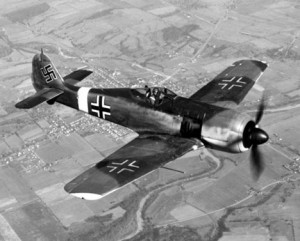
“[…] GM and Ford were vital
components of the Nazi war effort. German Ford
was the second largest producer of trucks for the Nazi military. GM’s
plants
built thousands of bomber and jet fighter propulsion systems for the
Luftwaffe
— while at the same time profiting from production of aircraft engines
for the
U.S. Army Air Corps.”
�
Standard Oil. The Luftwaffe needed tetraethyl lead gas in
order to get
their planes off the ground. Standard Oil was one of only three
companies that
could manufacture that type of fuel. So they did. Without them, the
German air
force never could've even gotten their planes off the ground. When
Standard Oil
was dissolved as a monopoly, it led to ExxonMobil, Chevron and BP, all
of which
are still around today.
�  Chase bank. A lot of banks sided with the Nazis during
World War Two.
Chase is the most prominent. They froze European Jewish customers'
accounts and
were extremely cooperative in providing banking service to Germany.
Chase bank. A lot of banks sided with the Nazis during
World War Two.
Chase is the most prominent. They froze European Jewish customers'
accounts and
were extremely cooperative in providing banking service to Germany.
�
IBM. IBM custom-build
machines for the Nazis that they could use to track everything... from
oil
supplies to train schedules into death camps to Jewish bank accounts to
individual Holocaust victims themselves.
�
Random House publishing. Random House's parent company, Bertelsmann
A.G., worked for
the Nazis... they published Hitler propaganda, and a book called
"Sterilization and Euthanasia: A Contribution to Applied Christian
Ethics".
�
Some corporations of
the Nestl� Group that were active in countries
controlled by the
National Socialist (Nazi) regime employed forced laborers.” Nestl�
helped with
the financing of a Nazi party in Switzerland in 1939 and ended up
winning a
lucrative contract, supplying the entire chocolate needs of the German
army
during World War II.
� BMW has admitted using up to 30,000 forced laborers
during the war.
These POWs, slave laborers and inmates of concentration camps produced engines
for the Luftwaffe and so were forced to aid the regime in defending
itself
against those who were trying to save them. BMW focused solely on aircraft and
motorcycle manufacture during the war, with no pretense of being
anything other
than a supplier of war machinery to the Nazis.
BMW has admitted using up to 30,000 forced laborers
during the war.
These POWs, slave laborers and inmates of concentration camps produced engines
for the Luftwaffe and so were forced to aid the regime in defending
itself
against those who were trying to save them. BMW focused solely on aircraft and
motorcycle manufacture during the war, with no pretense of being
anything other
than a supplier of war machinery to the Nazis.
�  In 1946 General
Electric was fined by the US government owing to its
nefarious wartime
activities. In partnership with Krupp, a German manufacturing firm,
General
Electric deliberately and artificially raised the price of tungsten
carbide, a
material that was vital for machining metals necessary for the war
effort.
In 1946 General
Electric was fined by the US government owing to its
nefarious wartime
activities. In partnership with Krupp, a German manufacturing firm,
General
Electric deliberately and artificially raised the price of tungsten
carbide, a
material that was vital for machining metals necessary for the war
effort.
�
Deutsche Bank...
�
The Rockefeller Foundation - helped
found
the German eugenics program and even funded the program that Josef Mengele worked in before he went
to Auschwitz.
http://www.businesspundit.com/10-global-businesses-that-worked-with-the-nazis/
http://www.11points.com/News-Politics/11_Companies_That_Surprisingly_Collaborated_With_the_Nazis
U.S.
CORPORATIONS AND THE NAZIS
http://www.iahushua.com/WOI/us_nazis.htm
*******************************************************
Further Reading
The “corporatist” confusion: Why a prominent political term needs to be retired