may | june 2001
may | june 2001
F E
A T U R E D article
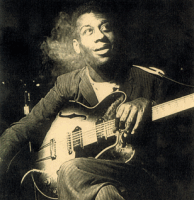
Grant Green: First
Sessions
This past year the capacious
Blue Note vaults yielded four previously unreleased sessions from the
sixties that feature Green.
He is a sideman on Man with
a Horn by Lou Donaldson
and Kicker by Bobby Hutcherson
and he’s the leader on Blues for
Lou and the just released First
Session. He also
appears on two new Blue Note reissues, complete collections of recordings
by Don Wilkerson and George Braith.
If we were in the sad position fifteen years ago of having little
or no Grant Green to choose from, we now have an embarrassment of
riches. I’m not complaining;
for me, there can never be too much Grant Green. The reasons for the temporary
undervaluing of Grant Green’s stock following his death are somewhat hard
to pin down. Some of the
decline can be attributed to the funk-based recordings he made during the
last ten years of his life.
Those records have long been shrugged off, even by some of Green’s
defenders. I think they’re
unfairly maligned. They’re
highly rhythmic, driving records (Idris Muhammed is the drummer for many
of them) and Green’s playing on them is of a high order. He often transcends what might at
first sound like limited harmonic possibilities. While those albums fall short of
his earlier achievements, at their worst they still have more fire than,
say, Wes Mongomery’s later recordings for Creed Taylor. At the time of Green’s death,
fusion was dominant and jazz guitarists were valued for speed and empty
virtuosity. More traditional
guitarists like Kenny Burrell and Joe Pass continued playing straightahead
jazz during those years and were able to reclaim their rightful audience
when fusion began to fade. Green was gone by then and his music had to
await rediscovery. A number
of writers, including Green’s biographer, Sharony Andrews Green, claim
that the acid jazz movement, which championed the later funk records,
sparked the renewed interest in Green. That may be true, but only in
part. As jazz labels began
reissuing their back catalogs on CD, Green’s ubiquity as a sideman during
the sixties made it inevitable that his playing, including his work as a
leader on recordings prior to 1969, would demand reevaluation. It is upon that work, his pure
jazz playing, that Green’s reputation rests. Writers often refer to Green as
a single-note or single string guitarist. This designation carries with it a
slight scent of condescension, as if Green couldn’t manage the difficult
chord changes that are a jazz guitarist’s stock-in-trade. While his comping isn’t as
complicated as Montgomery’s or Tal Farlowe’s, to name just two chord
masters, he certainly knew enough of the fingerboard to play chords in
support of other instrumentalists.
The fact remains, however, that he rarely did so and when he did it
was usually brief and discreet.
In addition, he almost never used chords during solos. A comparison of Green’s playing
on First Sessions and Wes
Montgomery’s on his albums Bags
Meets Wes and Full House
illustrates the difference in their approaches. Wynton Kelly is the pianist on all
three sessions. On “He’s a
Real Gone Guy” from First Sessions,
Green states the theme and improvises for a time before stepping aside
for Kelly. He doesn’t comp at all behind Kelly’s solo. By contrast, Mongomery comps
impressively, though lightly, behind the Kelly and the other soloists on
his sessions. At first,
Green’s silence is disconcerting; we’re used to hearing a guitarist
playing in support of the soloists.
After listening to a few of his sessions, however, you grow
accustomed to their space and openness. Why Green’s reluctance to play
chords is held against him is beyond me. After all, horn players don’t play
chords and many other jazz guitarists choose to comp with restraint or to
lay out altogether. Grant
Green’s approach to chord playing was of a piece with the musical
philosophy his playing conveyed: keep it direct and melodic. His playing wasn’t simple--far
from it. But it was straightforward and uncluttered. Each note rang out clearly, even
in the quickest melody lines, and Green wasn’t afraid to let a note
sustain. He also allowed
space between notes in a solo.
A burst of melody will be followed by a few beats where he doesn’t
play. More than any other
jazz guitarist, Green let pauses help develop his melodic ideas. The second track on First Session, “Seepin’,”
highlights another of Green’s strengths: He was a convincing and moving
blues player. Many jazz
musicians who voice tribute to the blues are about as believable when they
play it as classical musicians are when performing popular material. Green didn’t shy away from
borrowing a blues riff from someone like T.Bone Walker--he knew the
music’s tradition. But with
his tone and the way he plucked the notes, you weren’t going to mistake
his playing for anyone else’s.
When he expanded on the possibilities of a blues tune, as he does
on “Seepin’,” he doesn’t try to bury it in technique as if to demonstrate
his superiority to the form.
He takes daring and quick melodic leaps but always returns to the
familiar feel of the blues. First Session was recorded in
November 1960, except for the last two tracks (two alternate takes of
Dizzy Gillespie’s “Woody ‘N’ You”), which were recorded in October
1961. The rhythm section for
the earlier session is Wynton Kelly, Paul Chambers on bass, and Philly Joe
Jones on drums. The disc
contains two blues based songs, “He’s a Real Gone Guy” and “Seepin’,” one
standard “Just Friends,” and some straightahead compositions. Kelly’s playing is as unashamedly
blues influenced as Green’s and he brings a relaxed feel to the
proceedings. He’s also a
confident, energetic soloist.
Green is a little hesitant in spots on the earlier session and
there are one or two rough edges, which, along with some technical
glitches, explain why Blue Note’s Alfred Lion chose not to release the
session. On the two tracks
recorded a year later with Sonny Clark on piano, Butch Warren on bass, and
Billy Higgins on drums, Green is far more assured and plays fluidly. Even with its rough spots, this
is a disc worth owning. It’s
always a pleasure to hear Kelly and Paul Chambers, who are both in good
form. As far as I know, this
is the only recording that Green did with Philly Joe Jones, who brings a
solid, aggressive swing to the session. While Green’s talent is certainly
in development, the seeds of his greatness await only his confidence in
the recording studio to bear fruit.
His performance on “Seepin’” is as good as anything he ever played
and by itself justifies the release of the disc. If you’re new to Grant Green, this isn’t a bad disc to start with, although Idle Moments and The Complete Quartets with Sonny Clark are probably his definitive statements. Of course, then you’ll want to pick up Matador and Born to Be Blue, along with many of his other discs and the discs that feature him as a sideman. His playing is a constant surprise.
Click here for a Grant Green web-site that includes a biography and an extensive, but incomplete, discography: http://website.lineone.net/~johnharris/grant.htm This Japanese web-site contains a complete, up-to-date- discography in English: http://www.ceres.dti.ne.jp/~acchan/ggdisc.html Joseph Taylor |
Copyright © 1997 - 2001 Planet HiFi, Inc. All rights reserved.